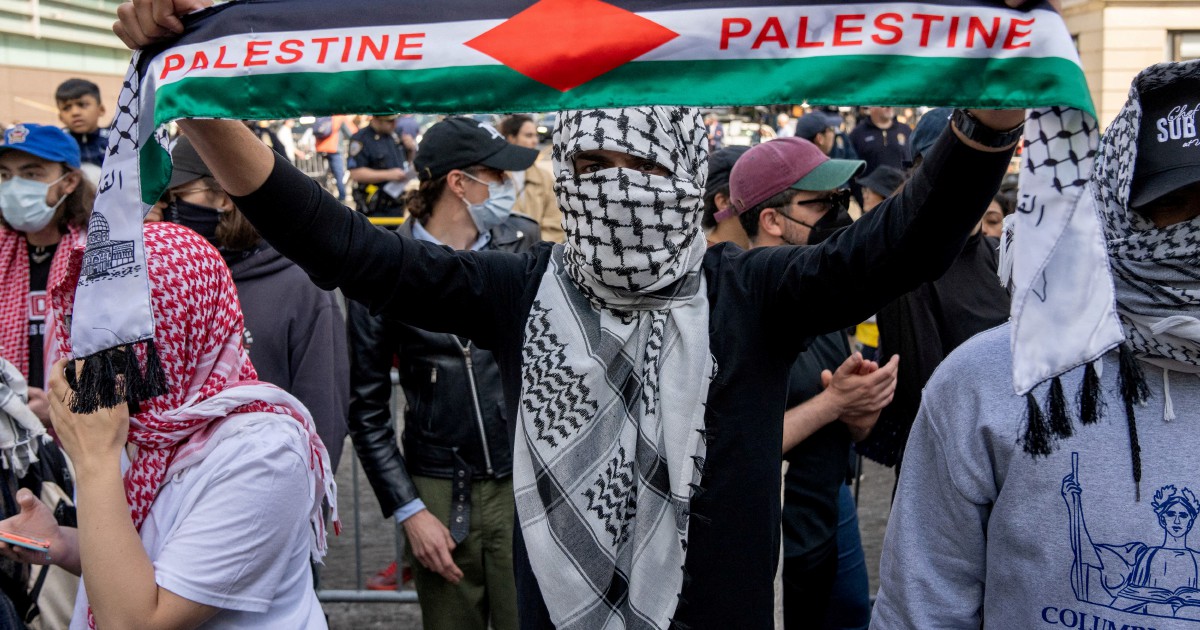
Members of Columbia University's Palestinian community have taken the American institution to court, filing a lawsuit in New York that accuses the university of fostering a discriminatory environment. The legal action, brought by current and former Palestinian students alongside staff members, marks an escalation in tensions that have defined campus relations since late 2023, when geopolitical events intensified scrutiny of university policies affecting students from the region.
The case represents a significant moment in ongoing debates about campus safety, institutional accountability, and the protection of minority student communities on American university campuses. Columbia, one of the United States' most prestigious and influential educational institutions located in New York, has become a focal point for discussions surrounding how universities balance free speech, academic freedom, and the wellbeing of diverse student populations. The lawsuit suggests that Palestinians at the institution believe their experiences have not been adequately addressed through existing grievance mechanisms.
The timing of this legal challenge coincides with heightened tensions on university campuses across North America and Europe regarding student activism and institutional responses to geopolitical conflicts. Many institutions, including those in the Ivy League, have faced criticism from multiple constituencies—some arguing that universities have not done enough to protect Palestinian and Arab students, while others contend that campus environments have become hostile toward pro-Israel perspectives. Columbia's administration has previously stated its commitment to ensuring all students feel safe and included regardless of their background or political views.
The allegations centre on discriminatory treatment and institutional practices that the plaintiffs assert have created an unwelcoming environment for Palestinians at Columbia. Such claims typically invoke concerns about differential enforcement of student conduct policies, surveillance of student organizations, restrictions on campus activities, or inadequate responses to harassment and hostile comments. These are recurring themes in complaints from marginalized student communities across American higher education, where concerns about double standards in institutional enforcement have periodically surfaced.
For Malaysian readers and Southeast Asian observers, this lawsuit underscores how university governance and student protection mechanisms operate differently across jurisdictions. While Malaysian universities are governed under distinct regulatory frameworks and cultural contexts, the underlying principles—ensuring equitable treatment, protecting student welfare, and managing institutional neutrality on contentious issues—remain universally relevant. This case also demonstrates how global geopolitical tensions increasingly intersect with campus life, affecting international student experiences even in regions far removed from conflict zones.
The legal strategy employed by the Palestinian plaintiffs reflects broader trends in civil rights litigation, wherein marginalized groups use American courts to compel institutional accountability. Such lawsuits typically require demonstrating either explicit discriminatory policies or patterns of differential treatment that disadvantage a protected class. Columbia will likely respond by defending its policies as viewpoint-neutral and designed to maintain campus safety and academic integrity for all students. The outcome could influence how universities across North America approach similar complaints from other student communities.
Columbia's position as a major research institution with significant influence over American academia means that any ruling or settlement could reverberate through higher education more broadly. Universities nationwide monitor prominent cases involving peer institutions, and judgments regarding campus discrimination frequently inform policy adjustments at other schools. Additionally, Columbia's location in New York provides visibility that extends beyond academic circles into broader public discourse and media coverage.
The lawsuit also raises questions about how universities balance competing interests: supporting vulnerable student populations, protecting freedom of speech and academic inquiry, and maintaining institutional neutrality on contested geopolitical questions. Universities have historically struggled with this balance, particularly when student activism on foreign policy matters intensifies. The challenge lies in creating environments where Palestinian students feel genuinely safe and respected without restricting legitimate political expression or scholarly inquiry.
For international students generally, including those from Southeast Asia, this case signals that American universities can become flashpoints for geopolitical tensions. Malaysian students studying abroad should understand that their institutional rights and protections may be tested during periods of heightened international conflict. This lawsuit, while specific to Columbia and its Palestinian community, reflects systemic questions that affect how universities serve diverse student populations during turbulent periods.
The court process will likely unfold over months or years, with discovery phases potentially revealing internal university communications, policy documents, and institutional decision-making records. Such revelations often shed light on how universities actually implement their stated commitments to inclusion and non-discrimination, sometimes exposing gaps between policy and practice. The case may ultimately prompt Columbia and other institutions to reconsider their approaches to community accountability and student protection mechanisms.
Moreover, this litigation occurs within a broader context of increasing legal challenges to American university policies and practices. Students have increasingly pursued litigation to address perceived institutional failures, from sexual harassment to discrimination based on identity. The Palestinian students' decision to pursue legal remedies suggests they view internal university processes as insufficient, a judgment that will be examined throughout the court proceedings.
The implications extend beyond Columbia's campus. If the plaintiffs succeed in establishing discriminatory treatment, it could strengthen legal arguments at other institutions where similar complaints exist. Conversely, if courts rule against the plaintiffs, it may establish precedent that constrains future discrimination claims in higher education. Either outcome will influence how universities approach sensitive community relations and develop policies affecting students from regions experiencing conflict or political instability.

