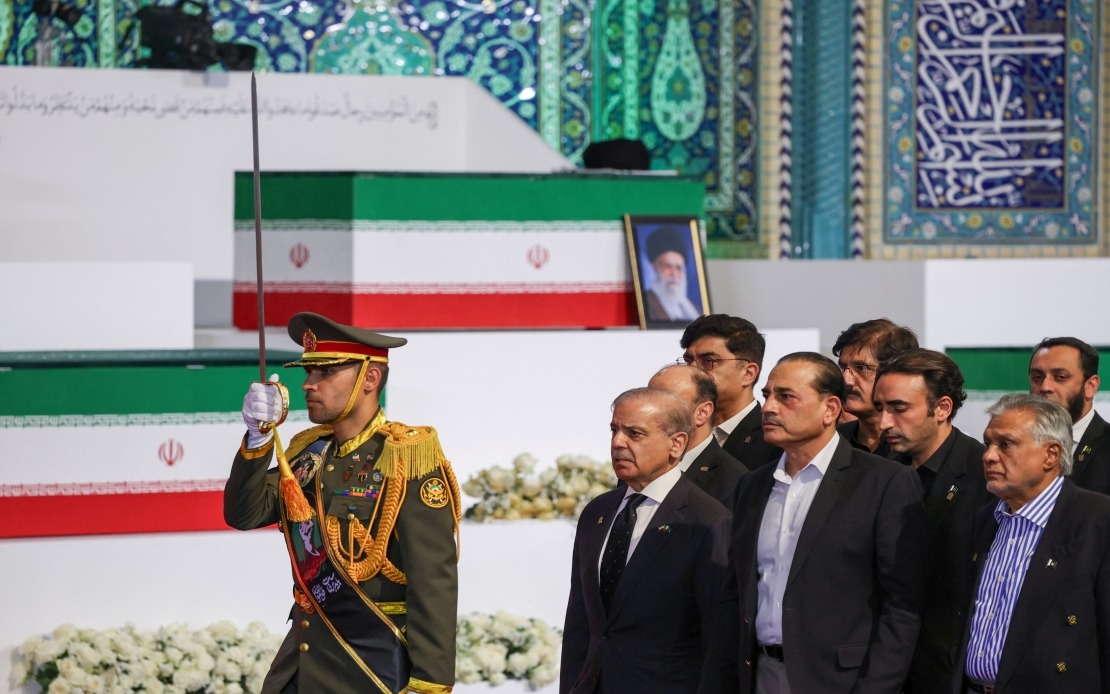
Pakistan's decision to send one of the world's most senior delegations to the funeral of Iran's Supreme Leader Ayatollah Ali Khamenei has emerged as a significant diplomatic statement, with Iranian officials publicly commending the gesture as a powerful affirmation of enduring partnership between two neighbouring Muslim-majority nations. The funeral ceremony held in Tehran on Friday drew dignitaries from approximately 100 countries, yet Pakistan's representation stood conspicuous both in rank and scale, prompting the Iranian ambassador to Islamabad to underscore what he characterised as a watershed moment in bilateral relations.
Khamenei's death on February 28 during what Iran termed a United States-Israeli attack on his compound in the Iranian capital created a moment of heightened geopolitical significance across the Islamic world and beyond. The 86-year-old leader, who had steered Iran's domestic and foreign policy since 1989, left behind a complex legacy spanning decades of regional influence and ideological leadership. His passing triggered a carefully orchestrated succession process within Iran's governmental structures, with the funeral serving as both a ceremonial farewell and a public demonstration of international solidarity with the Islamic Republic during a transitional period.
Pakistan's delegation composition underscored the mission's elevated importance and the breadth of institutional commitment Islamabad wished to demonstrate. Prime Minister Shehbaz Sharif's personal attendance signalled executive-level engagement, whilst the inclusion of Deputy Prime Minister and Foreign Minister Ishaq Dar ensured senior diplomatic representation. The participation of Chief of Army Staff Field Marshal Syed Asim Munir reflected the military establishment's investment in Iran relations—a particularly meaningful dimension given the deep institutional ties between Pakistan's armed forces and various Iranian security apparatus over decades. The presence of Pakistan People's Party chairman Bilawal Bhutto Zardari, National Assembly Speaker Sardar Ayaz Sadiq, Interior Minister Mohsin Naqvi, and Information Minister Attaullah Tarar created a rare display of cross-party and multi-sectoral unity in foreign policy messaging.
Iranian Ambassador Reza Amiri Moghadam seized upon this unified presentation, describing Pakistan's contingent as not merely the largest from any single nation but as embodying a historical gesture of profound significance. His public statements on social media platforms characterised the delegation as testimony to bonds of friendship and mutual respect, language deliberately chosen to resonate with narratives of shared Islamic identity and regional brotherhood that form bedrock justifications for Tehran's foreign policy engagement. The ambassador's emphasis on "enduring friendship" and "fraternal bonds" functioned as diplomatic shorthand for deeper security and strategic cooperation that extends far beyond ceremonial protocols.
The gathering itself brought together an extraordinary cross-section of global and regional powers whose very presence in Tehran conveyed competing messages about Iran's international standing. Malaysia, Bangladesh, Saudi Arabia, Turkiye, Qatar, Oman, Egypt, Russia, Iraq, China, and India each sent official representatives, creating a tableau that suggested Iran retained meaningful influence across diverse geopolitical alignments despite international sanctions and regional tensions. For Malaysian observers, the participation of Malaysia's own delegation underlined how even Southeast Asian nations with limited direct interests in Iran-Pakistan relations understand the importance of acknowledging Iran's role within broader Islamic world affairs and demonstrating respect through official attendance at state ceremonials.
Prime Minister Shehbaz Sharif's tribute to Khamenei, emphasising the departed leader's "wisdom, leadership and profound influence on Iran and the wider region," served multiple audiences simultaneously. Domestically, it signalled to Pakistan's significant Shia Muslim population that the government recognises Iran's spiritual and political significance within Islamic civilisation. Regionally, it reinforced Pakistan's commitment to maintaining balanced engagement with Iran despite competing pressures from Gulf Arab allies and Western partners. The language of remembrance for "generations" invoked a temporal dimension that transcended immediate diplomatic courtesy, suggesting Islamabad views its relationship with Tehran as structurally enduring rather than transactional.
The scheduled progression of Khamenei's funeral rites, with public ceremonies commencing on Saturday and burial planned for July 9 in Mashhad, created a ceremonial window during which international delegations could register their positions and preferences. Pakistan's high-profile participation during this critical window positioned it advantageously within Iran's political calculations as the country navigated succession and consolidated new leadership structures. The visibility of military leadership in Pakistan's delegation carried particular significance, as Iran's Revolutionary Guards and security apparatus maintain operational relationships with Pakistani counterparts across multiple domains from border security to counter-terrorism coordination.
For Southeast Asian observers and policymakers, Pakistan's approach to the Khamenei funeral illustrates how regional powers calibrate diplomatic presence to balance competing interests and relationships. Pakistan's simultaneous partnerships with Saudi Arabia and other Gulf states, coupled with its proximity to Iran and deep civilisational ties, require precisely the kind of nuanced positioning that attending Khamenei's funeral at the highest level demonstrates. The absence of inflammatory rhetoric, the emphasis on shared values, and the cross-party consensus within the Pakistani delegation all reflect sophisticated understanding that grand state funerals serve as barometers of bilateral intentions and future trajectory.
The international dimensions of Khamenei's funeral revealed how even in an era of intensifying global polarisation, state funeral protocols retain their capacity to generate displays of formal respect and official acknowledgment that transcend ideological divides. Russia and China's attendance alongside Western-aligned nations, Saudi Arabia's presence alongside Iran's allies, and the broad sweep of Islamic and non-Islamic nations converging on Tehran suggested that certain moments of collective ceremony still command near-universal recognition of legitimacy and protocol observance, even when underlying geopolitical relationships remain contested and volatile.
Looking forward, Pakistan's investment in visible presence at this funeral may yield diplomatic dividends as Iran's new leadership consolidates authority and considers how to recalibrate relationships with key regional partners. The Pakistani delegation's scale and composition appear calibrated to position Islamabad as a reliable, serious partner worthy of consultation on issues ranging from border stability to regional security architecture to economic cooperation. For Malaysia and other Southeast Asian nations monitoring regional developments, Pakistan's diplomatic approach offers instructive examples of how middle powers navigate complex relationships with larger neighbours whilst maintaining principled positions and demonstrating cultural and religious solidarity without sacrificing strategic autonomy or contradicting commitments elsewhere.

