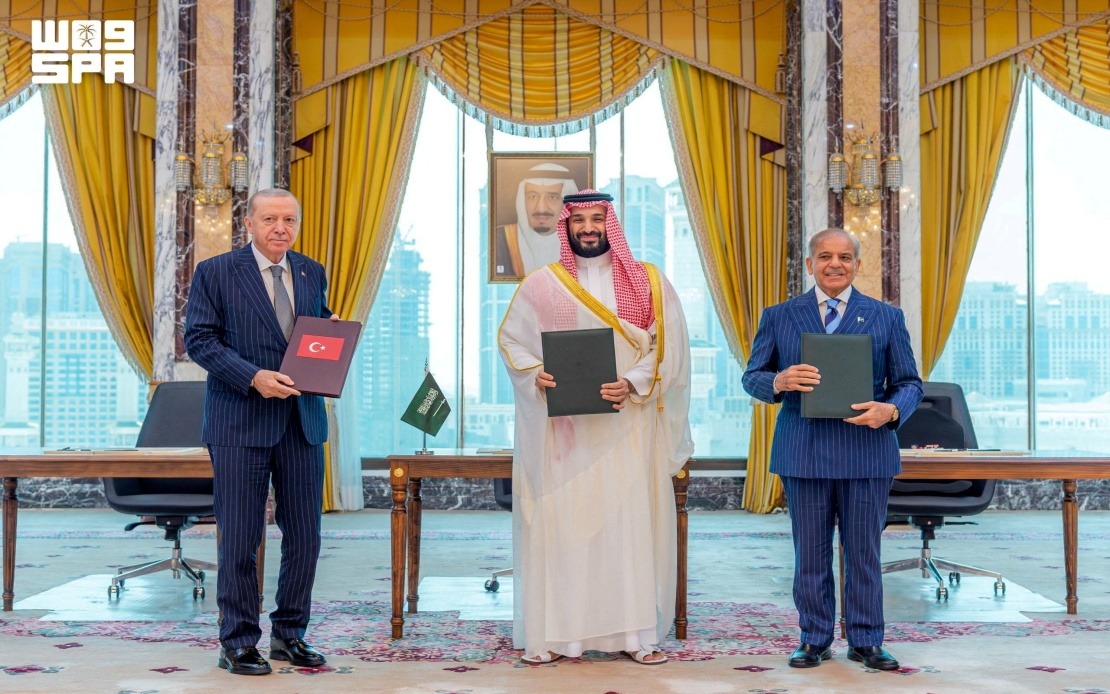
The leaders of Pakistan, Saudi Arabia and Türkiye have formalised a significant strategic partnership by signing a comprehensive defence accord at Al Safa Palace in Makkah on Friday, marking a notable consolidation of security ties among three influential Muslim-majority nations in Asia and the Middle East.
Saudi Crown Prince Mohammed bin Salman bin Abdulaziz Al Saud, Pakistan Prime Minister Shehbaz Sharif and Turkish President Recep Tayyip Erdogan put their signatures to the Joint Defence Agreement, which establishes a framework treating military aggression against any single member as an attack demanding collective response. The accord emerged from high-level talks reflecting mounting regional security concerns and the three nations' determination to strengthen their strategic posture in an increasingly complex geopolitical environment.
Central to the pact is a mutual defence clause stipulating that armed conflict targeting any one signatory would constitute grounds for coordinated action by the others. Beyond this core commitment, the agreement encompasses broadened defence collaboration spanning multiple operational domains, technology transfer initiatives, joint training exercises and enhanced intelligence sharing. This layered approach demonstrates the signatories' intent to move beyond symbolic gestures toward practical military integration.
The trilateral arrangement represents a natural evolution of existing bilateral relationships. Pakistan and Saudi Arabia established a comparable defence treaty in September of the previous year, obligating reciprocal military assistance should either face external assault. Türkiye maintains longstanding security partnerships with both nations, particularly through NATO membership and its role as a regional balancing power. The three-way agreement essentially elevates these separate relationships into a triangular framework.
For Malaysia and other Southeast Asian nations, this development carries important implications. The accord signals that major Muslim-majority states are prioritising collective security arrangements as a counterweight to perceived external threats and regional power competition. Pakistan's status as one of nine nuclear-armed countries adds significant weight to such commitments. The strengthened Makkah axis may influence broader geopolitical calculations, particularly regarding relationships with major powers and competing strategic blocs in Asia and the Middle East.
Saudi Arabia's Deputy Public Diplomacy Minister Rayed Krimly emphasised through social media that the partnership aims to build joint military capabilities, fortify deterrence mechanisms and synchronise defence readiness among the three nations. His statement explicitly rejected characterisations of the pact as threatening regional stability or representing escalatory measures. This defensive messaging suggests the signatories recognise potential concern among neighbouring states and non-signatory regional players.
The agreement addresses legitimate security anxieties facing all three nations. Pakistan confronts persistent terrorism and security challenges along its borders; Türkiye manages complex regional dynamics involving Syria, Iraq and Kurdish-related security issues; Saudi Arabia faces threats from Houthi forces in Yemen and broader regional tensions. A coordinated defence posture potentially offers each nation reassurance while reducing individual vulnerability to asymmetric threats and conventional military pressure.
However, the pact's practical implementation will determine its significance. Defence agreements between developing nations often remain aspirational, constrained by resource limitations, logistical challenges and divergent operational priorities. The three countries will need to establish effective coordination mechanisms, regular military exercises and transparent communication channels to translate commitments into genuine integrated capability. Previous regional defence arrangements have sometimes faltered when tested against actual crises or competing national interests.
The timing reflects broader regional dynamics. Saudi Arabia's recent diplomatic reengagement with Iran, Pakistan's ongoing economic challenges and Türkiye's balancing act between NATO and regional partners create a complex backdrop. The Makkah agreement represents an attempt to strengthen collective leverage precisely as geopolitical competition intensifies across Asia and the Middle East, from great power competition to proxy conflicts.
For smaller nations including Malaysia, such developments underscore the importance of sophisticated foreign policy management. The emergence of new strategic blocs and security arrangements reshapes regional relationships and alliance structures. Nations must carefully calibrate their own security policies, partnerships and diplomatic positioning to reflect these evolving alignments while maintaining strategic autonomy and regional stability.
The agreement also reflects the enduring significance of Islamic solidarity in shaping geopolitical outcomes, even as specific national interests drive decision-making. Joint statements emphasising shared commitment to regional peace and prosperity attempt to frame the arrangement as stabilising rather than destabilising, though perceptions will vary among other regional actors based on their own strategic positions and threat assessments.
Moving forward, the substance and durability of this defence partnership will depend on consistent political will, adequate resource allocation and demonstrated military cooperation. Observers across Asia will monitor implementation closely, assessing whether the Makkah accord represents a meaningful shift in regional security architecture or primarily serves ceremonial purposes.

