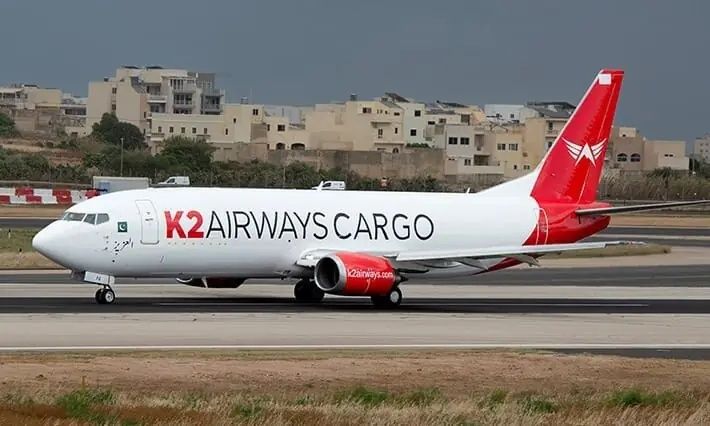
Pakistan intensified rescue efforts on Wednesday following the disappearance of a K2 Airways Boeing 737-400 cargo plane with five crew members aboard, as Prime Minister Shehbaz Sharif confirmed the aircraft had crashed into the Arabian Sea. The twin-engine freighter vanished while making its final approach to Karachi International Airport after departing from Sharjah in the United Arab Emirates, marking another aviation tragedy for the South Asian nation.
The Pakistan Airports Authority reported that radar contact was lost at 9:21 pm local time on Tuesday, approximately 155 nautical miles west of Karachi. In the moments before losing communication, the aircraft had transmitted a troubling sequence of events: operators first reported a navigational system malfunction, followed by the plane exhibiting rapid descent and abrupt heading changes on radar screens. The deteriorating situation unfolded within minutes, leaving little time for emergency procedures or crew response.
Flightradar24, the international aviation tracking service, released preliminary flight data revealing a pattern consistent with severe technical distress. The aircraft initially lost altitude sharply, then climbed slightly, before experiencing what the service described as a "sudden and dramatic" plunge—a sequence suggesting either catastrophic mechanical failure or a catastrophic loss of control. Such erratic altitude changes often indicate problems with engine power, hydraulic systems, or structural integrity.
Prime Minister Shehbaz Sharif issued a formal statement expressing "deep sorrow, grief, and regret" over the incident and ordered Pakistan's civil aviation authorities, navy, and air force to deploy every available resource toward locating the wreckage and survivors. Multiple naval vessels and merchant ships, coordinated with military aircraft, commenced search operations across the Arabian Sea. The scale of the operation reflects both the humanitarian imperative and the political sensitivity surrounding aviation accidents in Pakistan.
K2 Airways operates as a private cargo carrier conducting both scheduled and charter services across South Asia and beyond. The airline's fleet serves regional and international routes, transporting freight for commercial clients. However, the specific aircraft involved, bearing registration details linking it to decades of prior service, carried a complex operational history that may prove relevant to accident investigators. The Boeing 737-400 was manufactured in 1999 and initially flew as a passenger aircraft for Russian carrier Aeroflot before serving with Indonesian flag carrier Garuda Indonesia. Following conversion to cargo configuration in 2012, it entered the freight transport sector, where it had operated for more than a decade.
For Malaysian and wider Southeast Asian aviation professionals and regulators, this incident arrives amid ongoing scrutiny of regional air safety standards. Pakistan's aviation sector has struggled with a troubling safety record over the past decade, experiencing multiple fatal crashes that have drawn international attention and prompted regulatory investigations. The most significant crashes occurred in Karachi itself, Pakistan's largest commercial aviation hub, raising questions about airport operations, air traffic control procedures, and aircraft maintenance standards in the region.
The European Union's previous suspension of Pakistan International Airlines from its airspace underscored these concerns. The four-year ban, imposed due to safety and licensing deficiencies, represented one of aviation's most serious regulatory actions and reflected fundamental doubts about Pakistan's ability to ensure safe operations. Only after implementing substantial reforms did European authorities lift the restriction in 2024, signalling cautious confidence in improved oversight. However, the broader ecosystem—including private cargo operators, maintenance facilities, and training institutions—continues to operate under varying degrees of regulatory attention.
This latest accident raises critical questions about the maintenance and certification status of ageing aircraft operating in regional cargo services. The 25-year-old Boeing 737-400 represents the class of narrowbody freighters that have become workhorses for regional logistics networks across Asia. While properly maintained examples continue safe operation worldwide, aircraft of this vintage require increasingly rigorous inspection protocols and component replacement schedules. Investigators will scrutinise maintenance records, crew training qualifications, and whether the reported navigational system failure represented a primary cause or symptom of deeper technical problems.
The Arabian Sea's challenging search environment—deep waters, strong currents, and limited visibility—complicates recovery efforts. Locating wreckage and determining the precise accident sequence requires sophisticated maritime search capabilities, underwater sonar equipment, and expert analysis. International aviation investigation standards typically involve multi-agency coordination, with the United States' National Transportation Safety Board and Boeing often participating in investigations involving American-manufactured aircraft.
For Malaysia's aviation community, particularly operators of similar aging aircraft and smaller cargo carriers, the incident serves as a sobering reminder of safety responsibilities. The Malaysian aviation authority and domestic carriers monitor such accidents closely to identify systemic vulnerabilities applicable to regional operations. Training standards, maintenance oversight, and crew resource management protocols remain focal points for continuous improvement across the sector.
The immediate priority remains locating survivors and recovering the aircraft, though preliminary indications and the violent nature of the descent suggest slim prospects for survivors. The five crew members aboard represent families facing devastating loss, and their colleagues within the aviation community confronting questions about systemic safety. As Pakistan's authorities conduct their investigation, the broader Southeast Asian aviation sector watches closely, conscious that safety lessons learned from such tragedies protect all who depend on regional air transport networks.

