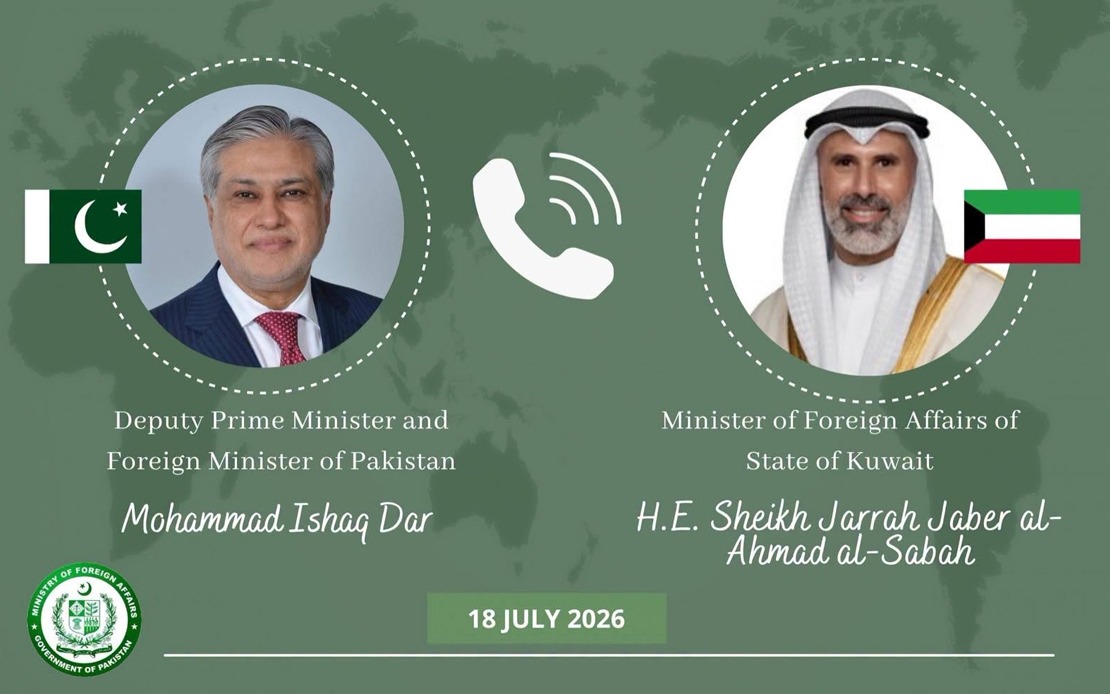
Pakistan and Kuwait issued a joint statement of concern on Saturday regarding the intensifying military confrontation between Iran and the United States, signalling growing anxiety among Gulf and South Asian nations about the potential for wider regional conflict. The two countries' foreign policy leadership engaged in direct discussions to assess the deteriorating situation, reflecting a coordinated diplomatic effort to prevent further escalation in a strategically vital region that touches the interests of multiple Muslim-majority nations.
Pakistan's Deputy Prime Minister and Foreign Minister Ishaq Dar and his Kuwaiti counterpart Sheikh Jarrah Jaber Al Ahmad Al Sabah held a telephone conversation to address mounting security concerns. The exchange underscored how the bilateral dispute between Iran and the United States has begun drawing responses from neighbouring states keen to preserve stability and protect their own territorial integrity. Both nations appear intent on mobilising diplomatic pressure to ensure compliance with existing agreements designed to contain the conflict.
Kuwait has emerged as a particular flashpoint in the escalating confrontation, having suffered direct military strikes against its critical infrastructure. The emirate reported that Iranian forces had damaged another power generation and water desalination facility on Saturday, marking the second consecutive day of attacks on its essential utilities. These strikes carry serious implications for Kuwait's civilian population and economic stability, as damage to desalination plants threatens the nation's freshwater supply in an arid region heavily dependent on such facilities.
Central to both nations' diplomatic messaging is the Islamabad Memorandum of Understanding, a ceasefire accord signed between Iran and the United States on June 17. Kuwait specifically appealed for the full implementation of this agreement, suggesting that both signatories have failed to honour their commitments adequately. Pakistan's deputy prime minister similarly insisted on maintaining ceasefire obligations and avoiding provocative actions that might deepen the crisis, positioning Islamabad as a voice of restraint within the Islamic world.
The broader pattern of escalation has seen repeated strikes against Iranian infrastructure by United States Central Command forces, prompting Tehran to issue warnings of retaliatory attacks against American-allied nations throughout the region. This tit-for-tat cycle of military action and counter-action creates a dangerous dynamic where miscalculation or domestic political pressure could trigger a wider conflict affecting multiple nations and disrupting global energy supplies.
A critical concern underpinning Pakistan and Kuwait's intervention is the security dimension affecting the entire region. Pakistan emphasised the importance of respecting state sovereignty and maintaining territorial integrity, principles directly threatened by the current military operations. These values, particularly crucial in the fractious Middle East, form the foundation for any sustainable regional order and must be preserved to prevent competing powers from justifying further interventions.
The economic ramifications extend far beyond Iran and the United States. Iran has reportedly closed the Strait of Hormuz to shipping traffic, a critical chokepoint through which roughly 20 per cent of global oil passes. Simultaneously, the United States military has established a naval blockade against Iran, restricting maritime commerce and creating potential flashpoints for accidental confrontation. For energy-dependent nations throughout Asia, including Malaysia and other Southeast Asian economies reliant on Middle Eastern oil, such disruptions carry direct consequences for fuel prices and economic growth.
Malaysia and other regional observers should note that this crisis reflects deeper structural tensions within the international system. The United States and Iran remain locked in fundamental strategic competition, with proxy conflicts and military buildups characterising their relationship across Iraq, Syria, Yemen, and beyond. The involvement of Gulf states like Kuwait in escalating incidents demonstrates how easily localised disputes can become regional conflagrations.
Pakistan's role as a diplomatic interlocutor reflects its historical position as a bridge between Western and Islamic worlds, as well as its geographic proximity to potential conflict zones. Islamabad's stress on de-escalation and adherence to the Islamabad MoU suggests that South Asian nations recognise the catastrophic consequences a full-scale Iran-US confrontation could unleash. Such a conflict would destabilise oil markets, disrupt trade routes critical to Asian economies, and potentially draw other regional powers into the fray.
Kuwait's particular vulnerability also highlights the precarious position of smaller Gulf states caught between great power competition. Though nominally aligned with Western interests through defence treaties, Kuwait must carefully balance its security partnerships with the reality of Iranian military proximity and capability. Its appeals for international restraint reflect a pragmatic understanding that military solutions to the underlying Iran-US dispute remain elusive.
The ceasefire agreement signed in June appears fragile, with both sides accusing the other of violations. The involvement of Pakistan and Kuwait in demanding its implementation suggests that third-party states now view themselves as stakeholders with legitimate interests in ensuring the accord holds. This multilateral dimension could eventually provide the foundation for more inclusive diplomatic efforts involving the United Nations, regional organisations, and neighbouring powers.
For Southeast Asian nations with significant trade interests in the Middle East and reliance on energy imports, the deteriorating security situation warrants close monitoring. Escalation risks commodity price spikes and disrupted supply chains that would reverberate across the regional economy. Malaysia, Singapore, and other ASEAN members should consider coordinating messaging at international forums to emphasise the need for restraint and commitment to established agreements.

