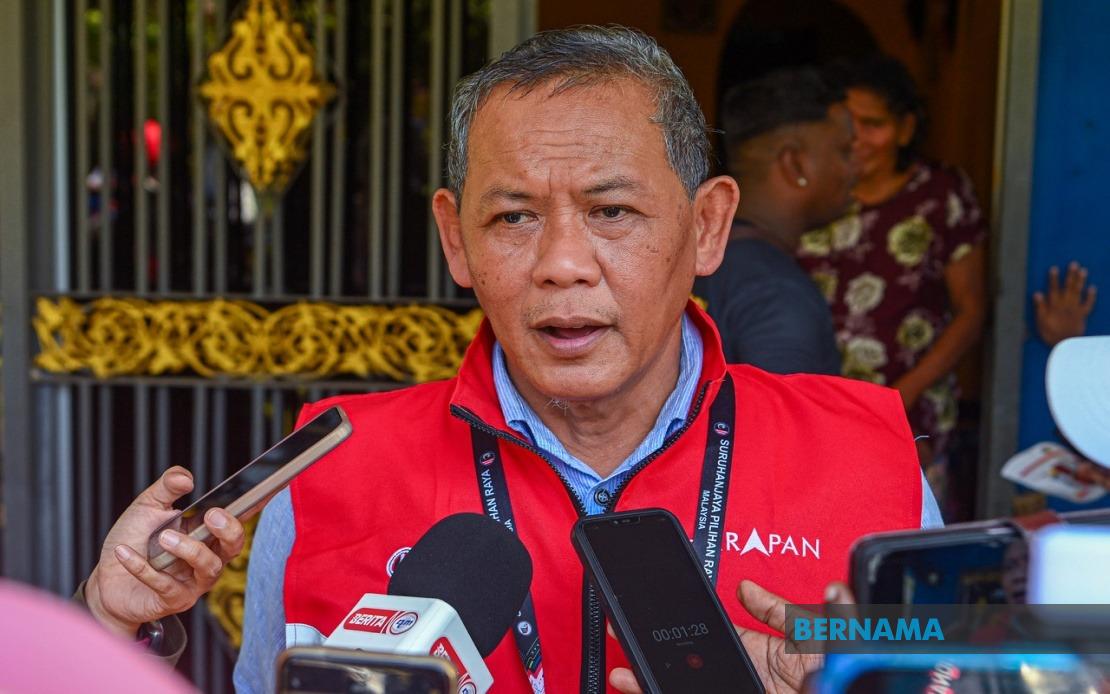
Pakatan Harapan has shifted its approach for the upcoming Negeri Sembilan state election by unveiling a manifesto that extends financial and welfare assistance beyond low-income households to encompass the middle-income segment, a strategic expansion aimed at broadening electoral appeal in the 16th state assembly polls set for August 1.
State PH chairman Datuk Seri Aminuddin Harun presented the coalition's 10-point election platform, titled 'Negeri Sembilan Kekal Harapan' (Negeri Sembilan Stays with Harapan), during a community engagement session with the Indian community at Sekang Estate in Linggi. The manifesto represents a deliberate recalibration of the coalition's previous approach, which had concentrated primarily on programmes targeting the B40 income bracket—households earning below RM3,000 monthly.
The inclusion of M40 households, representing those earning between RM3,000 and RM8,000 monthly, signals recognition within PH's leadership that middle-income families face distinct economic pressures and deserve targeted policy support. Aminuddin emphasised that the expanded scope would have more tangible benefits for a larger cross-section of Negeri Sembilan's population, reflecting lessons learned from the coalition's five-year tenure governing the state since the 2018 general election.
Education access emerged as a focal point of the broadened initiative, with Aminuddin highlighting how educational opportunities previously limited to B40 families would now extend to children from M40 households. This expansion carries particular significance in a Malaysian context where middle-income families often struggle with rising education costs despite earning above the poverty threshold, a pattern observable across the region. By incorporating education into the manifesto's M40 provisions, PH positions itself as responsive to the cost-of-living anxieties increasingly voiced by middle-class voters facing stagnant wages and inflation.
Aminuddin, who simultaneously serves as Menteri Besar and Member of Parliament for Port Dickson, positioned the expanded manifesto within a broader narrative about delivery and accountability. He argued that PH distinguishes itself from political competitors not merely by presenting platforms for electoral consumption but by demonstrating tangible execution of announced commitments. This framing directly addresses scepticism about campaign promises in Malaysian politics, where voter cynicism around unfulfilled pledges runs deep across socioeconomic groups.
The coalition's track record in Negeri Sembilan governance became central to its electoral messaging. Since assuming control in 2018, PH has governed the state through successive administrations, providing what its leadership characterises as measurable evidence of commitment to welfare and development initiatives. However, the challenge of translating past performance into future electoral support remains acute, particularly in an environment where opposition parties can highlight specific unfulfilled aspects of previous campaigns or point to service delivery shortcomings.
Aminuddin's personal electoral contest in Linggi adds dimension to the state-level campaign dynamics. He faces competition from incumbent Datuk Mohd Faizal Ramli of Barisan Nasional and Zamri Md Said of Parti Pribumi Bersatu Malaysia in a three-cornered contest. This particular race exemplifies broader trends in Malaysian electoral politics, where UMNO-led BN retains traditional strongholds while Bersatu positioning itself as an alternative on the Malay-Muslim voter axis, leaving PH navigating complex identity and economic messaging across communal lines.
The Negeri Sembilan election occurs within a broader context of state-level reassessment across Malaysia, where coalition performance and internal unity face scrutiny before larger national electoral cycles. For PH, Negeri Sembilan represents an opportunity to demonstrate sustained electoral credibility and programme delivery in a state it has controlled since 2018, building momentum for potential future national campaigns. The manifesto's expansion to M40 households also reflects recognition that economic stratification within the Malaysian middle class—a politically volatile demographic—requires nuanced policy responses rather than one-size-fits-all welfare frameworks.
Aminuddin made explicit appeals for maturity in campaign conduct, requesting that all contesting parties refrain from raising divisive issues that might compromise social harmony in Negeri Sembilan. This rhetorical move, common across Malaysian political contests, reflects underlying anxiety about communal tensions during election periods and attempts to establish a consensus around issue-based rather than identity-based competition. Whether such appeals gain traction depends substantially on how competing parties frame their respective platforms and whether economic messaging dominates communal considerations in voters' decision-making.
The timing of the poll, with early voting scheduled for July 28 and general polling on August 1, follows the state assembly's dissolution on June 5. The Election Commission's scheduling provides a standard campaign window, during which PH's manifesto messaging around expanded M40 benefits will compete against opposition narratives. For Malaysian voters and regional observers tracking coalition performance, Negeri Sembilan's August outcome will offer insights into whether expanded welfare targeting across income segments proves electorally persuasive or whether traditional political alignments and communal considerations continue to dominate state electoral outcomes.

