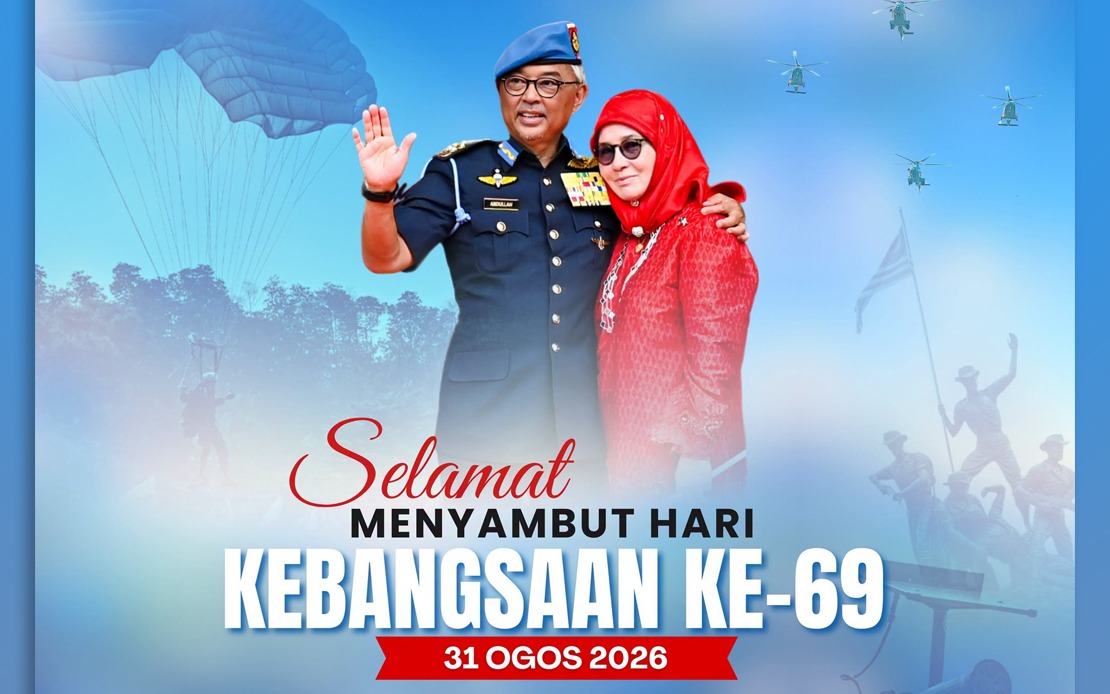
Pahang's reigning monarchs have issued a heartfelt message on the occasion of Malaysia's 69th National Day, reinforcing the significance of the nation's independence milestone and calling upon citizens to deepen their commitment to national cohesion. Al-Sultan Abdullah Ri'ayatuddin Al-Mustafa Billah Shah and Tengku Ampuan Pahang Tunku Azizah Aminah Maimunah Iskandariah released their message through official channels in Kuantan, appealing to the people of Pahang to embrace the values that have sustained the nation through nearly seven decades of self-governance.
The royal couple's statement reflects a broader emphasis within Malaysia's constitutional monarchy on the spiritual and civic foundations of national identity. By framing independence as a "great trust," Their Royal Highnesses sought to remind Malaysians that sovereignty carries reciprocal obligations—not merely to celebrate past achievements, but to actively safeguard the structures and principles upon which the nation rests. This framing carries particular resonance in Pahang, a state with significant demographic diversity and considerable economic importance to the national economy through its natural resources and strategic geography.
Central to the monarchs' message is an invocation of the Rukun Negara, Malaysia's foundational constitutional principle established in 1970 following the 1969 racial riots. The five pillars—belief in God, loyalty to the Sovereign and country, upholding the Constitution, rule of law, and good conduct—represent the consensus that emerged from a national crisis. By urging Pahang's residents to "practise the principles" of Rukun Negara in daily life, the Sultan and Tengku Ampuan positioned these ideals as active, lived commitments rather than abstract constitutional provisions. This is a significant rhetorical move in contemporary Malaysia, where questions of national identity, religious pluralism, and communal harmony remain contested political terrain.
The emphasis on gratitude to Allah SWT for "peace, prosperity and harmony" enjoyed over 69 years speaks to a particular vision of the Malaysian social contract. While Malaysia has experienced economic growth and relative stability compared to some peers in Southeast Asia, the period has also witnessed significant political turbulence, including the constitutional crisis of 2020-2021, rising partisan polarization, and ongoing debates over institutional roles and powers. The royal message implicitly acknowledges these complexities by stressing that harmony must be continuously cultivated through "unity, mutual respect and tolerance."
For Pahang specifically, the National Day message carries additional weight. As the largest state on Peninsular Malaysia and home to the federal capital's water supply through the Pahang River system, Pahang plays a crucial strategic role. The state's development trajectory, from primary commodity dependence toward diversification, mirrors broader Malaysian economic challenges. The Sultan's call for patriots to "live up to" national principles suggests that prosperity and security cannot be taken for granted, but require ongoing collective effort and commitment.
The royal couple's particular attention to the younger generation reflects concerns increasingly articulated across Malaysian public discourse. As Malaysia's population bulges with youth born after 1990, questions about whether younger Malaysians adequately understand or appreciate the historical struggles preceding independence have gained prominence. By urging young people to "appreciate the history of the country's struggle," the monarchs addressed a perceived knowledge or attitudinal gap. This concern is not unique to Malaysia—across Southeast Asia, postcolonial nations grapple with transmitting historical consciousness to digital-native generations.
The invocation of preserving "heritage, culture and social harmony" through youth engagement suggests an intergenerational compact. Rather than presenting Merdeka as a finished historical event, the royal message reframes it as an ongoing project requiring stewardship. This is particularly important in Pahang, where cultural diversity—including significant Orang Asli populations, substantial Malay-Muslim communities, and Chinese and Indian minorities—means that social harmony depends on active maintenance of intercommunal relationships and mutual recognition of diverse heritage.
The Sultan and Tengku Ampuan's prayer for Pahang to remain "under the protection and blessings of Allah SWT, blessed with lasting peace, prosperity and well-being" employs both religious and secular registers. This dual appeal reflects Malaysia's constitutional arrangement, whereby Islam holds a special position while the state maintains protections for religious minorities and secular governance structures. The invocation of divine protection, combined with emphasizing that peace and prosperity are desired outcomes requiring human effort, presents a balanced theological-political vision.
These National Day messages from Pahang's monarchs function as more than ceremonial utterances. They provide guidance to state residents regarding how to interpret and participate in national life at a moment when Malaysian politics faces challenges around institutional legitimacy, inter-ethnic relations, and economic confidence. By emphasizing continuity with established constitutional principles rather than advocating policy changes or political realignment, the royal couple positioned the sultanate as a stabilizing force within Malaysia's constitutional framework—a role that has become increasingly important given the country's recent political volatility and the prominence of monarchy-related controversies in public debate.
The timing of the message, released on August 30 ahead of the official August 31 National Day, ensured prominent placement in news cycles and allowed other Malaysian institutions and political leaders to respond to and build upon the royal couple's themes. In this sense, Pahang's rulers modeled the articulation of patriotic values and national commitment in a way designed to set the rhetorical tone for broader National Day celebrations throughout Malaysia.

