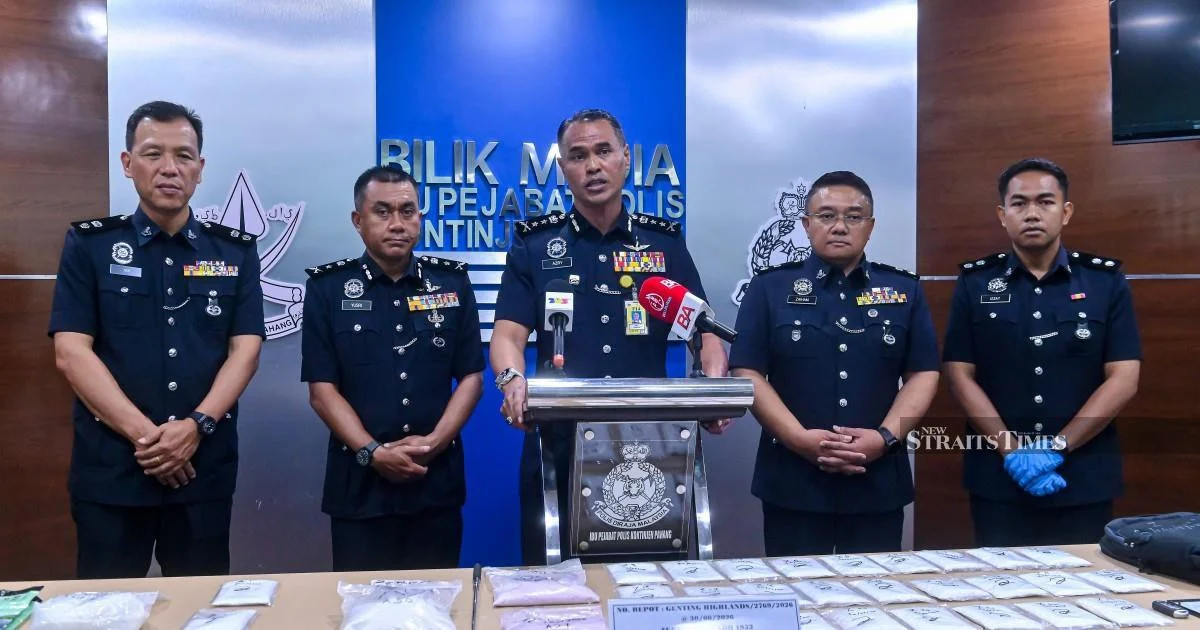
Pahang's latest comprehensive anti-drug operation, designated Operation Hawk, has concluded with substantial results that underline the state's continued enforcement drive against narcotics trafficking. Over a three-day period, coordinated police teams fanned across all 11 districts of the state, conducting raids and roadside checks at known drug distribution points and hotspots. The operation culminated in the arrest of 333 individuals suspected of involvement in drug-related offences, while authorities recovered contraband including narcotics, cash holdings and motor vehicles with a combined estimated value exceeding RM500,000.
The statewide scope of Operation Hawk reflects a strategic approach to addressing drug supply and consumption networks that span multiple jurisdictions within Pahang. By mobilising resources across every district simultaneously, enforcement authorities aimed to disrupt the coordination between suppliers, distributors and street-level dealers, making it difficult for suspects to receive advance warning or relocate operations. The timing and intensity of such operations often catch networks off guard, leading to higher-than-usual arrest and seizure rates that provide temporary disruptions to illicit drug markets.
The seizure figures paint a picture of significant contraband flows within Pahang. Drugs recovered during the operation represent inventory at various stages of the distribution chain, from wholesale quantities held by traffickers to retail portions destined for end users. The accompanying cash seizures indicate the operation's success in identifying financial assets tied to drug proceeds, which authorities believe are often laundered through informal channels or used immediately to purchase fresh supplies. The vehicles seized likely served as transport mechanisms for moving drugs between districts or facilitating retail transactions.
Pahang's position as a crossroads between major urban centres and rural areas makes it vulnerable to drug trafficking networks that operate along key transportation corridors. Kuantan, the state capital, serves as a commercial hub where distribution networks converge. Simultaneously, smaller towns and rural communities throughout the state face emerging drug problems that strain local enforcement resources. Operations like Hawk attempt to create simultaneous pressure across these varied environments, though sustainability remains a constant challenge given the cyclical nature of drug production and trafficking adaptation.
The arrest of 333 individuals represents a significant enforcement exercise, though local drug enforcement observers note that such operations typically net a mix of primary targets—mid-level dealers and traffickers—alongside street-level users and minor offenders. The composition of those arrested matters considerably for assessing the operation's genuine impact on drug supply. Removing senior trafficking organisers from circulation produces longer disruptions than arresting individual users, yet the scale of arrests provides statistics that demonstrate enforcement commitment to both public reassurance and political stakeholders.
Malaysia's drug problem has intensified over recent years, with synthetic narcotics including methamphetamine in pill and crystalline forms becoming increasingly prevalent alongside traditional heroin markets. Pahang, like other states, has become a focal point for these evolving trafficking patterns. The presence of ports, industrial zones and residential concentrations in some districts creates multiple pathways for drug entry and distribution. Regional supply chains connecting southern Thailand, regional chemical precursor suppliers and Malaysian markets have created more resilient trafficking networks that frequently adapt routes and methodologies in response to enforcement pressure.
The RM500,000 valuation of seized materials provides a snapshot of the economic scale of drug trafficking affecting Pahang. This figure likely reflects wholesale or street-market valuations of the narcotics involved rather than pure cost-of-goods metrics. For traffickers, the seizure represents lost revenue and profit that drives criminal enterprise calculus—though successful trafficking operations typically factor in percentage losses to law enforcement as operational costs. The size of seizures required to achieve meaningful deterrent impact remains a subject of ongoing debate within Malaysian law enforcement circles.
Operation Hawk's execution across all 11 districts—including urban centres like Kuantan, Temerloh and Raub as well as more remote areas—demonstrates the territorial reach of modern drug trafficking. Even smaller districts with limited repeat enforcement presence have become supply destinations, suggesting that trafficking networks no longer concentrate exclusively in major population centres. This dispersal pattern complicates enforcement strategy, as it requires sustained resource commitment across geographically extensive areas rather than allowing focused concentration in high-profile urban locations.
The operation's three-day intensive format reflects common enforcement methodology where short-term saturation strategies attempt to overwhelm trafficking logistics and catch suspects unprepared. However, the temporary nature of such operations means that disruption effects typically dissipate within days or weeks as networks reconstitute supply chains and redistribute operations. Enforcement authorities acknowledge the need for sustained, continuous operations rather than periodic crackdowns, yet budget and personnel constraints frequently necessitate the concentrated-effort approach that Operation Hawk exemplifies.
For Malaysian readers, Operation Hawk illustrates the ongoing cat-and-mouse dynamics between law enforcement and trafficking networks operating within Pahang and the broader region. While the arrests and seizures represent tangible enforcement outcomes, they also serve as indicators of the underlying scale of drug activity requiring suppression. The operation's geographical breadth underscores how thoroughly drug trafficking has integrated into various communities across the state, from urban retail markets to rural consumption zones. Sustained attention to enforcement capability and international cooperation on precursor chemicals and trafficking route disruption remains essential for managing Malaysia's complex drug situation.

