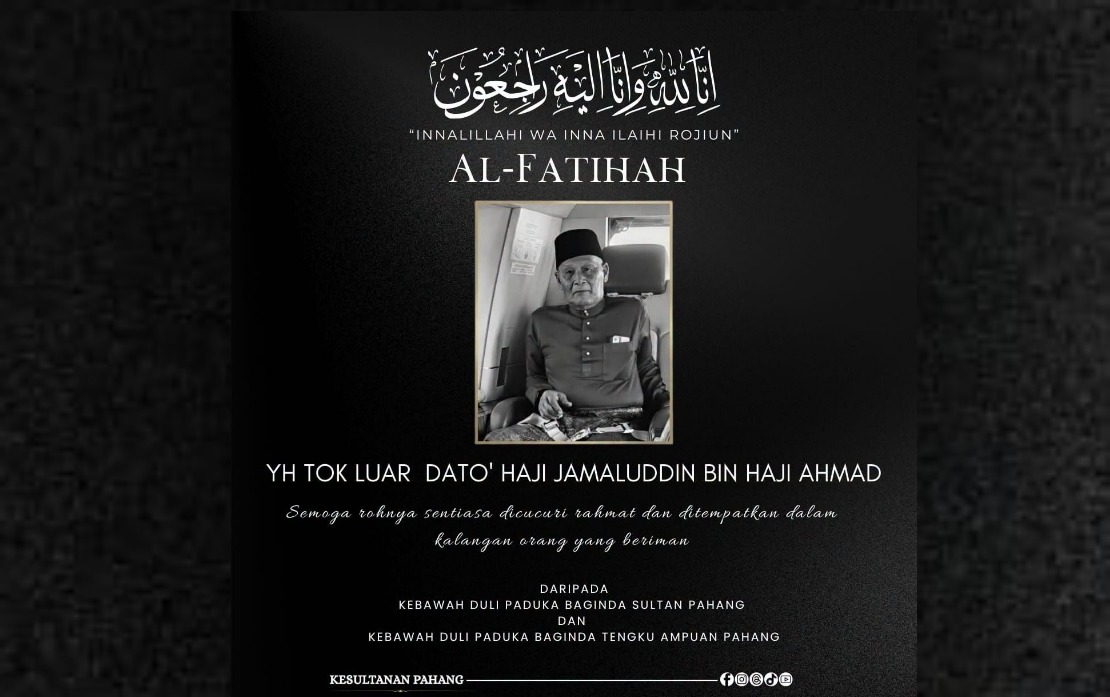
The Sultan of Pahang Al-Sultan Abdullah Ri'ayatuddin Al-Mustafa Billah Shah and Tengku Ampuan of Pahang Tunku Azizah Aminah Maimunah Iskandariah have extended formal condolences following the death of Tok Luar Datuk Jamaluddin Ahmad, a figure of significance in Pahang's social and institutional landscape. The respected community leader passed away on June 28 at Tengku Ampuan Afzan Hospital in Kuantan at 6.48 am, prompting the royal household to issue a statement acknowledging his contributions and expressing sympathy to his bereaved family.
Through an official announcement posted on the Kesultanan Pahang Facebook page, the royal couple conveyed their profound sorrow at Jamaluddin's passing, characterising him as a steadfast champion of the Pahang Sultanate institution. Such public expressions of royal condolence serve an important ceremonial function in Malaysian society, reinforcing the symbolic bonds between the monarchy and prominent members of the community. The statement underscored the value the Sultan and Tengku Ampuan place on loyalty and dedication to state institutions, qualities they identified as central to Jamaluddin's life and service.
Beyond the formal acknowledgment of his death, the royal statement incorporated religious elements reflecting Malaysia's Islamic heritage and values. The Sultan and Tengku Ampuan prayed that Jamaluddin's soul would receive divine mercy, that his transgressions be forgiven, that his virtuous actions be accepted before Allah, and that he be granted a place among the faithful and righteous servants of God. This invocation of Islamic traditions in the context of royal bereavement reflects the intersection of institutional protocol and religious observance in Malaysia's constitutional monarchy, where the Yang di-Pertuan Agong and state sultans hold religious as well as political significance.
The royal couple also extended their wishes to Jamaluddin's family, praying that they would be strengthened with resolve and patience as they navigate the grief following his sudden death. Such expressions acknowledge the emotional weight experienced by bereaved families while invoking spiritual resilience rooted in Islamic teachings about acceptance of divine will. In Malaysian society, where family structures remain central to social organisation and where collective mourning plays an important role in processing loss, such royal acknowledgment carries symbolic weight beyond mere formality.
The death of Jamaluddin represents the passing of a figure who, through his association with the Pahang Sultanate, occupied a meaningful position within the state's institutional hierarchy and social fabric. While specific details of his background and particular roles within the Sultanate's administration were not elaborated in the initial announcement, his designation as "Tok Luar" suggests he held a position of respect and responsibility within state circles. The royal household's decision to publicly mourn his passing indicates the regard in which he was held by the palace.
Tengku Ampuan Afzan Hospital, where Jamaluddin spent his final hours, remains one of Pahang's principal medical facilities and serves as the reference hospital for the state. The fact that he received treatment at this institution reflects both the standard healthcare pathways available to those of his standing and the medical infrastructure serving Pahang's population more broadly. His death marks a moment when the broader Pahang community, beyond the immediate royal circle and his family, became aware of the loss of a community elder.
In the Malaysian context, the mourning of public figures by the royal family serves multiple functions simultaneously. It provides official recognition of an individual's contributions, offers comfort to grieving families through association with the monarchy's dignified position, and reinforces societal values regarding loyalty, service, and respect for institutions. The Sultan and Tengku Ampuan's statement therefore operates at several levels: as a genuine expression of sorrow, as an institutional acknowledgment of Jamaluddin's role, and as a broader statement about the values the palace wishes to emphasise within Pahang society.
The closing invocation in the royal statement, "May Allah SWT shower His mercy upon his soul and place him among the righteous. Al-Fatihah," represents a traditional Islamic prayer for the deceased widely used throughout Malaysia and the broader Muslim world. This formulaic closure, combined with the more personalised opening sections of the condolence message, demonstrates how official condolences in Malaysia typically blend bureaucratic formality with authentic expression of grief and spiritual conviction. For Malaysian readers and Pahang residents especially, such language carries immediate cultural resonance and demonstrates the palace's connection to the everyday spiritual practices of the population.
The death of Tok Luar Datuk Jamaluddin Ahmad thus becomes not merely a private family matter but an event registered within the institutional memory of the Pahang state system. Through the official condolence statement, his passing enters the formal record of the Sultanate, and his life is acknowledged as having carried significance beyond his immediate circle. For other public figures and community leaders in Pahang and across Malaysia, such moments serve as reminders of the interconnected nature of institutional life and the ways in which individuals who dedicate themselves to service become woven into the fabric of state identity itself.

