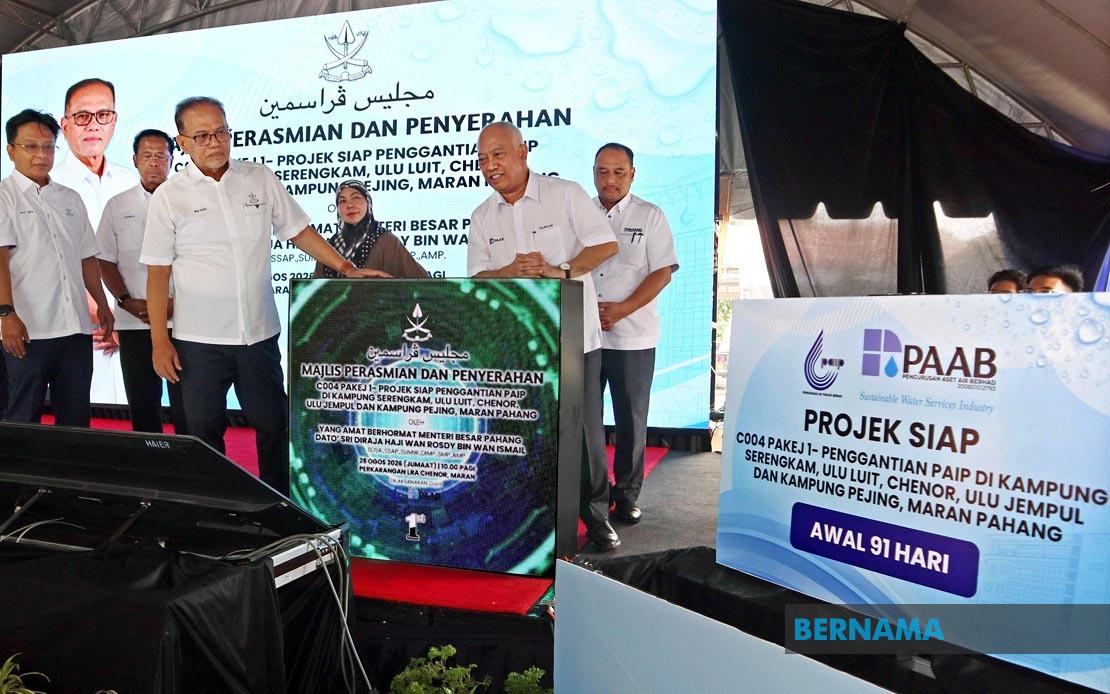
The Pahang government is moving forward with plans to tackle a persistent environmental challenge that has constrained economic activity and livelihoods along the Sungai Pahang, particularly in affected settlements such as Kampung Pesagi in Maran. Menteri Besar Datuk Seri Wan Rosdy Wan Ismail outlined the state's measured approach during a visit to inaugurate a completed water infrastructure project, signalling the administration's commitment to addressing the issue through evidence-based policymaking rather than rushed remedial action.
The pathway to resolution centres on obtaining a thorough diagnostic assessment from relevant authorities examining the river's current condition across the affected localities. This foundational step is essential for determining the underlying causes of the shallow-water phenomenon and evaluating which interventions will prove most effective. The Menteri Besar indicated that district-level officials have been tasked with compiling detailed data that will feed into executive council deliberations, ensuring decisions benefit from rigorous scrutiny before implementation commences.
Wan Rosdy acknowledged that the shallow Sungai Pahang represents more than an environmental concern; it undermines the economic viability of communities dependent on the waterway for transportation, commerce, and livelihoods. Recognising this broader impact, the state government has committed to developing a phased intervention strategy spanning short-term, medium-term, and long-term horizons. This tiered approach reflects an understanding that some immediate measures may provide relief whilst longer-duration projects address root causes of the problem.
The decision to ground policy responses in comprehensive analysis marks a departure from ad-hoc interventions that sometimes characterise regional infrastructure responses. By requiring detailed examination and exco-level review before action, Pahang's leadership is attempting to avoid committing substantial resources to solutions that might prove ineffective or inadequately targeted. This methodical process, whilst potentially frustrating to affected residents, acknowledges that poorly conceived remediation can waste public funds and generate unintended ecological consequences.
Simultaneously, the state government is advancing complementary infrastructure developments that underscore its broader vision for regional development and connectivity. The water supply pipe replacement programme, which has achieved resolution rates exceeding 90 per cent across four districts, demonstrates progress on fundamental utility challenges. Maran district, where the Menteri Besar visited the Chenor Water Treatment Plant, is expected to join this success cohort, addressing long-standing complaints about water reliability in eastern Pahang communities.
Beyond water provisioning, the state is prioritising energy infrastructure development as a catalyst for economic transformation. A major Tenaga Nasional Berhad (TNB) project in Kampung Awah will establish a 500kV Transmission Main Intake Substation (PMU) at an estimated investment of approximately RM350 million, with completion targeted for 2030. This installation represents strategic infrastructure designed to strengthen the East Coast's electrical backbone and position Pahang as an increasingly attractive investment destination.
The energy infrastructure initiative carries particular significance for Southeast Asia's broader economic integration. By enhancing transmission capacity across the East Coast corridor, the substation project will enable more efficient power distribution to industrial zones, manufacturing hubs, and emerging economic clusters throughout the region. For Malaysia's manufacturing and processing sectors, reliable and robust energy systems represent critical competitive advantages in attracting multinational operations and supporting domestic enterprises.
Wan Rosdy framed infrastructure development as integral to Pahang's economic acceleration strategy, directly linking capital investments in utilities and energy to job creation and improved living standards. This narrative reflects the state government's understanding that addressing immediate service deficiencies whilst simultaneously attracting investment requires demonstration of governmental competence and commitment to modernisation. Communities experiencing water shortages or living near underdeveloped rivers gain confidence when administrators simultaneously advance high-profile infrastructure projects.
The shallow Sungai Pahang issue exemplifies challenges facing many Southeast Asian river systems affected by sedimentation, altered rainfall patterns, and competing demands on water resources. Pahang's approach of commissioning detailed assessments before implementing solutions offers instructive lessons for other jurisdictions confronting similar environmental constraints. The interconnection between water accessibility, energy security, and economic competitiveness increasingly defines development trajectories across the region.
For Malaysian policymakers, the Pahang example underscores the necessity of integrating environmental management with economic development planning. Solutions targeting the shallow-water issue must account for potential impacts on water supply, agricultural requirements, transportation, and ecological systems. The multi-year timeline for the TNB substation project and the ongoing pipe replacement initiative suggest that Pahang's leadership recognises transformative infrastructure requires sustained commitment and patient capital deployment.
The state's willingness to invest in detailed pre-decision analysis, whilst potentially extending timelines, demonstrates institutional maturity. Regional governments that rush into expensive infrastructure modifications without adequate preparatory work often discover that solutions require expensive retrofitting or prove incompatible with other systems. Pahang's methodical approach, whatever frustrations it may generate among affected communities, positions the state to implement durable interventions addressing the Sungai Pahang challenge whilst maintaining compatibility with ongoing water supply and economic development initiatives.
Looking forward, the success of these initiatives will depend partly on whether the anticipated investment effects materialise. The RM350 million TNB project must actually attract industrial investment and expand the state's economic base rather than simply absorbing capital without generating proportionate employment or tax revenues. Similarly, resolved water supply issues must translate into improved living conditions and enhanced business activity for residents across Maran and surrounding districts. These outcomes remain contingent upon complementary investments in skills training, business support services, and market connectivity that enable communities to fully leverage improved infrastructure access.

