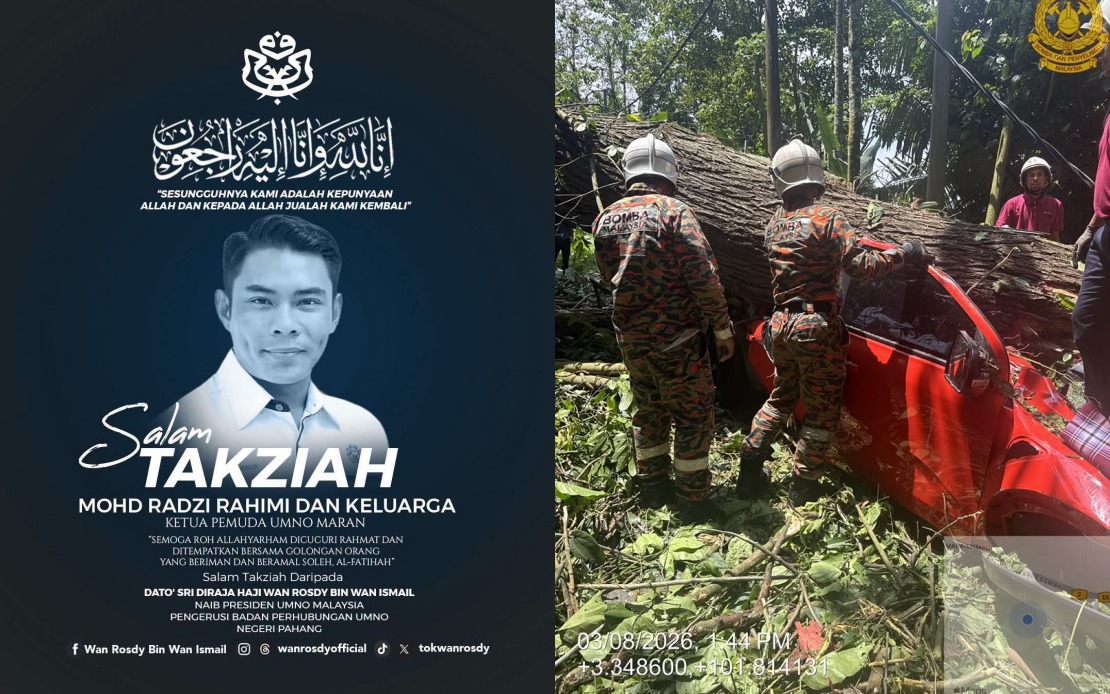
Pahang Menteri Besar Datuk Seri Wan Rosdy Wan Ismail has paid tribute to the late Mohd Radzi Rahimi, the Maran UMNO Youth chief who was killed in a tree-falling incident on the old Kuala Lumpur-Bentong road near Janda Baik on August 3. Speaking from Temerloh, Wan Rosdy characterised the deceased as a devoted leader whose primary concern was always the wellbeing of those he served, emphasising that Mohd Radzi—commonly known as Edy Radzi—consistently prioritised the needs of his community above all other considerations.
The fatal accident claimed four lives in total when a towering tree fell onto a four-wheel-drive vehicle travelling along the rural stretch of road. Besides Mohd Radzi, those who perished in the tragedy included Nuriani Mohammad Jafri, her son Muhammad Rizz Hazim, and her younger brother Mohammad Nizam. A child travelling with the group sustained injuries but survived the incident, which struck without warning on what was otherwise an ordinary afternoon. The sudden nature of the disaster has sent shockwaves through Pahang's political establishment and the broader UMNO grassroots network.
Wan Rosdy, who chairs the Pahang UMNO Liaison Committee in addition to holding the state's top administrative post, described the loss as profound and far-reaching. The Menteri Besar stressed that Mohd Radzi's absence would be acutely felt not only by his immediate family members but across multiple layers of the party structure—from the Maran division at the constituency level to the wider Pahang UMNO Youth movement and the state liaison committee itself. His remarks reflect the significant role Mohd Radzi held within UMNO's organisational hierarchy and the networks he had cultivated throughout Pahang's political landscape.
In addressing the tragedy through a Facebook post, Wan Rosdy extended formal condolences to all families affected by the incident, offering prayers for their resilience during what he acknowledged as an exceptionally trying period. His public statement served not merely as an expression of personal grief but as a formal gesture from the state leadership, underscoring the institutional recognition of Mohd Radzi's contributions to UMNO and to Pahang more broadly. The use of religious language in the condolence—invoking Allah's mercy and the deceased's place in the hereafter—reflects the cultural and spiritual dimensions through which Malaysian political leaders typically frame such losses.
UMNO Youth national chief Datuk Dr Muhammad Akmal Saleh also issued his own condolences, praying for the forgiveness of Mohd Radzi's sins and the acceptance of his charitable works. This parallel statement from the national youth wing hierarchy underscores the significance of Mohd Radzi's position within UMNO's youth structure and the wide network of relationships he maintained at different tiers of party organisation. The national-level acknowledgment suggests that Mohd Radzi had made sufficient impression to warrant recognition from figures beyond Pahang's borders, a testament to his engagement in party activities and his reputation among peers.
The incident near Bentong represents a stark reminder of the unpredictability of road travel in Malaysia, particularly along older routes that traverse forested or semi-rural terrain. The Janda Baik area, situated along the winding path between Kuala Lumpur and Bentong, is known for its scenic highland environment but also for weather conditions that can render trees unstable. Fallen trees and debris-related accidents have claimed lives on Malaysian roads intermittently, especially during monsoon seasons or periods of heavy rainfall, though the exact meteorological conditions at the time of this particular incident have not been detailed in available reports.
Mohd Radzi's role as Maran UMNO Youth chief placed him at the forefront of party mobilisation efforts at the divisional level, a position that typically involves organising grassroots activities, mentoring younger party members, and serving as a conduit between national party directives and local implementation. Youth wings within UMNO have historically served as incubators for future party leadership, with youth chiefs often progressing to more senior roles within the party structure. The loss of Mohd Radzi therefore represents not merely the removal of a current office-holder but the potential foreclosure of a developmental pathway that might have led to his further advancement within UMNO's ranks.
The characterisation of Mohd Radzi as a people-centred leader by Wan Rosdy aligns with the broader rhetoric that UMNO leadership typically employs when commemorating members who have distinguished themselves through community engagement. In the Malaysian political context, such tributes often emphasise accessibility, responsiveness to constituent concerns, and a perceived willingness to engage directly with ordinary citizens rather than remaining aloof from grassroots realities. Whether formally documented or not, these attributes have become part of the narrative framework through which successful local politicians build their legacies within party structures and public perception.
The accident has occurred at a moment when political organisations across Malaysia remain active in grassroots mobilisation and engagement, particularly in the lead-up to potential electoral contests. The loss of an engaged youth leader like Mohd Radzi represents a disruption to established networks and organisational momentum that will require time and deliberate effort to rebuild. UMNO's youth movement, which has faced criticism in recent years regarding the engagement and retention of younger members, may feel the absence of dedicated mid-level leaders who bridge the gap between party brass and the rank-and-file.
The broader implications of this tragedy extend beyond UMNO's internal structures to encompass road safety discourse in Malaysia. While individual tree-falling incidents may appear random and unavoidable, patterns of infrastructure maintenance, vegetation management along major thoroughfares, and emergency response protocols remain subjects of ongoing national conversation. The old Kuala Lumpur-Bentong road, whilst no longer the primary arterial route due to the existence of alternative highway connections, still carries significant traffic and remains part of the broader transportation network serving Pahang's residents and visitors to highland areas.

