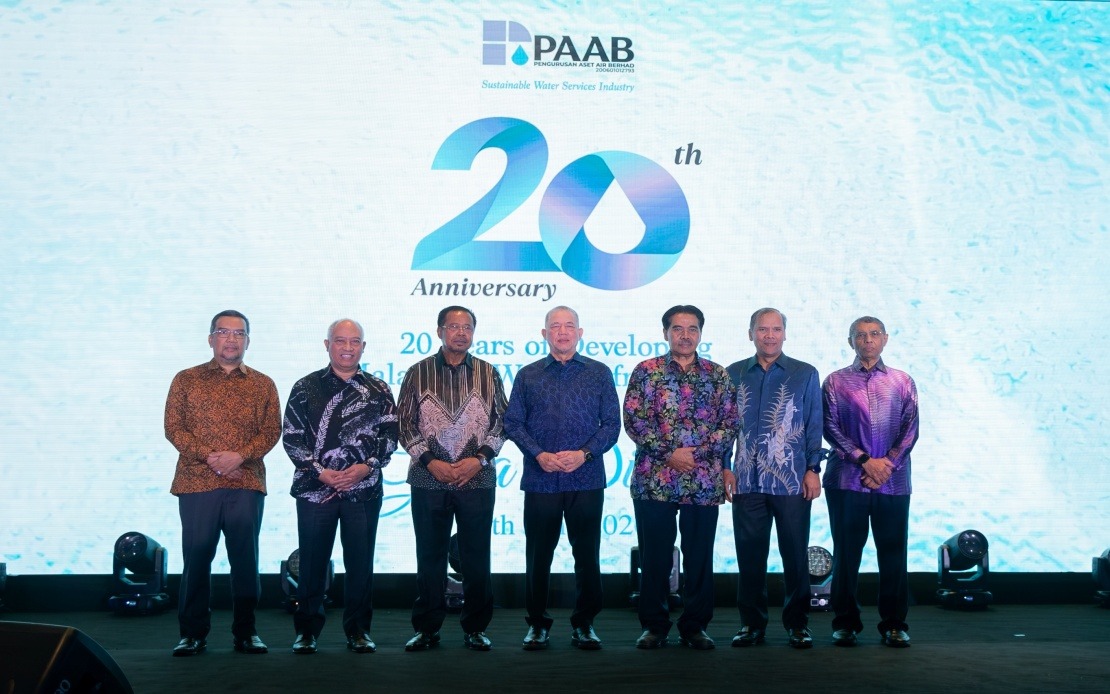
Pengurusan Aset Air Berhad (PAAB), the government-owned entity tasked with managing Malaysia's water industry transformation, has marked two decades of operational achievement since its establishment on May 5, 2006. The anniversary underscores the organisation's pivotal role in restructuring the national water services landscape and enhancing supply security across the country. Over the past 20 years, PAAB has become instrumental in channelling substantial capital toward modernising water infrastructure, positioning itself as a cornerstone of Malaysia's public infrastructure development strategy.
The scale of PAAB's financial commitment to the water sector is substantial. The organisation has financed the takeover of industry loans worth RM23.04 billion whilst simultaneously investing RM23.84 billion directly into infrastructure projects. Combined, these figures represent total financing and investments reaching RM46.88 billion, reflecting a long-term institutional commitment to addressing the country's water supply challenges. This dual mechanism of debt assumption and direct capital deployment has enabled water operators across Malaysia to access the financing required for essential upgrades without bearing the full burden themselves.
Progress under the National Water Services Industry Restructuring Plan has accelerated notably, with 10 states now formally committed to the transformation framework as of December 2025. Several major infrastructure milestones illustrate the tangible results of this strategic initiative. Twenty-one new water treatment plants with combined daily capacity of 2,085 million litres have been constructed, representing a significant expansion of the nation's production capability. Additionally, 42 storage tanks with cumulative capacity of 783 million litres have been installed to improve distribution resilience, whilst 3,263 kilometres of pipeline network have been upgraded or newly laid across the country. These physical assets represent the backbone of improved water service delivery to millions of Malaysian households and industrial users.
Deputy Prime Minister Datuk Seri Fadillah Yusof, who holds the Energy Transition and Water Transformation portfolio, officiated PAAB's anniversary dinner at Menara Felda Platinum Park in Kuala Lumpur. His remarks during the event revealed an urgent dimension to Malaysia's water crisis that extends beyond infrastructure investment. Fadillah highlighted that non-revenue water losses, which occur through leakage, theft, and metering inaccuracies, currently stand at approximately 40 per cent nationwide. This staggering figure means that nearly two-fifths of treated water never reaches paying customers, representing both an environmental waste and a financial drain on the water utility system.
The Deputy Prime Minister emphasised that addressing the non-revenue water challenge cannot wait for the completion of long-term strategic plans extending to 2050. Despite ongoing infrastructure improvements, the 40 per cent loss rate persists, indicating that construction of new treatment plants alone will not resolve the underlying system inefficiencies. Instead, Fadillah called for coordinated, immediate intervention involving all federal agencies and state governments. His framing of this issue as one requiring urgent action signals recognition that Malaysia's water sector faces mounting pressure from multiple directions, necessitating tactical responses rather than purely long-term planning horizons.
Context for this urgency lies partly in Malaysia's ambitions to attract substantial foreign investment in emerging high-growth sectors. Data centres have emerged as a particularly important target for inbound investment, given their alignment with digital economy objectives and their capacity to generate high-value employment. However, data centre operations demand reliable, consistent access to large quantities of water for cooling purposes. Concurrently, the energy-intensive nature of these facilities requires equally stable power supply. Without confidence in the stability of Malaysia's water infrastructure, investors may direct capital toward competing jurisdictions offering greater service reliability. Thus, the water sector restructuring effort has taken on strategic economic dimensions extending well beyond domestic consumer needs.
PAB Chairman Datuk Seri Jaseni Maidinsa outlined the organisation's implementation framework during the anniversary event. The National Water Services Industry Restructuring Plan operates according to a phased timeline spanning four decades. The Migration phase, running from 2008 to 2020, involved the foundational shift toward the restructured model. The current Stabilisation phase, scheduled for 2021 to 2030, aims to consolidate gains and ensure steady-state operations across the transformed system. Subsequent Consolidation (2031–2040) and Full Cost Recovery (2041–2050) phases will progressively deepen the transformation, ultimately positioning operators to recover the full economic cost of providing water services without ongoing government subsidies.
The RM23.84 billion capital expenditure breakdown reveals where PAAB's investment focus currently lies. Of this sum, RM8.33 billion has already been deployed toward completed projects that have been handed over to water operators for ongoing management and revenue generation. A further RM1.84 billion remains committed to projects actively under construction, which are expected to deliver capacity within the planning horizon. However, the largest allocation—RM13.67 billion—remains committed to projects in design and planning phases, indicating that the infrastructure modernisation programme has substantial pipeline of future developments. This distribution suggests that PAAB expects material capital deployment to continue well into the current decade as projects progress from planning through construction to commissioning.
Beyond the numerical metrics of financing and asset volumes, PAAB frames its success through the lens of public impact. The organisation measures achievement not merely by the quantity of capital deployed or the number of treatment plants constructed, but by the tangible improvements in water supply stability, quality, and cleanliness experienced by Malaysian households and businesses. This outcome-focused perspective acknowledges that infrastructure without reliable service outcomes represents incomplete progress. The increasing participation of additional states in the restructuring plan, coupled with operational improvements in existing participating jurisdictions, suggests that the model is generating sufficient results to command broader political and administrative support.
The presence of senior government officials at the anniversary dinner, including National Water Services Commission (SPAN) leadership and Energy Transition and Water Transformation Ministry personnel, underscores the political priority assigned to water sector transformation. The attendance of Datuk Seri Mad Zaidi Mohd Karli, the ministry's secretary-general, reflects the centralised importance of water policy within government administration. This high-level engagement indicates that whilst PAAB operates as a financial and administrative institution, its mandate remains tightly integrated with broader government objectives around infrastructure development, economic competitiveness, and public service delivery.
For Malaysian businesses and investors, the PAAB milestone carries several implications. The expansion of treatment capacity and pipeline networks translates directly into improved water security for industrial operations, particularly those with significant consumption requirements. The demonstrated progress over 20 years provides some confidence that the restructuring trajectory will continue. However, Fadillah's warnings about non-revenue water losses and the need for immediate coordinated action suggest that water security remains a work in progress. Businesses operating in water-intensive sectors should anticipate continued infrastructure development and potential service improvements, but should also plan for possible short-term supply disruptions as systems transition toward the restructured model. The investment trajectory outlined by PAAB indicates sustained capital commitments to water infrastructure through at least 2050, suggesting that opportunities will persist for suppliers and contractors engaged in water sector development.

