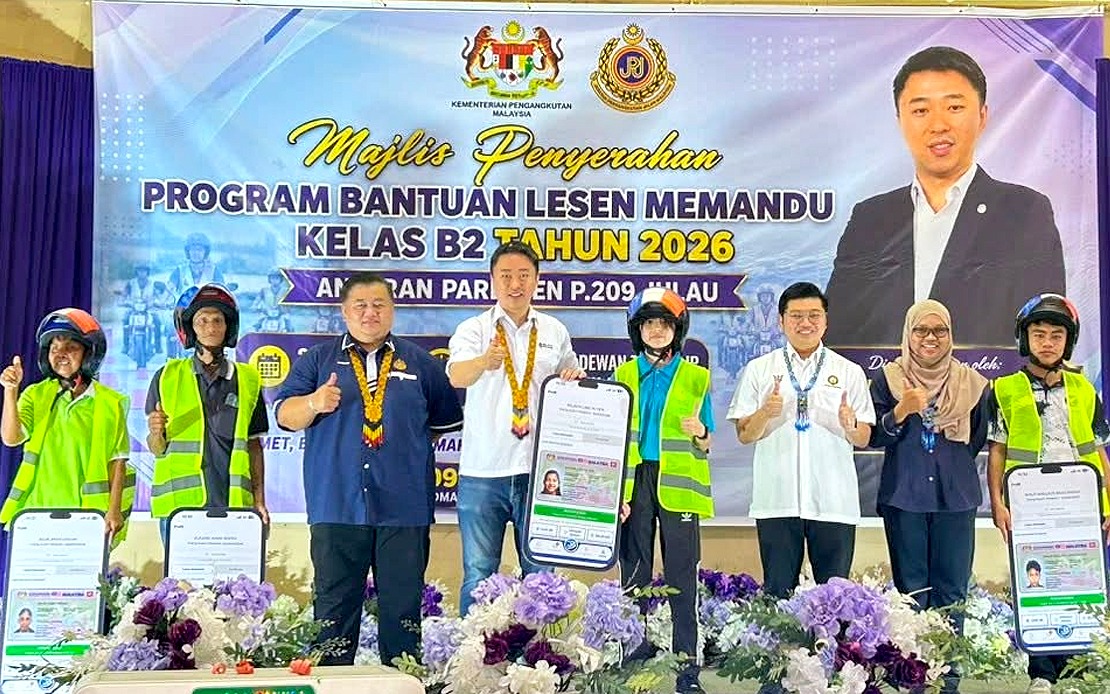
A landmark driving licence initiative in Sarawak's Julau parliamentary constituency has concluded successfully, with over 885 rural residents now holding valid Class B2 Probationary Driving Licences after participating in the Driving Licence Assistance Programme. The scheme, which closed recently at the Julau Closed Stadium in Sarikei, represents a significant step towards regularising motorcycle use in farming communities while providing tangible financial relief through access to subsidised petrol rates. The programme was officially closed by Julau MP Datuk Larry Sng Wei Shien, who chairs the Malaysian Timber Industry Board, alongside Sarawak Road Transport Department director Norizan Jili, underscoring the initiative's importance to regional governance.
For residents of remote settlements across the Julau constituency, the absence of valid driving credentials has represented a persistent practical and financial obstacle. Many agricultural workers and smallholders depend on motorcycles as their primary transportation to reach orchards, oil palm plantations, and market centres scattered throughout the interior, yet lacked the formal documentation required to purchase fuel at government-subsidised rates. This gap forced them to purchase fuel at significantly higher commercial prices, compounding the cost burden of agricultural livelihoods already characterised by thin margins and volatile commodity prices. The assistance programme directly addresses this systemic disadvantage by removing bureaucratic barriers to obtaining motorcycling endorsements.
Bajik Undum, aged 57, from Rumah Ajau in Ulu Kuntau, Pakan, exemplifies the programme's real-world impact. Previously unable to access subsidised petrol supplies due to her lack of a valid licence, Undum relied on her motorcycle to travel to her orchard and transport agricultural produce—work that required regular fuel purchases at premium rates. With her new licence, she has immediately become eligible for subsidised petrol, a seemingly modest change that translates into measurable weekly savings on transport costs. As the oldest female participant in the 2026 cohort, Undum's experience reflects how licensing gaps disproportionately affect older residents and women in rural areas, populations that frequently face additional barriers to regulatory compliance.
Kudang Jenggi, the programme's oldest male participant at 64 years old, works as a caretaker at a bird's nest facility in Bayong, Sarikei, and similarly relies on his motorcycle for daily work commutes and personal errands. Beyond the financial advantages of subsidised fuel access, Kudang emphasised the psychological benefit of holding a valid licence—the confidence that comes from legal compliance and the absence of anxiety when encountering police roadblocks. This dimension of the programme extends beyond economics into dignity and social integration; rural residents often experience heightened vulnerability to enforcement activities, and regularisation addresses both practical legal exposure and the psychological strain of operating outside regulatory frameworks.
Daniel Padong, aged 45, operates a smallholding in the oil palm sector and depends entirely on his motorcycle for daily access to his plantation. Rising petrol prices have directly compressed his household budget and reduced farm profitability, making the fuel subsidy qualification particularly crucial for his economic viability. By securing a licence through the assistance programme, Padong has lowered his daily operational costs and improved his ability to sustain agricultural production in a commodity sector increasingly vulnerable to price volatility and input cost inflation. His case illustrates how regulatory access directly impacts agricultural productivity and rural income security.
The programme's design reflects an understanding that rural populations, particularly in Malaysian Borneo, often face distinct barriers to regulatory compliance that differ from urban contexts. Geographic remoteness, limited access to licensing centres, and the practical challenges of travelling to administrative facilities create structural disadvantages that reduce licensing uptake among legitimate users. By bringing the driving licence assistance scheme to communities directly, the initiative reduces these friction points and recognises that compliance barriers often stem from accessibility rather than resistance or disinterest among residents.
Subsidised fuel access represents a cornerstone of Malaysian rural policy, designed to mitigate transportation cost burdens that otherwise undermine agricultural viability and rural economic participation. However, access to this subsidy mechanism requires valid documentation—a requirement that inadvertently excludes significant populations of legitimate motorcycle users who simply lack the formal credentials. By processing 885 residents through the assistance programme, authorities have effectively integrated a substantial cohort of previously unregistered riders into the formal regulatory system while simultaneously extending subsidy eligibility. This dual outcome strengthens both road safety compliance and the distributional effectiveness of fuel subsidy programmes.
The Julau constituency, encompassing dispersed rural settlements and interior communities, presents particular administrative challenges for licensing initiatives. The parliamentary seat's geographic composition—featuring communities such as Rumah Ajau, Ulu Amot, and Bayong spread across considerable distances—necessitates creative approaches to service delivery. The decision to establish a comprehensive licensing assistance programme within the constituency, rather than requiring residents to travel to distant urban centres, reflects pragmatic governance responsive to rural realities. This model potentially offers a template for other remote parliamentary constituencies across Malaysia and Southeast Asia facing similar regulatory access challenges.
The presence of senior officials at the programme's closing ceremony—including the local MP and state-level transport authorities—signals political commitment to formalising rural transport systems and ensuring equitable access to subsidies. Such high-level engagement validates the programme's significance and suggests potential for expansion or replication. Rural constituencies across Sarawak and peninsular Malaysia contain comparable populations of motorcycle-dependent workers lacking formal driving credentials, indicating substantial latent demand for similar assistance initiatives.
Beyond immediate financial benefits, the licensing programme generates broader public safety outcomes. Riders with valid licences are more likely to maintain insurance compliance, observe traffic regulations, and participate in road safety awareness initiatives. By transitioning 885 rural residents from unregistered to formally documented status, the programme contributes to more comprehensive road safety data, improved accident accountability, and stronger insurance protections for affected communities. Rural road safety represents a persistent challenge in Malaysian contexts, where fatality rates often exceed urban benchmarks; formalising the motorcycle-using population creates foundation for more targeted safety interventions.
For agricultural-dependent communities across the region, such initiatives address structural inequalities embedded within rural livelihood systems. The cost of fuel represents a significant proportion of smallholder production expenses, particularly for those engaged in interior commodity farming. When regulatory barriers prevent access to subsidised rates, smallholders become economically disadvantaged relative to better-resourced competitors in more accessible regions. The Julau programme helps correct this inequity by ensuring that geographic remoteness and administrative accessibility do not perpetually exclude farmers from policy benefits designed to support rural viability.

