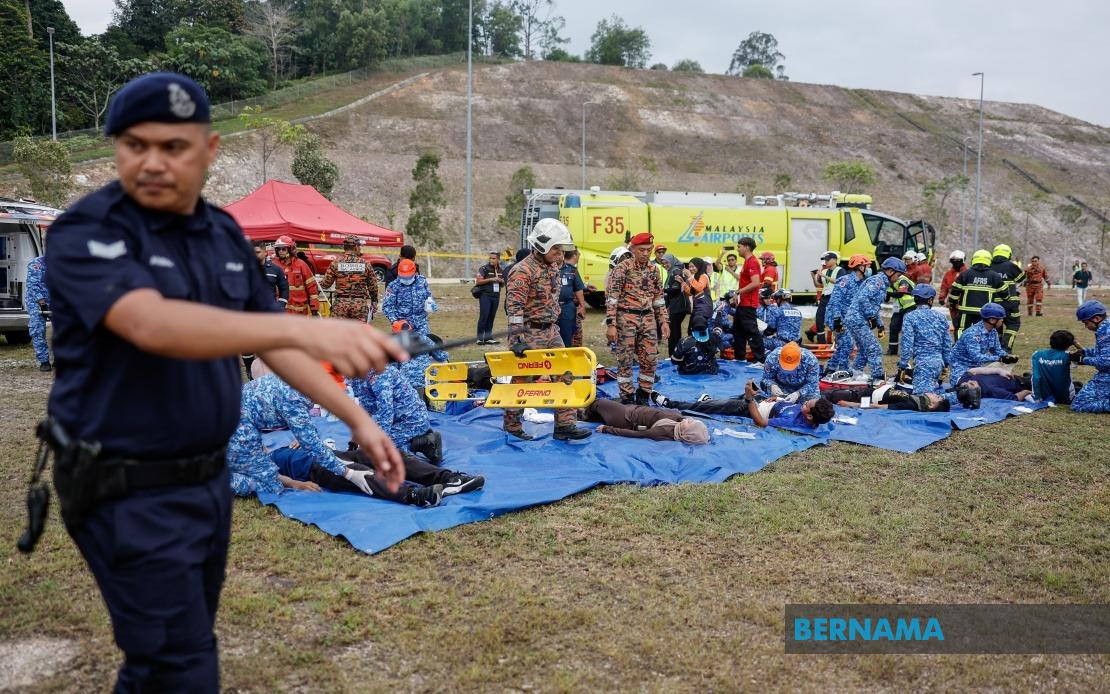
In a significant test of Malaysia's aviation emergency preparedness, over 20 government and private-sector agencies converged on the Denai Alam Rest and Service Area along the Damansara-Shah Alam Elevated Expressway on July 16 for Ex Urban Falcon 2026, a comprehensive air disaster simulation. The exercise marked the first occasion where Malaysian authorities conducted a full-scale emergency response drill centred on an aircraft accident occurring well beyond airport perimeter, introducing complexity and real-world challenges that previous exercises had largely circumvented.
The simulation depicted an ATR72 aircraft disaster approximately six kilometres from Sultan Abdul Aziz Shah Airport in Subang. Muhammad Hidayat Ismail, general manager of Airport Fire and Rescue Services, explained that the fundamental purpose was validating Malaysia Airports Holdings Berhad's capacity to harmonise emergency operations across multiple responding organisations under conditions specified in the aerodrome emergency plan. This operational framework becomes particularly critical when incidents unfold outside airport confines, where coordination procedures differ substantially from established protocols refined through decades of on-site drills.
According to the National Aeronautical Search and Rescue Manual, AFRS maintains responsibility across an eight-kilometre radius from airport midpoint, extending significantly beyond the immediate airport zone. Muhammad Hidayat emphasised that conducting disaster drills beyond this traditional boundary was essential for genuine readiness, as agencies frequently trained exclusively near airport peripheries where infrastructure and accessibility remained optimal. The choice of location along a major expressway corridor with multiple toll plazas and narrow approach roads deliberately introduced logistical obstacles that response teams would inevitably encounter in genuine emergencies.
Navigating traffic infrastructure and ensuring rapid scene arrival emerged as the primary operational challenge identified during the drill. Emergency responders had to coordinate movement across toll systems and narrow roads under time pressure, reflecting authentic scenarios where minutes determine survival outcomes. This constraint highlighted gaps in pre-positioned resources and routing protocols that comfortable airport-proximity exercises would never expose, making the exercise invaluable for identifying operational vulnerabilities before actual incidents occur.
Responding personnel demonstrated technical competence, executing firefighting and rescue operations according to established procedures with apparent proficiency. However, Muhammad Hidayat stressed that today's exercise provided a foundation for systematic improvement rather than confirmation of complete readiness. The lesson from directing this operation was that rare testing of off-airport scenarios meant accumulated experience remained thin, particularly regarding coordination during disasters that challenge even optimal response capabilities.
A critical distinction separates off-airport crashes from airport-centred incidents: survival probabilities diminish substantially when aircraft impact uneven terrain distant from specialised facilities. Victims facing rough ground, vegetation, and structural obstacles often sustain injuries incompatible with survival, a grim reality that shapes rescue prioritisation and victim identification operations. The exercise demonstrated that response teams must anticipate casualty scenarios where survivors represent minorities rather than majorities, fundamentally altering medical triage protocols and disaster victim identification procedures that Royal Malaysia Police coordinate across responding agencies.
Disaster Victim Identification operations assume heightened complexity when crash sites sprawl across difficult terrain, complicating systematic victim location and processing. The drill revealed that coordinating DVI efforts across multiple agencies working simultaneously within confined spaces and challenging environmental conditions demands protocols refined through practice. Regular exposure to realistic scenarios helps teams establish communication hierarchies, equipment positioning, and personnel rotation strategies that collapse under genuine catastrophe pressure if never previously rehearsed.
Technologically, Malaysia's aviation disaster response capabilities reflect contemporary standards. AFRS operates aircraft firefighting vehicles designed to international specifications mandated by the International Civil Aviation Organisation and the Civil Aviation Authority of Malaysia, ensuring equipment meets global benchmarks. Yet technology alone cannot compensate for coordination failures or logistical breakdowns. The exercise validated that mechanical readiness must couple with organisational preparedness, where human factors and inter-agency dynamics determine actual operational effectiveness during high-stakes situations.
The drill assembled 450 participants from critical public and private-sector organisations, representing a substantial portion of Malaysia's aviation emergency response apparatus. This scale of participation enabled testing not merely isolated agency performance but the intricate interdependencies that characterise multi-organisation disaster response. The strategic partnership uniting Malaysia Airports Holdings, the National Disaster Management Agency, the Selangor state government, and PROLINTAS-DASH demonstrated recognition that aviation safety transcends individual organisational boundaries, requiring integrated planning across traditionally separate operational spheres.
Following the exercise, authorities scheduled a comprehensive review workshop for July 26 and 27 to analyse findings and formulate improvement recommendations. This structured follow-up process distinguishes serious preparedness efforts from symbolic training, ensuring that operational insights translate into procedural refinements. Muhammad Hidayat indicated that systematic analysis would strengthen coordinated disaster response frameworks, addressing vulnerabilities identified during the drill before actual emergencies test these procedures with genuine consequences.
The broader significance of Ex Urban Falcon 2026 extends beyond immediate operational improvements. By demonstrating sustained inter-agency commitment to aviation disaster preparedness through realistic scenario testing, Malaysia reinforces public confidence in its civil aviation safety infrastructure. Disasters inevitably occur despite prevention efforts; societies judge aviation safety partly by emergency response excellence. This exercise represents tangible evidence that Malaysian authorities recognise off-airport accident risks, invest resources in realistic preparedness testing, and maintain systematic frameworks for continuous improvement. Such visible commitment to readiness helps sustain public trust that should catastrophe strike, response capabilities would reflect professional standards commensurate with Malaysia's status as a major regional aviation hub.

