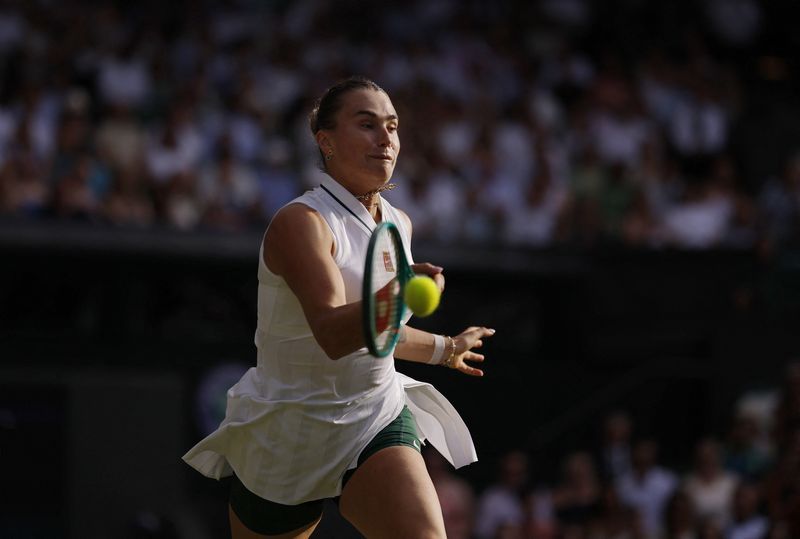
The women's singles championship at Wimbledon took a dramatic turn on Centre Court on Sunday when 14th seed Naomi Osaka dismantled world No. 1 Aryna Sabalenka with a commanding 6-2, 7-6 display that stands as her most significant triumph since resuming her professional career following maternity leave. The victory marked a seismic shift in the tournament trajectory, with Osaka advancing to her first Wimbledon quarter-final while simultaneously extinguishing the hopes of the tournament's top seed and fundamentally altering the women's draw.
The match delivered a curious narrative arc, beginning as a lopsided affair that disappointed spectators expecting a closer encounter. Osaka's dominance in the opening set proved almost suffocating, with Sabalenka's trademark power game completely neutralised during a ruthless 32-minute opening stanza. The world No. 1 found herself visibly frustrated, her attempts to generate pace and rhythm consistently thwarted by Osaka's superior positioning and clean striking. The contrast between the player-seeding and actual performance could hardly have been starker, as the crowd watched the favoured Sabalenka struggle to impose her game on a composed opponent.
The second set proved considerably more competitive, with Sabalenka demonstrating the resilience that has carried her through three consecutive Wimbledon semi-finals. Yet even as she matched Osaka's intensity and forced a tiebreak, the momentum remained firmly with the Japanese challenger. In the deciding points, Osaka revealed the mental fortitude that underpinned her return to competitive tennis, maintaining composure while dismantling Sabalenka's remarkable streak of 21 consecutive tiebreak victories at Grand Slam tournaments. The older competitor's frustration boiled over after squandering a match point, with her reaction so forceful that she struck a ball with sufficient violence to send it sailing completely out of the stadium.
Osaka's resurrection as a force in tennis has captured widespread attention since her return to the professional circuit in 2024, yet this victory represents a qualitative leap in her competitive recovery. The 26-year-old has meticulously rebuilt her career while managing the demands of motherhood, with her daughter Shai now a constant presence in her world. This triumph constitutes her largest scalp since that return, demonstrating that her tennis acumen has not diminished during her absence from full-time competition. Her visible enjoyment during and immediately after the match suggested that the simple pleasure of competing at the sport's highest level continues to drive her forward.
The broader implications for the women's tournament cannot be overstated. With defending champion Iga Swiatek eliminated in the third round on Saturday and second seed Elena Rybakina falling the same day, Sabalenka's exit leaves the draw without any of its three top seeds advancing beyond the fourth round. This unexpected pruning of established contenders transforms Wimbledon into a genuinely open competition, where unseeded players and lower-ranked challengers suddenly possess genuine pathways to the final. For a tournament accustomed to predictable progressions through the rounds, this democratic upheaval provides precisely the kind of narrative unpredictability that captures global sporting attention.
The contrasting trajectories of Osaka and Sabalenka reveal much about modern tennis and the sport's evolving competitive landscape. Both players have accumulated four Grand Slam titles apiece, yet their surfaces of dominance diverge significantly, with each claiming all their major victories on hardcourts. Born merely seven months apart, they have experienced markedly different career arcs. Osaka captured all four of her Grand Slams before Sabalenka claimed her first, creating an unusual chronological reversal in their respective peaks. Their meeting on Centre Court constituted merely their second encounter at a major championship, with eight years having elapsed since their previous Grand Slam meeting when Osaka prevailed at the 2016 U.S. Open en route to that first major title.
Osaka's serve returns emerged as the decisive technical weapon during Sunday's contest, with her positioning and timing consistently disrupting Sabalenka's rhythm from the opening moments. The Japanese player broke serve twice during the first set's one-sided progression, and her ability to neutralise one of modern tennis's most potent serving techniques speaks to the quality of her present form. Sabalenka attempted various motivational tactics—including striking her racket against her own head—but these psychological resets proved insufficient to stabilise her game against an opponent playing with absolute clarity and purpose.
The visual spectacle of the match extended beyond the tennis itself, as Osaka continued to generate conversation through her distinctive Japanese-inspired walk-on attire that has become a recognisable element of her courtside presence. Yet as observers noted, it is ultimately her tennis that has begun capturing more serious attention among the sport's cognoscenti and casual fans alike. The quality of execution displayed throughout Sunday's contest demonstrated that her time away from competition has only enhanced her ability to dissect opponents through intelligent shot selection and exceptional movement.
Osaka advances to face Czech 10th seed Karolina Muchova in the quarter-finals, a matchup that promises further competitive drama in an increasingly unpredictable women's tournament. Her comments in the immediate aftermath—acknowledging both her enjoyment during the match and her lingering disappointment at having lost directly to Sabalenka on three consecutive previous occasions—revealed the emotional investment she brings to professional tennis despite her previous sabbatical. For Malaysian and Southeast Asian tennis followers, Osaka's resurgence represents a powerful narrative about resilience, return, and the capacity to recalibrate competitive priorities without sacrificing on-court excellence.

