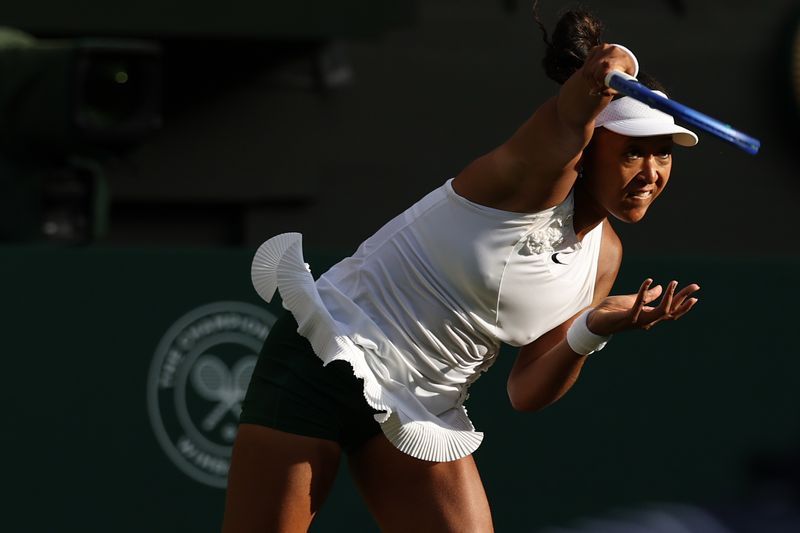
Naomi Osaka capped a striking week at Wimbledon by dismantling top seed Aryna Sabalenka in the fourth round, progressing to the quarter-finals for the first time with a commanding 6-2 7-6(2) victory on Centre Court. The Japanese 14th seed showcased the assertive, precise tennis that propelled her to four Grand Slam crowns, overwhelming a Sabalenka who appeared uncharacteristically out of sorts throughout the encounter.
Osaka's emphatic win represents her most significant scalp since returning from maternity leave in 2024, delivering a statement performance on the sport's most hallowed grass court. The unseeded player's arrival at the quarter-finals came just hours after she stepped onto Centre Court wearing a distinctive kimono-inspired walk-on outfit, a style homage to a character from Quentin Tarantino's Kill Bill film, signalling her intent to enjoy the occasion while remaining focused on the tennis itself.
The knockout of Sabalenka compounds an extraordinary upheaval in the women's draw, with defending champion Iga Swiatek and 2022 winner Elena Rybakina both falling in the third round. The elimination of the tournament's three highest-seeded women has now guaranteed that a ninth consecutive first-time Wimbledon champion will be crowned, further widening the competitive landscape at the All England Club. This unprecedented disruption at the top has opened the door for lesser-seeded players and wildcards to mount genuine title challenges.
The Osaka-Sabalenka collision held considerable intrigue given their shared pedigree: two 28-year-olds with four Grand Slam titles each, accumulated exclusively on hard courts. Their previous encounter in 2018 saw Osaka triumph en route to winning the US Open, yet nearly eight years separated their next meeting. When competition resumed between them in 2024, Sabalenka had claimed three consecutive victories over her Japanese rival, establishing herself as the clear favourite heading into this Wimbledon showdown. Those recent results proved irrelevant, however, as Osaka displayed the serene mastery that had characterised her Grand Slam-winning campaigns, leaving Sabalenka visibly frustrated throughout.
While observers anticipated a pyrotechnic display between two powerful baseline operators, Osaka's supremacy was such that expected theatrics never materialised. Instead, the Japanese player executed a masterclass in sustained aggression coupled with tactical discipline, dictating rallies and converting opportunities with clinical efficiency. Sabalenka's unforced error count mounted as her rhythm deteriorated, a stark contrast to her typically devastating ball-striking. Osaka would later reflect on the pleasure of competing at her peak, noting the redemptive satisfaction of reversing recent losing patterns against an opponent who had seemingly found her measure.
On the men's side, Novak Djokovic progressed to his 17th Wimbledon quarter-final despite admitting substantial discomfort during his fourth-round encounter against Russian qualifier Roman Safiullin. The 39-year-old Serbian champion secured a 7-6(6) 6-3 3-6 6-3 victory, yet confessed to feeling mechanical and disconnected throughout, prioritising the result over performance quality. His advancement carried historical weight: the match victory represented his 106th at Wimbledon, surpassing legendary Swiss great Roger Federer's previous record, though Djokovic's demeanour suggested little celebration accompanied the milestone.
Djokovic's comments in the post-match interview reflected a pragmatist's resignation to advancing through adversity rather than a champion savouring his trajectory. Relief characterised his emotional landscape far more than satisfaction or enjoyment, a mentality that often accompanies deep tournament runs where physical and mental resources deplete incrementally. Nevertheless, the victory positioned him one step closer to an eighth Wimbledon title that would equal the record held by William Renshaw and Pete Sampras, targets that motivated his participation despite the mounting toll of competition.
The path to potential semi-final redemption against defending champion Jannik Sinner requires Djokovic to overcome Canadian third seed Felix Auger-Aliassime in the quarter-finals. Auger-Aliassime advanced through an exhausting four-hour 26-minute marathon against Spain's Alejandro Davidovich Fokina, prevailing 6-7(4) 7-6(6) 6-3 6-7(2) 6-1 in a contest that concluded with heated verbal exchanges between the players at the net. The toll of such extended competition may prove significant for Auger-Aliassime's subsequent matches, though his ability to overcome a player ranked lower in seeds and quality suggests sufficient reserves remain.
Elsewhere in the men's draw, dramatic circumstances removed Poland's Hubert Hurkacz from contention when he was forced to retire during a fifth-set struggle against German veteran Jan-Lennard Struff. The latter's progression to the quarter-finals at age 36 marked a maiden Grand Slam last-eight appearance, a remarkable achievement for a player whose career had followed a less celebrated trajectory than many of his contemporaries. Struff's longevity and competitiveness at an advanced age underscores how grass-court expertise and tactical maturity can compensate for diminished physical attributes.
The women's American contingent demonstrated unexpected strength, with five representatives reaching the fourth round—the highest total since 2002. Fourth seed Jessica Pegula showcased veteran polish when she dispatched 18-year-old Iva Jovic 4-6 6-3 6-1 on Court One, demonstrating superior match management and experience against a youthful opponent. Pegula matched her previous best Wimbledon performance and positioned herself for another potential All-American clash should fellow American Coco Gauff overcome Switzerland's Belinda Bencic in subsequent matches.
Osaka's advancement sets up a quarter-final encounter with 10th seed Karolina Muchova, who earlier recorded a hard-fought 7-5 5-7 6-3 victory against 2024 champion Barbora Krejcikova. The Czech rivalry played out as a tactical battle rather than a display of unrelenting power, with momentum shifts and break opportunities defining the proceedings. Muchova's capacity to upset established expectations, demonstrated through eliminating the defending champion, suggests she possesses the tactical flexibility and fighting spirit necessary to provide Osaka with a genuine test.

