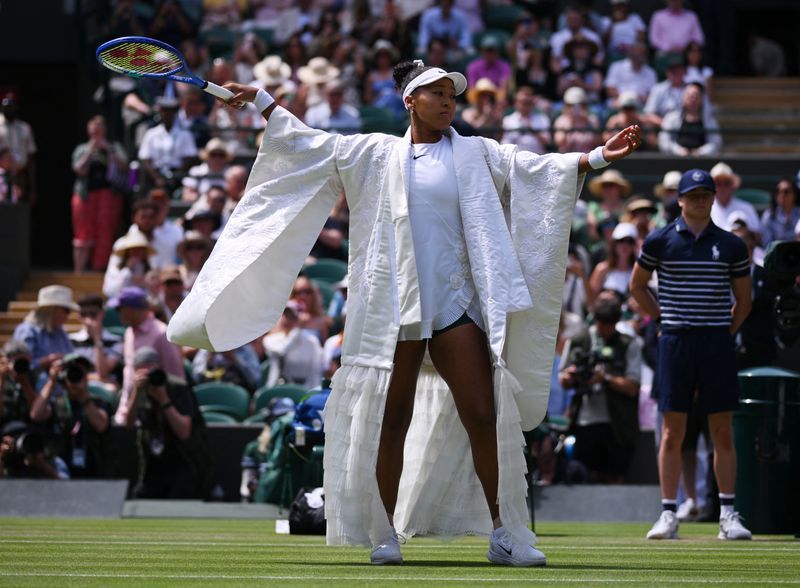
Naomi Osaka continued her impressive run at Wimbledon on Friday with a convincing victory over unseeded Daria Kasatkina, advancing to the tournament's last 16 for the first time in her career. The fourth-seeded Japanese champion produced a controlled and confident display on Court One to dismiss the Russian-born Kasatkina 6-1 6-3, marking a significant milestone in her relationship with the All England Club.
While Osaka has garnered considerable media attention throughout the opening week for her striking fashion choices — including a series of elaborate kimonos reminiscent of the film Kill Bill — her progression into the second week demonstrates that her tennis is now matching her sartorial presence. The four-times Grand Slam winner has deliberately cultivated an image as one of the sport's foremost style innovators, using the hallowed lawns of Wimbledon as a global stage for her creative expression. Yet increasingly, the focus is shifting toward what matters most in professional tennis: results on the court.
From the opening moments, Osaka established her authority over the encounter. She secured an early break in the second game through a powerful backhand winner, immediately following this with a deep and precise forehand stroke that allowed her to consolidate a double break. Racing through the first set in just 34 minutes against the afternoon sun on one of London's warmest days of the tournament, Osaka demonstrated the kind of controlled aggression that defines champions at grasscourt events. The surface's demands require a particular blend of power and finesse — qualities the Japanese champion showcased throughout the match.
Kasatkina, despite her seeding as an unseeded player, offered limited resistance to Osaka's onslaught. The Australian competitor struggled to find rhythm against an opponent who was clearly comfortable on grass and fully attuned to the pace required. Osaka's serving proved particularly effective, limiting the number of break-point opportunities her opponent could manufacture. The Japanese star's aggressive court positioning and willingness to attack both wings forced Kasatkina into defensive situations from which recovery proved impossible.
The second set initially suggested a tighter contest when Osaka squandered an early advantage, creating some hope for a Kasatkina comeback. However, the Japanese champion quickly reasserted her dominance, rallying to position herself with two match points. When the opportunity arose, Osaka executed with clinical precision, sealing the contest in emphatic fashion and demonstrating the mental resilience required to win significant matches at grand slam level. Her composure in critical moments has long been a hallmark of her championship pedigree.
Following her victory, Osaka addressed the Court One crowd with genuine appreciation, acknowledging that she had never previously won a match on this particular court surface at Wimbledon. Her comments highlighted the personal significance of the achievement. The 26-year-old spoke of feeling confident throughout the encounter and recognized the quality of her opponent's performance, demonstrating the sportsmanship and grace expected of players at this level of professional competition. Her demeanor suggested an athlete who has moved beyond merely participating in major tournaments and is now contending seriously for significant titles.
Osaka's pathway to the quarter-finals presents a fascinating matchup against either world number one Aryna Sabalenka or former French Open champion Jelena Ostapenko, depending on the outcome of their third-round clash. Both represent formidable obstacles, yet Osaka's current form suggests she possesses the tools to compete effectively against the sport's elite practitioners. Her success on grass courts over the past fortnight, culminating in a run to the Bad Homburg final before a retirement brought that campaign to a premature end, indicates she has rediscovered comfort on this surface.
The significance of Osaka's performance extends beyond the immediate context of Wimbledon. For Japanese tennis enthusiasts and Malaysian-based sports fans following Asian competitors, her progression provides encouragement that champions can effectively transition between surface types and different tournament formats. The grasscourt game demands distinct technical and tactical adjustments from hard-court specialists, and Osaka's capacity to make these adaptations successfully demonstrates the depth of her understanding of professional tennis.
Looking ahead, Osaka's comments about taking matches one day and one point at a time reflect a pragmatic approach to a tournament that rewards patience and consistency over extended periods. Rather than projecting far into the future, she remains focused on the immediate challenge before her. This mental discipline, combined with her obvious technical prowess and physical capabilities, positions her as a genuine contender for the crown during the second week of play. Her journey at Wimbledon 2024 represents not merely a career milestone but perhaps the beginning of a more sustained period of success on grasscourts.

