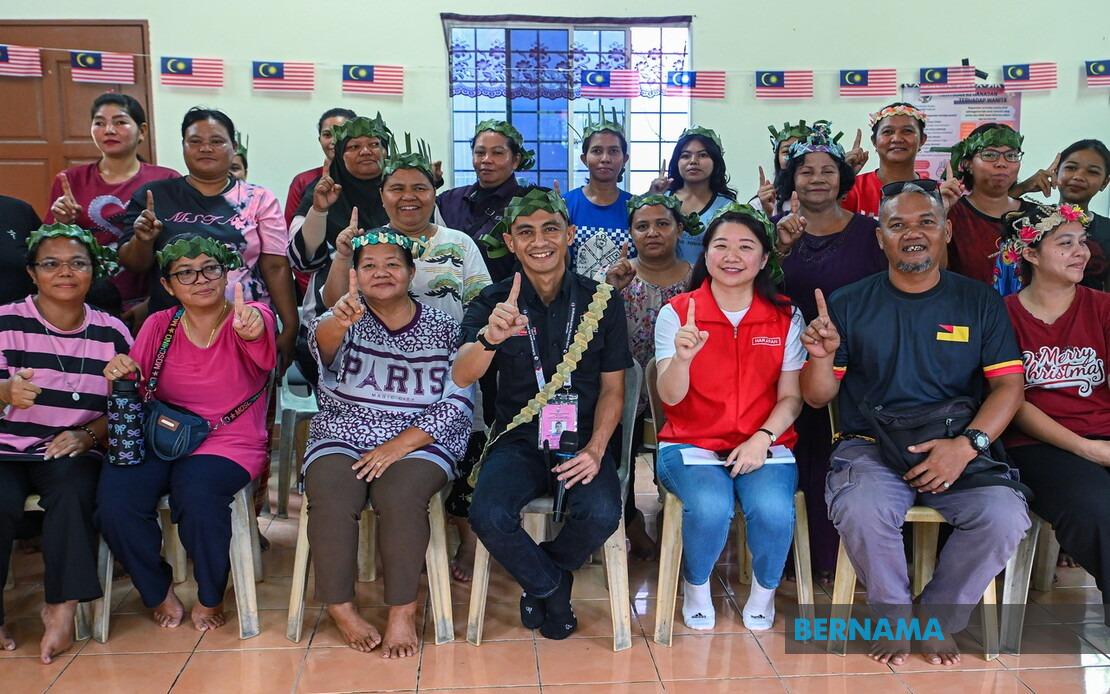
Datuk Ahmad Faez Abdul Razak, the Pakatan Harapan nominee for Labu, has positioned indigenous community advancement as a cornerstone of his campaign for the Negeri Sembilan state election. Speaking after attending an Orang Asli Women Empowerment programme in Kampung Orang Asli Tekir, the first-time contestant outlined an ambitious agenda centred on tangible improvements to living standards and economic participation within the indigenous settlement.
The candidate's platform reflects recognition of longstanding disparities affecting the Orang Asli population, who comprise roughly 150,000 individuals across Peninsular Malaysia but remain disproportionately marginalised economically. Ahmad Faez's approach goes beyond rhetorical commitments, detailing specific interventions designed to address infrastructure deficits that have historically constrained development in such communities. His pledge to champion customary land issues at the State Legislative Assembly represents a direct engagement with a contentious matter that has plagued indigenous communities for decades, where unclear tenure arrangements and encroachment have undermined both security and development prospects.
Infrastructure modernisation features prominently in the candidate's vision. The Labu constituency's Orang Asli villages currently lack adequate road networks and digital connectivity—fundamental prerequisites for economic participation in contemporary Malaysia. Ahmad Faez's commitment to upgrading these basic amenities addresses immediate quality-of-life concerns while simultaneously opening pathways to broader economic inclusion. Digital connectivity particularly carries strategic significance; it would enable residents to access online markets, participate in e-commerce, and acquire skills training remotely, transforming their economic prospects without requiring physical relocation.
Economic empowerment through skills development and targeted sector strategies forms another pillar of the campaign. Ahmad Faez identified handicraft production as a sector where Kampung Orang Asli Tekir residents possess innate capability but lack market access. Traditional crafts represent an authentic economic avenue aligned with indigenous cultural practices, and wider commercialisation through regional and national channels could generate sustainable income streams. Education and youth development receive complementary emphasis, acknowledging that demographic investment today yields medium and long-term returns across health, productivity, and social stability indicators.
Agricultural modernisation constitutes an innovative dimension of the development framework. By introducing fertigation systems—precision irrigation combined with fertiliser application—Ahmad Faez proposes transitioning subsistence farming toward commercial viability. This technological uptake would increase yields per hectare, reduce water and nutrient waste, and create marketable surpluses. For rural indigenous communities historically dependent on subsistence activities, such modernisation could anchor household incomes while preserving agricultural identity.
The candidate's continuity narrative carries political relevance. Ahmad Faez asserts that his engagement with Labu constituency residents extends beyond electoral cycles, claiming two years of consistent ground presence and assistance-provision. This framing directly challenges the transactional perception many voters hold toward politicians—that engagement intensifies during campaign periods before dissipating. Whether verified through electoral records or community endorsement, the assertion attempts to establish credibility essential for first-time candidates seeking voter confidence.
Village chief Nasir Musil's validation of Ahmad Faez's engagement reinforces this narrative. The chief's articulation of community priorities—infrastructure, economic upliftment, and resolution of the stray cattle problem—reflects practical grievances rather than abstract aspirations. The cattle issue, seemingly minor, carries genuine safety implications for road users in rural areas and signals environmental management capacity. That the chief publicly associates the candidate with responsive leadership suggests community-level political positioning.
The electoral contest assumes three-way complexity uncommon in Malaysian state elections. Ahmad Faez faces incumbent Mohamad Hanifah Abu Baker of Parti Pribumi Bersatu Malaysia and Siti Nur Umaira Hasim representing Barisan Nasional. The incumbency advantage, combined with a divided opposition, theoretically benefits Mohamad Hanifah, though the presence of three distinct constituencies creates potential for non-linear outcomes. First-time candidates sometimes benefit from voter appetite for change, particularly when ground mobilisation exceeds institutional party machinery.
The timing and mechanics of the Negeri Sembilan state election merit contextualisation within Malaysia's broader political landscape. Early voting on July 28 and polling on August 1 compressed an unusually brief campaign window, limiting candidate time to consolidate messaging and mobilise supporters. Negeri Sembilan, with its relatively small electorate and localised politics, typically features personality-driven contests where individual candidate networks and ground presence substantially influence outcomes. For a developmentally oriented candidate like Ahmad Faez, this environment favours detailed constituency-specific policy articulation over broad national messaging.
Orang Asli policy has gained elevated prominence within Malaysian discourse following successive national development plans acknowledging indigenous marginalisation. The Federal Constitution recognises special position for Bumiputera populations including Orang Asli, yet translation of constitutional framework into substantive development outcomes remains inconsistent across states and constituencies. Ahmad Faez's Labu campaign, whether successful, contributes to broader political conversation regarding indigenous inclusion mechanisms and development equity.
For Orang Asli communities specifically, electoral contests offer leverage opportunities to articulate grievances and negotiate commitments from aspiring representatives. Kampung Orang Asli Tekir's estimated 796-person population, though numerically modest, comprises a concentrated voting bloc capable of influencing constituency outcomes when mobilised cohesively. The community's engagement with the Orang Asli Women Empowerment programme and receptiveness to candidate outreach suggest political consciousness and willingness to participate in electoral processes as developmental negotiation forums.
The intersection of indigenous rights advocacy, rural development policy, and electoral competition evident in the Labu race reflects Malaysia's ongoing negotiation between constitutional provisions, demographic realities, and governance capacity. Ahmad Faez's campaign platform—whether ultimately successful—articulates one vision for operationalising indigenous development principles through state-level political action. The implementation fidelity of such commitments, post-election, will test the relationship between electoral promises and bureaucratic capacity within Negeri Sembilan's state administration.

