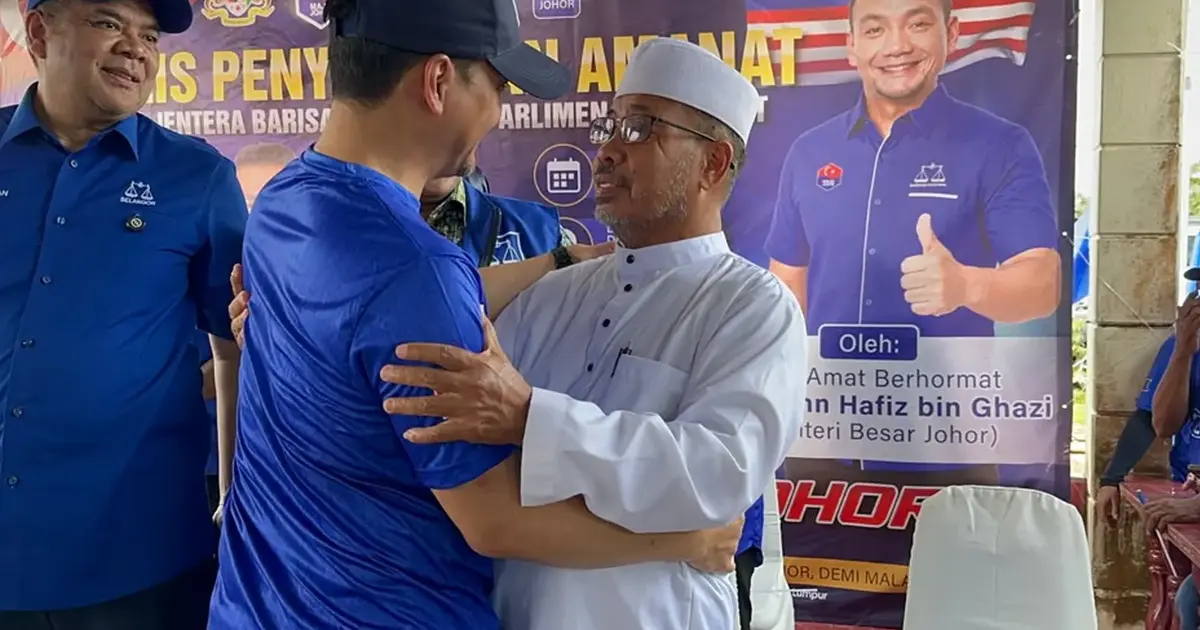
Johor Menteri Besar Onn Hafiz expressed his appreciation as senior figures from PAS attended a Barisan Nasional gathering in Batu Pahat, underscoring the coalition's solidarity even in constituencies where the Islamic party has chosen not to contest. The gesture from PAS leadership, despite their absence from the electoral battle in this Johor stronghold, reflects the nuanced political choreography that continues to define BN's internal relationships as it consolidates its position in key strongholds.
The attendance of PAS delegations at campaign events signals that coalition unity extends beyond seat-sharing arrangements and extends into shared platforms and mutual endorsement. For Onn Hafiz, now consolidating his authority within Johor's political establishment, such gestures carry symbolic weight that transcends the immediate electoral contest. The participation underscores how BN's component parties, despite maintaining distinct organisational identities and voter bases, continue to function as a coordinated political force rather than merely coexisting competitors.
Bersatu's presence in Batu Pahat represents the Perikatan Nasional's stake in this competitive environment, with the party fielding candidates in two of the three available seats. This arrangement reflects the broader accommodation reached between PN and BN across various electoral battlegrounds, where territorial adjustments and mutual non-interference have become critical to preventing vote splits that could benefit opposition forces. The three-way dynamic—with BN holding primary dominance, PAS as a significant partner, and Bersatu pushing from outside as a PN representative—characterises contemporary Johor politics.
The Batu Pahat constituency holds considerable significance within Johor's political landscape, serving as both a barometer of BN's electoral health and a test of how rival coalitions manage their respective territorial claims. Historically a BN stronghold, the area has seen shifting fortunes as national political tides have ebbed and flowed, making it a focus point for both major coalitions as they prepare for electoral contests. The nature of PAS's decision to forgo fielding candidates here appears strategic, calculated to preserve coalition resources and avoid fragmenting the anti-opposition vote.
The choice by PAS to support BN candidates in Batu Pahat without direct participation reflects a broader realignment occurring within Malaysian politics following the 2022 general election. Such arrangements, where established partners tacitly back each other's candidates despite not directly contesting, have become increasingly common as coalitions seek efficiency in electoral strategy. This approach allows larger partner parties to maximize their presence while smaller or strategically positioned parties concentrate resources where they believe they can secure victories or where their presence would prove counterproductive.
Onn Hafiz's public acknowledgment of PAS leaders' attendance carries implications beyond ceremonial recognition. As Johor's chief minister and a prominent BN figure, his expressions of appreciation serve to reinforce narratives of coalition stability and effective cooperation. In an era where opposition movements have attempted to exploit perceived fractures within ruling coalitions, such moments of visible unity become politically valuable, allowing coalition leaders to project competence and cohesion to both internal party members and the broader electorate.
The dynamics playing out in Batu Pahat reflect broader patterns in Malaysian electoral politics, where coalition stability increasingly depends on sophisticated seat-sharing arrangements and mutual accommodation rather than organic electoral competition between allies. The presence of multiple seats within the constituency allows for calibrated distribution of candidacies, enabling parties to contest where they believe they have competitive advantages while supporting coalition partners elsewhere. This requires substantial coordination and political discipline across party structures.
For the Malaysian electorate, particularly in Johor where BN's dominance remains substantial though no longer unquestioned, such arrangements often operate behind the scenes with limited transparency. Voters may not fully appreciate the complex negotiations and strategic calculations that determine who actually contests in their constituencies. The Batu Pahat example illustrates how formal coalition membership increasingly involves negotiated non-competition as much as active participation, a reality that fundamentally shapes contemporary Malaysian electoral outcomes.
The attendance of PAS delegation members at the BN event also signifies confidence in eventual electoral victory for coalition partners in the area. Such support from a major Islamic party validates the candidacies of BN representatives, reinforcing their legitimacy particularly among voters concerned with Islamic credentials and values. This cross-endorsement becomes especially significant in constituencies where religious identity and Islamist politics constitute important voter considerations, making PAS's visible backing a valuable asset for BN candidates seeking to consolidate their electoral base.
Looking forward, the Batu Pahat model of PAS-BN cooperation without direct PAS participation may serve as a template for other constituencies where seat-sharing has created similar arrangements. As coalition politics in Malaysia continue evolving, the ability of parties to maintain unity while respecting territorial agreements will largely determine whether BN and PN can sustain their respective political architectures through successive electoral cycles. Onn Hafiz's acknowledgment of PAS's supportive stance represents a calculated reinforcement of these delicate equilibria that currently define Malaysian coalition politics.

