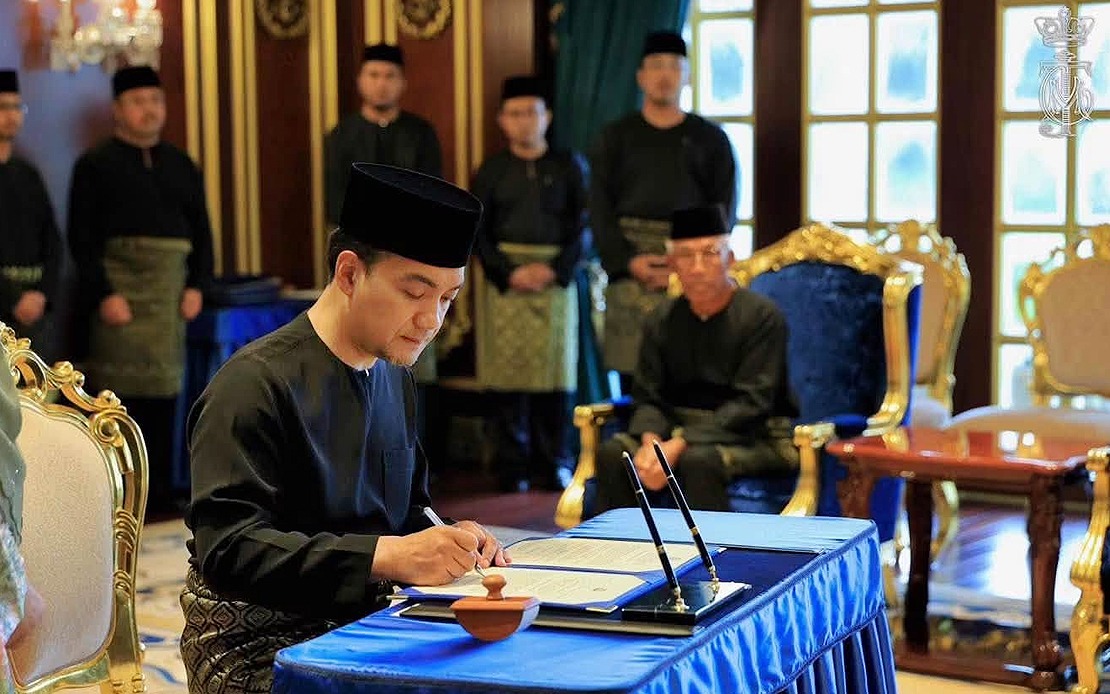
Datuk Onn Hafiz Ghazi has been reappointed Johor Menteri Besar following a decisive mandate delivered by voters in the state's recent election, allowing him to press forward with his development agenda. The 48-year-old takes his oath before the Regent of Johor, Tunku Mahkota Ismail, at Istana Bukit Serene, solidifying his position to oversee one of Malaysia's most economically significant states. His reappointment comes as Barisan Nasional captured 48 of 56 state seats, a marked improvement over the 40 seats the coalition secured in 2022, signalling strengthened public backing for the administration's direction.
Onn Hafiz's ascendancy reflects the enduring influence of one of Malaysia's most prominent political families. He is the great-grandson of Datuk Onn Jaafar, the founding father of UMNO and Johor's seventh Menteri Besar, whose legacy continues to shape Malaysian politics more than half a century later. Through his maternal line, he descends from Tun Hussein Onn, who served as the nation's third Prime Minister during a transformative period in Malaysia's post-independence trajectory. This genealogical connection anchors his political identity within narratives of national leadership and state governance, providing both institutional credibility and historical weight in the eyes of Johor's electorate.
Since his appointment as Johor's 19th Menteri Besar on March 15, 2022, Onn Hafiz has positioned himself as a modernising administrator, departing somewhat from the traditional politician profile. His educational background reflects cosmopolitan exposure: early schooling at the Royal Military College was followed by undergraduate studies in accounting at the University of Hertfordshire in the United Kingdom. This international dimension informed his subsequent career trajectory, which emphasised technical expertise and professional credentialing rather than early party activism alone. Between 2001 and 2004, he worked at PricewaterhouseCoopers, one of the world's leading audit and consulting firms, gaining exposure to governance standards and organisational efficiency frameworks widely recognised in corporate settings.
His professional interlude in the corporate world extended over a decade, during which he held executive positions including directorships at Chin Well Holdings Berhad and a chief executive role at KMB Sdn Bhd. These roles exposed him to capital formation, operational management, and strategic business planning in ways that distinguish him from politicians whose careers developed primarily through party machinery. When he transitioned into electoral politics, he carried this business-oriented perspective into his administrative philosophy, emphasising measurable outcomes, investment attraction, and sectoral diversification as pillars of governance. This approach resonates with contemporary expectations that state leaders demonstrate competence in economic management alongside traditional political functions.
Onn Hafiz's formal entry into UMNO activism occurred through youth structures, serving on the UMNO Youth executive council and leading the Sembrong UMNO Youth division between 2012 and 2018. Concurrently, he gained exposure to ministerial-level policy work as political secretary to the defence minister from 2013 to 2018, positioning himself within defence and security policy circles. His election as Layang-Layang assemblyman in the 2018 general election marked his breakthrough into elected office, after which he was appointed to chair the Johor Tourism, Youth and Sports Committee, a portfolio combining economic development with social engagement. This trajectory demonstrates deliberate positioning across multiple domains—youth mobilisation, defence policy, tourism promotion, and sports governance—each contributing distinct expertise to his subsequent leadership role.
The 2022 Johor state election represented his pivotal moment. Contesting the Machap state seat, he won decisively, immediately establishing eligibility for the Menteri Besar position when Barisan Nasional formed government. His predecessor, Datuk Hasni Mohammad, stepped aside, and Onn Hafiz assumed office in March 2022 with significantly compressed time to build a public profile before facing re-election. Within UMNO's internal hierarchy, he ascended to chairman of the Johor UMNO Liaison Committee in 2023, simultaneously taking charge of the Simpang Renggam UMNO division following previous service as its deputy chief. These positions embedded him firmly within party structures, ensuring constituency-level support networks crucial for electoral performance.
During his initial tenure spanning more than four years, Onn Hafiz championed the "Maju Johor 2030" agenda, a comprehensive development blueprint designed to consolidate Johor's position as a primary economic engine within Malaysia and the broader ASEAN region. This framework operationalises the economic growth philosophy evident in his corporate background, positioning the state to compete for high-value investments while modernising existing manufacturing and agriculture sectors. The agenda encompasses infrastructure development, technology adoption, human capital enhancement, and sectoral diversification, reflecting contemporary thinking about sustainable competitive advantage in globalised markets.
Johor's significance extends beyond state borders, as the state borders Singapore and serves as a major transport hub connecting Malaysian peninsula populations to the southern economic zones. Its port facilities, petroleum refining capacity, and manufacturing base make it critical to national economic performance. Onn Hafiz's reappointment therefore carries implications for Malaysia's broader regional positioning, particularly concerning investment flows through Southeast Asia and integration with Singapore's economy. His emphasis on efficiency and economic competitiveness aligns with expectations that Johor maintain pace with regional development dynamics.
The electoral outcome demonstrates voter confidence in his administration's performance across tangible domains including infrastructure delivery, business sentiment, and public service quality. The 48-seat supermajority provides substantial latitude for legislative initiative without dependence on splinter groups or independent assemblymen, ensuring policy coherence and implementation discipline. For Malaysian observers, Onn Hafiz's re-election reflects broader satisfaction with Barisan Nasional's state-level governance following the coalition's recovery in Johor after losses elsewhere during the 2020-2022 political turbulence.
Looking forward, Onn Hafiz enters his second term with consolidated authority and expanded political capital. His family legacy, professional credentials, and demonstrated administrative performance create unusual convergence of legitimacy sources—dynastic continuity, meritocratic qualification, and practical results. The challenge ahead involves translating electoral mandate into concrete development outcomes whilst navigating economic pressures affecting Malaysia's middle-income positioning and inevitable tensions between growth imperatives and social equity demands. His administration's success in balancing these competing considerations will substantially influence Johor's trajectory through the remainder of this decade.

