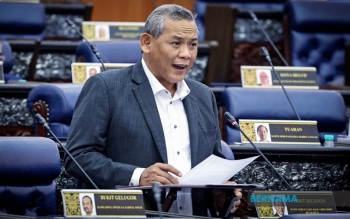
The debate over Tabung Haji's financial troubles took on a more nuanced tone during parliamentary discussions this week, with Port Dickson Member of Parliament Datuk Seri Aminuddin Harun cautioning against attributing all of the pilgrim fund's investment setbacks to deliberate wrongdoing. Speaking during a special sitting to address the findings of a Royal Commission of Inquiry, the former Negeri Sembilan menteri besar emphasised that separating legitimate market losses from those rooted in negligence, self-dealing or broken processes remains crucial to understanding what went wrong at the institution.
The distinction Aminuddin drew carries significant weight for how Malaysia's secular and Islamic stakeholders assess accountability at Tabung Haji, an entity that manages savings and investments for millions of Muslims preparing for the hajj pilgrimage. Since 2014, the fund has faced mounting scrutiny over how it deployed deposits across both conventional and Islamic financial instruments, with some positions deteriorating sharply. The RCI, which examined the period from 2014 to 2020, concluded that governance weaknesses and poor investment decisions compounded the damage. Yet Aminuddin's intervention suggests the parliamentary leadership recognises that oversimplifying the failures as pure misconduct risks misdiagnosing what remedies the institution truly needs.
Among the RCI's key recommendations were forensic audits of 14 investments that had declined substantially. These deeper examinations are intended to clarify whether losses arose from external market conditions—currency fluctuations, interest rate movements, asset class volatility—or from flawed decision-making by management. For Malaysian investors and savers, this methodical approach offers a template for distinguishing between unavoidable investment risk and avoidable institutional failure. The distinction matters not only for Tabung Haji's credibility but for broader confidence in how government-linked institutions deploy public and quasi-public funds.
Aminuddin's most pointed critique focused on the appointment process for Tabung Haji's board and senior leadership. He argued forcefully that the institution has been treated as a patronage posting rather than a professional trust requiring genuine expertise. The current practice, he said, allows well-connected individuals without specialist investment knowledge to occupy positions of fiduciary responsibility. This observation resonates across Malaysia's corporate governance landscape, where political connections and business acumen do not always align. By framing board appointments as a professional responsibility rather than a reward, Aminuddin articulated a principle that extends well beyond Tabung Haji to all state-linked enterprises navigating the intersection of governance and politics.
The RCI report itself recommended that amendments to the Tabung Haji Act should prohibit serving politicians from chairing or sitting on the board of the fund and its subsidiaries. Aminuddin endorsed this safeguard but went further, proposing a comprehensive screening framework for all board candidates. His proposed criteria encompassed integrity, investment experience, Islamic finance expertise, risk management competence, accounting and auditing literacy, legal knowledge, corporate governance understanding, and familiarity with hajj operations. Each nominee would also be required to disclose conflicts of interest. Such a granular framework would represent a marked shift from how many Malaysian institutions currently select their leadership, moving away from generalist credentials toward specialised technical and ethical competence.
The timing of Aminuddin's intervention merits attention. The RCI report, released on July 29, contained 25 recommendations, of which 75 per cent had been implemented by Tabung Haji as of late July. This relatively swift uptake suggests institutional receptiveness to reform, yet also raises questions about the comprehensiveness of those early steps. Whether forensic audits of the 14 troubled investments have been genuinely thorough, and whether board appointments have genuinely shifted in character, remain open questions that will shape investor and public confidence going forward.
Parallel to Aminuddin's structural critiques, Datuk Mohd Isam Mohd Isa, representing Tampin and sitting as a member of the Public Accounts Committee, raised an important temporal concern. The RCI's mandate covered 2014 to 2020, leaving a gap of five years until the present day. Mohd Isam argued that significant developments in Tabung Haji's management unfolded after 2020, potentially obscuring patterns or lapses that warrant investigation. He called for either a fresh inquiry extending to 2025, or alternatively, a shift of oversight authority to the PAC for the 2022 to 2026 period. This jurisdictional proposal reflects a broader parliamentary discussion about how to sustain scrutiny over large institutions without necessitating repeated commissions of inquiry.
For Malaysian depositors and the broader Muslim community relying on Tabung Haji, these parliamentary interventions offer some reassurance that governance failings are being examined. Yet the debate also highlights gaps in the current oversight architecture. A five-year lag between the RCI's window and today means that investors cannot yet assess whether the changes recommended two years ago have taken root in institutional practice. The call for extended or concurrent scrutiny through the PAC suggests that policymakers recognise a need for continuous monitoring rather than episodic investigation.
The Tabung Haji situation also carries resonance for other Southeast Asian nations grappling with how to manage large savings vehicles and pilgrimage funds. Indonesia, Brunei, and other Muslim-majority states operate similar institutions, and many have faced comparable governance challenges. Aminuddin's emphasis on specialist expertise and conflict-of-interest disclosure, if implemented consistently, could establish a regional standard for how such funds ought to be governed. Malaysia's willingness to conduct a public inquiry, release findings, and debate reforms openly distinguishes it in a region where institutional accountability sometimes remains more guarded.
Moving forward, the success of Tabung Haji's reform will depend on whether the cultural shift Aminuddin invoked actually materialises. Changing how an institution selects and evaluates its leaders requires not merely new policies on paper, but sustained pressure from political leaders, the media, and civil society to hold the institution to those standards. The distinction between market-driven losses and governance failures, which Aminuddin articulated, provides a useful framework for assessing progress. As forensic audits proceed and board vacancies arise, observers will be able to measure whether Tabung Haji is genuinely moving toward meritocratic, expertise-driven leadership or reverting to familiar patronage patterns. That real-world test will ultimately determine whether parliamentary debate translates into institutional transformation.

