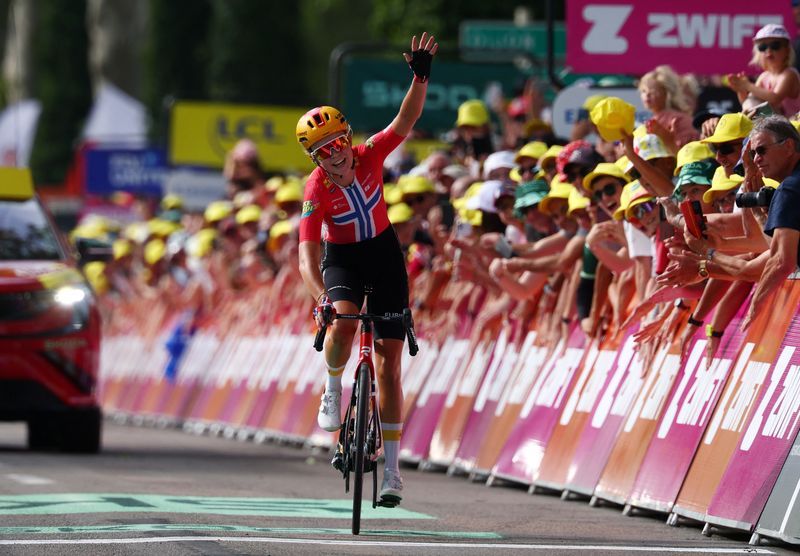
Sigrid Haugset delivered a breakthrough performance at the Tour de France Femmes on Monday, launching a solo attack that carried her to a stage victory and the overall race lead—a historic moment for Norwegian women's cycling. The 27-year-old Uno-X Mobility rider crested the finish line ahead of Belgium's Lotte Kopecky, who fought valiantly but fell 1 minute 24 seconds behind on a gruelling mountain stage. With this triumph, Haugset became the first Norwegian woman ever to win a stage at the event and to don the prestigious yellow jersey, marking a watershed moment for her nation's presence in professional women's cycling. She now leads the general classification by 2 minutes 22 seconds over Kimberly Le Court of Mauritius, positioning herself as a genuine contender for overall victory.
The emotional weight of the achievement was evident in Haugset's immediate reaction as she crossed into France near Poligny, still slumped over her handlebars from exhaustion. "I never thought it was possible ... it's unreal," she told reporters, her words tumbling out in a mixture of disbelief and joy. The moment carried added significance because becoming the first of her nationality to wear the yellow jersey at this prestigious event elevates Haugset into the pantheon of Norwegian cycling history. She reflected on the mental battle during the closing kilometres, when Belgian rival Kopecky closed the gap to just ten seconds with barely ten kilometres remaining. "I thought (Kopecky) would catch me. I thought, should I drop down to her? Because second is good... but I thought of everyone cheering from home and I had to give it all," Haugset explained, capturing how the weight of national expectation can paradoxically fuel a rider's reserves when fatigue threatens to end ambitions.
The 156.5-kilometre stage proved treacherous from its opening passages, with a category-one climb to Col de la Faucille claiming several high-profile casualties. The Dutch pursuit cyclist Marianne Vos, along with reigning world champion Magdeleine Vallieres and 2022 Tour de France Femmes winner Demi Vollering, all found themselves scattered across the tarmac as riders jostled for position through the technical ascent. The immediate nature of their recovery—all remounting quickly and pressing onward—meant that the peloton maintained cohesion through the 11.4-kilometre climb without any breakaway threats gaining traction. This reshuffling of the pack set the stage for what would become a pivotal turning point later in the race.
Haugset's decisive move came during the climb to Col de la Savine, roughly at the midway point of the stage, when she accelerated away from the increasingly thinning bunch. Kopecky responded within minutes, demonstrating the tactical awareness and climbing prowess that has made the Belgian a consistent podium threat throughout the European racing calendar. Yet despite Kopecky's determined pursuit, Haugset maintained her composure and her gap as the race's trajectory shifted northward across the French border. The Norwegian's earlier positioning and race reading proved crucial—she had positioned herself perfectly to respond when the decisive moment arrived, avoiding the energy-sapping battles that had consumed other contenders earlier on the climb.
Meanwhile, outgoing yellow jersey holder Lorena Wiebes of the Netherlands found herself distanced by over thirteen minutes as the stage entered its final twenty kilometres. This dramatic collapse in fortune for the erstwhile race leader underscored the mountains' capacity to reshape cycling hierarchies within mere hours. Kimberly Le Court and Demi Vollering, holding second and third positions respectively before the stage commenced, remained tethered to the main peloton, losing ground to the accelerating frontrunners as the tempo intensified on the upper slopes. For Malaysian and broader Southeast Asian observers, Le Court's presence among the podium contenders holds particular interest given her rising profile in international women's cycling.
The final kilometres devolved into a dramatic battle of wills between Haugset and Kopecky, with the Norwegian repeatedly digging deep to repel her pursuer's increasingly desperate attacks. With three kilometres remaining, Haugset manufactured a decisive gap that Kopecky could not bridge, pushing clear with a final surge that vindicated her earlier decision to attack rather than settle for a lesser placing. The Belgian's failure to reel in the Norwegian, despite riding an exemplary chase, highlighted both Haugset's superior fitness on this particular day and her mental fortitude when the race hung in balance.
Haugset's demeanour as she crossed the line perfectly encapsulated the extremity of her physical exertion. So depleted were her reserves that she found herself unable to perform the customary victory celebrations, remaining hunched over her bicycle frame as she passed the finish banner. "I know my boyfriend will be so angry at me for not celebrating, but I could not even lift my arms off the bike," she quipped afterwards, her self-aware humour suggesting a rider simultaneously elated by success yet humbled by the mountain stage's merciless demands. Vos of the Netherlands claimed third place, providing additional depth to what emerged as a compelling day of racing that fundamentally altered the Tour's competitive landscape.
Haugset's ascendancy carries broader implications for women's professional cycling beyond Norwegian boundaries. Her ability to execute a textbook attacking strategy while resisting closing moves from an accomplished rival demonstrates the tactical maturity increasingly evident among the sport's emerging generation of female cyclists. The yellow jersey now resting on her shoulders signals that the traditional powerhouses of women's cycling—Belgium, the Netherlands, and other Western European nations—face mounting pressure from athletes and programmes willing to invest in building competitive depth. For teams and national federations across Southeast Asia seeking to develop their own female cycling talent, Haugset's emergence as a stage-winning and overall contending force serves as a reminder that international success remains achievable for ambitious programmes regardless of population or traditional cycling infrastructure.

