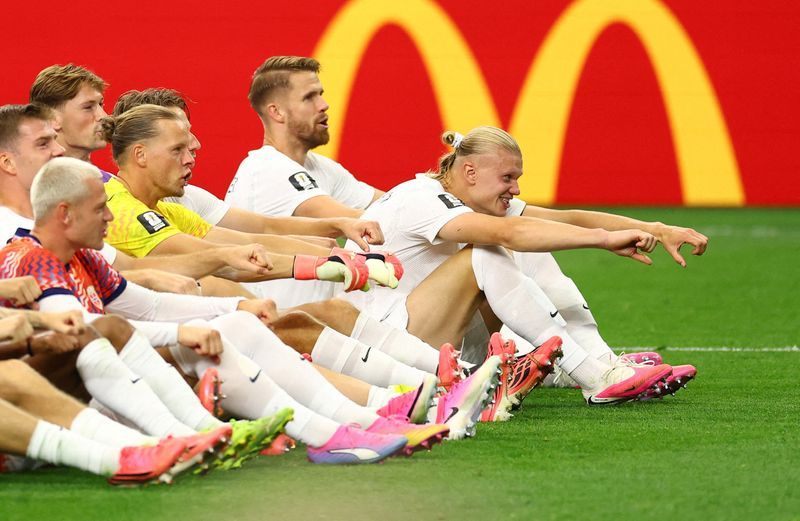
Norway's remarkable return to football's greatest stage came to an end in Miami on Saturday when England's Jude Bellingham struck twice in extra time to secure a 2-1 quarter-final victory, denying Stale Solbakken's side a semi-final berth. The defeat marked a bittersweet conclusion to what has been a transformative tournament for the Norwegians, who had been absent from the World Cup finals for nearly three decades before this summer's competition. Though the Scandinavian nation failed to reach the last four, their campaign left an indelible impression on the global football community and reinvigorated a proud footballing nation.
The Norwegian squad captured the imagination of tournament observers long before the first match was played, arriving at the finals dressed in Viking regalia as a tongue-in-cheek homage to their seafaring ancestors. What began as a clever public relations exercise evolved into something far more significant when supporters adopted the "Viking row" celebration, transforming it into one of the tournament's most recognizable and beloved traditions. The imagery resonated across continents, with American fans in particular drawn to the charisma of Erling Haaland and the team's distinctive brand of confident, entertaining football that refused to take itself too seriously.
Norway's path through the group stage justified the optimism that had surrounded their qualification campaign, during which Haaland's prolific finishing had established them as genuine contenders. Progression to the knockout rounds was widely viewed as the minimum requirement, yet Solbakken's charges exceeded expectations by eliminating the Ivory Coast in the round of 32, with Haaland's brace in a 2-1 triumph providing clear notice of their attacking potency. That victory set the stage for a stunning upset of Brazil in the next round, a performance that transcended typical tournament shocks and instead demonstrated Norway's capacity to outthink and outplay one of football's traditional powerhouses through superior organization and clinical finishing.
The 2-1 victory over Brazil represented the zenith of Norway's tournament and gave credence to supporters' dreams of an improbable journey to the final. The manner in which they dismantled a five-time world champion suggested that Norway had genuinely emerged as a force capable of challenging the sport's established hierarchy. Such optimism, however, proved premature as the accumulated physical toll of their extraordinary efforts against elite opponents finally caught up with them in the quarter-final encounter. England's greater depth of resources allowed them to capitalize when Norway's legs began to tire, with Bellingham's late heroics deflating the Scandinavian side just when they had seemed capable of holding their own.
Despite exiting the tournament, Norwegian football stands at a genuinely promising juncture. The domestic league has demonstrated genuine competitive quality through the performances of clubs like Bodø/Glimt, whose repeated deep runs in European competitions have demonstrated that Norwegian football is no longer defined by its historical reputation as a direct, physical approach bereft of technical nuance. Instead, the country has cultivated a player development system capable of producing technically sophisticated athletes who can compete at the highest level while maintaining the discipline and tactical intelligence that characterizes Scandinavian sporting culture.
The triumvirate of Solbakken, Odegaard, and Haaland embodies the evolution of Norwegian football and the wider national character. Rather than adopting a deferential posture toward established footballing superpowers, this leadership group projects quiet self-belief without arrogance, combining deadly seriousness about competition with an ability to maintain perspective and humor. This temperament has proved infectious, creating an environment where younger players feel empowered to believe they belong among the world's elite without succumbing to the overconfidence that often undermines such aspirations.
Solbakken's characterization of the tournament as "fairly OK" exemplified the understated optimism pervading the Norwegian camp even in defeat. This measured assessment deliberately downplays what has genuinely been a historic achievement for a nation rebuilding its international football program. More significantly, his subsequent comments revealed a manager convinced that his players have internalized a crucial psychological development: the recognition that Norwegian footballers can genuinely compete on level terms with the world's best. This belief, once established at the international level, typically cascades down through youth development systems and domestic leagues, creating a virtuous cycle of improvement and confidence.
The tournament has offered Norwegian football something that cannot be replicated through domestic success alone: proof that the national program's trajectory is sustainable and meaningful. Young Norwegian players observing Haaland's performances against the world's finest defences, witnessing Odegaard's composure in high-stakes encounters, and seeing their countrymen embrace a global audience will internalize different expectations about what is possible. The psychological impact of demonstrating competitive parity with traditional powers often exceeds the immediate competitive benefits, as it reshapes the ambitions and self-perception of an entire generation of aspiring athletes.
For Malaysia and other Southeast Asian football nations, Norway's renaissance offers useful perspective. The Scandinavian country lacked the population, climate advantages, or traditional football heritage of established powers, yet through systematic investment in player development, tactical sophistication, and confidence-building, it has engineered a competitive revival. Though distinct contextual differences exist between Norway and Southeast Asian nations, the underlying principle—that sustained commitment to player development and tactical innovation can create competitive progress even without historical advantage—provides instructive lessons for regional federations seeking to elevate their programs.
The legacy of Norway's 2026 campaign will extend far beyond the statistical reality of a quarter-final exit. The tournament has successfully re-established Norwegian football on the world stage after a generation-long absence, demonstrating that the country's players and coaching staff belong in the conversation about elite international football. English fans may recall Bellingham's dramatic strikes, but Norwegian supporters will remember the entire arc of a campaign that transformed expectations and established a foundation upon which future success can be built. For Solbakken and his charges, the summer of 2026 will indeed prove to have been more than fairly OK—it will be remembered as the moment when Norwegian football truly reclaimed its place among the world's respected footballing nations.

