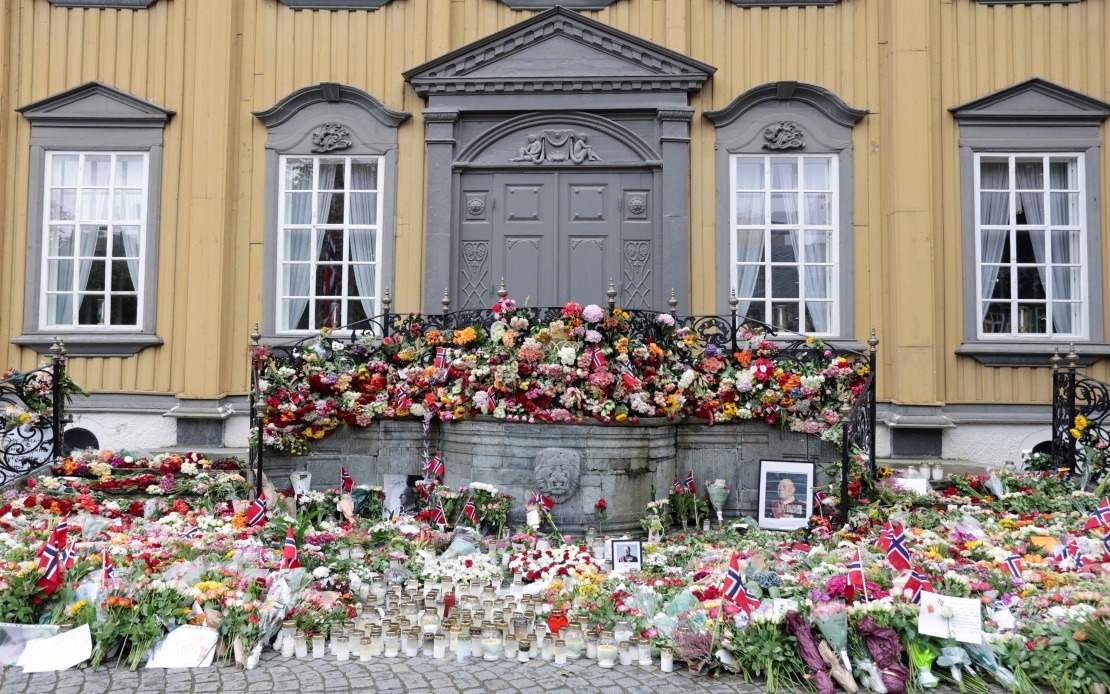
Norway came to a standstill on Sunday as the kingdom paid its final respects to King Harald V, whose death on Friday marked the end of an era that had defined modern Norwegian history. Across the Nordic nation, churches and cathedrals opened their doors to tens of thousands of mourners who gathered to commemorate the reign of a monarch who had guided Norway through decades of social, economic and political transformation. The scale of public participation underscored the deep affection and respect Norwegians held for their late sovereign, whose steady presence had become woven into the national fabric since his accession to the throne in 1972.
The Royal House of Norway announced that the formal state funeral will take place on September 9, providing the nation with a specific date to mark this significant transition. This timeline allows for proper preparations befitting a monarch of Harald V's stature, while also giving the extended royal family, foreign dignitaries, and the Norwegian people adequate time to prepare for a solemn ceremony that will be watched closely both domestically and internationally. The funeral is expected to draw leaders and representatives from monarchies and nations across Europe and beyond, reflecting Norway's position within the broader European community of constitutional monarchies.
Throughout Oslo and provincial cities, floral tributes accumulated steadily outside the Royal Palace as citizens engaged in a collective expression of mourning. Countless flowers, burning candles and handwritten cards created a spontaneous memorial that captured the emotional response of ordinary Norwegians to their sovereign's passing. These tangible expressions of grief extended beyond the palace gates, with similar scenes emerging at churches nationwide, suggesting that Harald V's death resonated across all demographic groups and geographic regions of the country. The sheer volume and persistence of these tributes indicated that the late king had transcended his ceremonial role to become a symbol of national continuity and stability.
Under the constitutional framework governing royal succession in Norway, the throne passed immediately upon Harald V's death to his eldest son, who assumed the regnal name Haakon VIII. At 53 years old, the newly crowned monarch brings to the role a generation steeped in contemporary European values while maintaining connection to Norway's royal heritage. His accession represents a smooth transition in a nation with a long constitutional tradition, where the line of succession has been clearly established and understood by the populace. The seamless transfer of power demonstrates the strength of Norway's institutional frameworks and the respect accorded to monarchical governance in Scandinavian political culture.
King Haakon VIII's ascension carries particular significance for Norwegian identity and governance. Having been born in the modern era and educated in an increasingly globalized world, he represents a different generational perspective from his father, who had witnessed the trauma of Nazi occupation during his childhood. The new king will face contemporary challenges ranging from climate change policy to questions about the monarchy's evolving role in a digitally connected society. His reign will inevitably be compared to his father's 52-year period on the throne, establishing new precedents while potentially building upon established traditions.
For Southeast Asian observers, the Norwegian succession offers instructive parallels regarding constitutional monarchy and orderly transitions of power. Malaysia itself has a system of rotating monarchical leadership among its constituent states, yet the Norwegian example of lineal succession provides context for understanding how stable constitutional monarchies manage generational change. The public participation in memorial services and the formal procedures surrounding funeral arrangements reflect institutional maturity that many nations aspire to achieve. The absence of uncertainty or constitutional crisis following Harald V's death contrasts sharply with succession challenges that have sometimes troubled other regions, highlighting the value of clearly codified rules and established constitutional conventions.
Harald V's nearly five-decade reign had witnessed Norway's transformation from a post-war nation recovering from occupation to a prosperous, stable democracy with substantial sovereign wealth derived from North Sea petroleum resources. The late king had presided over this remarkable economic and social evolution while maintaining the monarchy's relevance through careful balance between tradition and modernization. His death thus concludes a chapter in Norwegian history marked by consensus-building, social welfare development, and integration into European structures. The national mourning reflects recognition that Harald V had successfully navigated the delicate task of preserving the monarchy's symbolic importance while adapting it to changing democratic expectations.
The transition occurring in Norway also invites reflection on broader questions about constitutional monarchy in contemporary Europe. With other long-reigning monarchs in the continent having recently passed or abdicated, successions have become increasingly visible across the region. King Haakon VIII inherits not only a throne but also a responsibility to maintain the institutional legitimacy that his father cultivated. The monarchy's future relevance may depend significantly on how the new king addresses contemporary issues affecting Norwegian society, from immigration policy to environmental stewardship, while maintaining the ceremonial and symbolic functions that make constitutional monarchy valued by its citizenry.
As Norway prepared for the September 9 funeral, questions naturally emerged about how King Haakon VIII would shape the monarchy's direction and what priorities would characterize his early reign. The new monarch's relationships with political institutions, media approach, and engagement with civil society will establish tone for this new era. His educational background, international experience, and personal interests suggest potential areas of emphasis that might distinguish his reign from his predecessor's, while the formal structures and constitutional constraints of Norwegian monarchy will ensure continuity in fundamental governance patterns. The coming months will reveal how smoothly the transition consolidates institutional stability.

