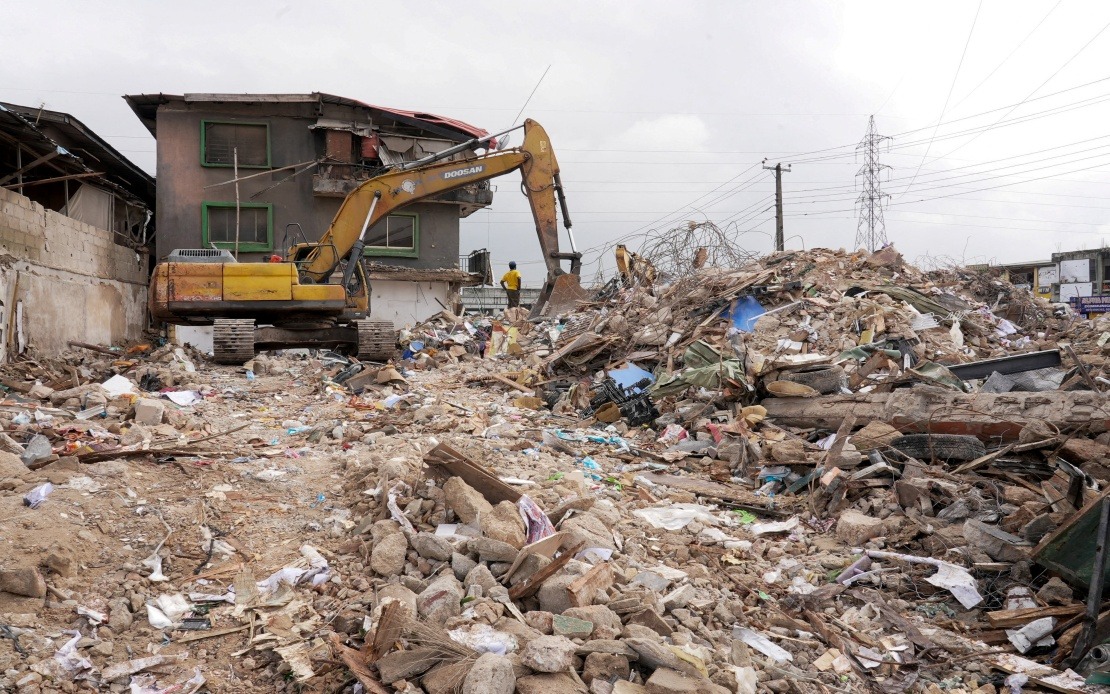
A three-storey shopping complex in Alakija, a rapidly developing satellite community along the Lagos-Badagry Expressway in Nigeria's Lagos state, collapsed on Thursday morning, claiming nine lives and leaving 27 others injured in what authorities confirmed as a completed rescue operation by Friday. The disaster occurred in one of Lagos's expanding commercial zones, where informal and formal retail businesses operate alongside residential areas, creating crowded conditions that complicated both the structural integrity and emergency response efforts.
Multi-agency rescue teams mobilized immediately after the structure gave way, launching round-the-clock operations to extract trapped individuals from beneath the collapsed structure. The search effort revealed a cross-section of victims typical of such incidents in congested urban commercial areas: shop owners conducting routine business transactions, customers shopping for goods, and nearby residents who happened to be in proximity when the building failed. The diversity of those affected underscores how such catastrophes affect entire neighbourhoods rather than isolated groups, with ripple effects across families and small business communities.
Olufemi Oke-Osanyintolu, permanent secretary of the Lagos State Emergency Management Agency, confirmed to media that all individuals trapped beneath the rubble had been successfully evacuated by early Friday. The 27 survivors sustained injuries ranging from minor to severe and were transported to medical facilities for treatment. The coordinated nature of the rescue, involving multiple government agencies and private sector participants, demonstrated the scale of mobilization required to conduct effective search and recovery operations in such circumstances.
Notably, the China Civil Engineering Construction Corporation, actively engaged in executing a railway infrastructure project in the locality, contributed personnel and equipment to the rescue efforts. This involvement highlights how major construction companies operating in Nigeria often provide material support during emergencies, though their participation also raises questions about the relationship between ongoing development projects and building standards in surrounding areas. The company's resources proved instrumental in accelerating the extraction process and locating victims in difficult-to-access spaces within the collapsed structure.
Initial investigations into the cause of the collapse remain inconclusive, with authorities indicating that a formal inquiry has commenced. However, structural failure in Lagos and across Nigeria frequently stems from identifiable patterns that have plagued the construction sector for decades. Experts consistently point to the prevalence of aging buildings constructed without adequate maintenance regimes, widespread circumvention of established building codes, and the systematic use of substandard materials sourced from unregulated suppliers seeking to reduce construction costs.
The Alakija collapse reflects broader infrastructure vulnerabilities across Lagos, Africa's largest metropolitan area, where rapid urbanization and population growth have created enormous pressure on the built environment. Many structures erected in earlier decades now face deterioration exacerbated by tropical climate conditions, inadequate upkeep, and the absence of systematic inspection regimes. The absence of rigorous enforcement mechanisms for building standards means that even newly constructed facilities sometimes fail to meet safety specifications, as developers prioritize cost minimization over structural soundness.
For Malaysian observers, the Lagos incident offers instructive parallels and contrasts to the construction oversight frameworks operating in Malaysia. While building collapses occur far less frequently in Malaysia due to stricter regulatory enforcement and more sophisticated inspection protocols, the underlying risk factors—aging infrastructure, cost-cutting pressures, and the challenge of maintaining oversight in rapidly expanding urban areas—remain universally relevant concerns. Malaysia's experience with disasters such as the Richter Pavilion incident demonstrates that even developed regulatory environments require constant vigilance and updating.
The human toll of such preventable disasters extends beyond immediate fatalities and injuries. Families lose breadwinners, small business owners lose livelihoods, and communities experience psychological trauma that persists long after rescue operations conclude. The incident in Alakija displaced numerous shop owners and residents who depended on the complex for daily commerce and living space, creating secondary economic and social impacts that receive less media attention than the initial catastrophe.
Nigerian authorities face mounting pressure to strengthen building inspection protocols and enforcement mechanisms, particularly in high-density commercial zones where structural failures pose risks to large concentrations of people. However, resource constraints, limited technical capacity, and the sheer volume of buildings requiring inspection create persistent challenges. The construction industry's resistance to stricter regulation, driven by profit concerns, further complicates reform efforts.
Regional implications extend to other West African nations facing similar development challenges as urbanization accelerates. The Lagos collapse serves as a reminder that infrastructure safety cannot be treated as an afterthought in development planning. Investment in building inspection systems, technical training for engineers and contractors, and meaningful penalties for regulatory violations represents essential expenditure rather than bureaucratic overhead.
Moving forward, the incident should catalyze more rigorous building audits across Lagos and similar circumstances may prompt policy makers to mandate periodic structural assessments for older commercial buildings. International standards and best practices, including those developed by Malaysian and other regional engineering bodies, could inform upgraded local codes. However, implementation requires sustained political commitment and sufficient funding allocation—challenges that have historically proven difficult in the Nigerian context.

