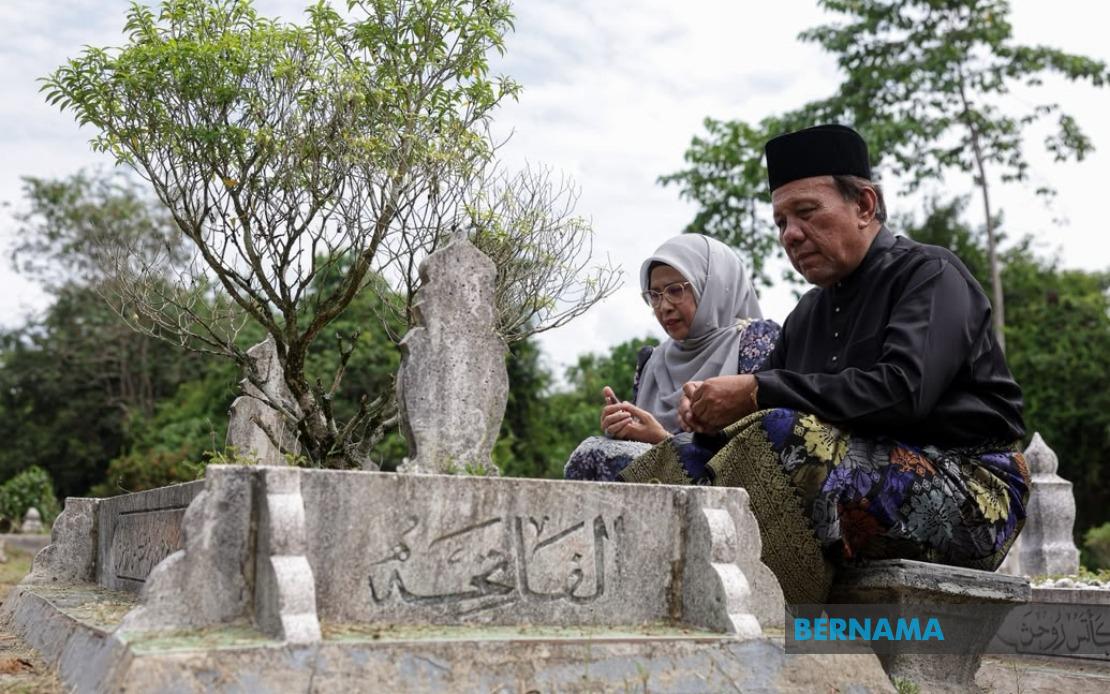
Datuk Ismail Lasim marked the beginning of his tenure as Menteri Besar of Negeri Sembilan with a deeply personal gesture, visiting the graves of his parents at Tebing Tinggi Muslim cemetery in Kuala Pilah shortly after being sworn in. The newly inaugurated state leader, accompanied by his wife Datin Noraishah Othman and dressed in formal traditional black Malay attire, made the solemn pilgrimage a priority on the day of his installation, reflecting the cultural and familial values that underpin leadership transitions in Malaysia.
Ismail's formal investiture took place before the Yang di-Pertuan Besar of Negeri Sembilan, Tuanku Muhriz Tuanku Munawir, at Istana Besar Seri Menanti. The ceremony capped a swift political process following the state election held the previous day, in which voters returned him to the state assembly as the representative for Juasseh. His elevation to the chief minister's post came as part of a broader electoral mandate that reshaped the state's political landscape, reflecting both continuity and shifts in voter sentiment across Negeri Sembilan's varied constituencies.
The graves he visited represent chapters of his family history. His father, the late Lasim Yaman, passed away on March 5, 2020, at the advanced age of 97, having lived through Malaysia's post-independence era and witnessed decades of the nation's development. His mother, the late Bedah Othman, had died earlier, on September 16, 2014, leaving Ismail without parental guidance during critical moments of his political career. By visiting their resting places on his inauguration day, the new Menteri Besar observed a tradition of filial piety that remains significant in Malaysian political culture, ensuring that family legacy and ancestral memory anchor the beginning of his administrative responsibilities.
The election that brought Ismail to this position delivered clear outcomes for state governance. Barisan Nasional secured 18 of the contested state assembly seats, while its coalition partner Perikatan Nasional won seven seats, combining to achieve a two-thirds majority. This outcome granted the coalitions substantial parliamentary strength to implement their legislative agenda without dependence on independent assemblymen or minor party support, a position that historically allows governments to pursue bolder policy initiatives and constitutional amendments if required.
Ismail's victory in Juasseh, a state constituency with its own electoral dynamics and demographic composition, demonstrated sufficient local support to elevate him within his party's hierarchy. The path from winning a single seat to becoming Menteri Besar typically involves factional bargaining, coalition arithmetic, and acceptance among assemblymen from both Barisan Nasional and Perikatan Nasional components. His selection by these coalitions underscores confidence in his ability to bridge the two groups and manage the consensus necessary for stable government in a state where previous administrations have occasionally faced internal tensions.
The timing and manner of Ismail's cemetery visit convey broader messages about governance priorities in Negeri Sembilan. Rather than immediately plunging into state secretariat meetings or ceremonial functions, he chose to begin with remembrance, signalling that traditional values and family considerations inform his approach to public office. This gesture may resonate particularly among older voters and those in rural areas where family bonds and respect for ancestors remain culturally central, potentially serving as an implicit promise that his administration will not abandon conservative social values in pursuit of modernisation.
Negeri Sembilan, located strategically between Kuala Lumpur and the southern corridor, plays an important role in Malaysia's political balance. The state has historically been a testing ground for political coalitions and governance models, with transitions between different administrations often preceded by complex negotiations. Ismail's assumption of office under the Barisan Nasional-Perikatan Nasional arrangement represents a continuation of these coalition dynamics, though the specific composition differs from earlier configurations. His leadership will likely face early tests regarding resource allocation, development priorities, and inter-coalition relations.
The state has particular significance for investors and those monitoring Malaysia's political trajectory. Negeri Sembilan's performance under the new administration may offer signals about how Barisan Nasional and Perikatan Nasional function as governing partners at the state level, providing insights valuable for understanding potential federal-level dynamics should these coalitions operate together nationally. Economic development initiatives, infrastructure projects, and social policies implemented under Ismail's watch will either strengthen or complicate these partnerships.
For Malaysian readers and political observers across Southeast Asia, Ismail's leadership offers an opportunity to observe how traditional values and contemporary governance intersect. His immediate pilgrimage to honour deceased parents, conducted with ceremonial formality and family presence, exemplifies how Malaysian political leaders often weave cultural identity into their public personas. Whether such gestures translate into substantive policy outcomes reflecting conservative or progressive leanings will become apparent as his administration develops its legislative programme and budget priorities.

