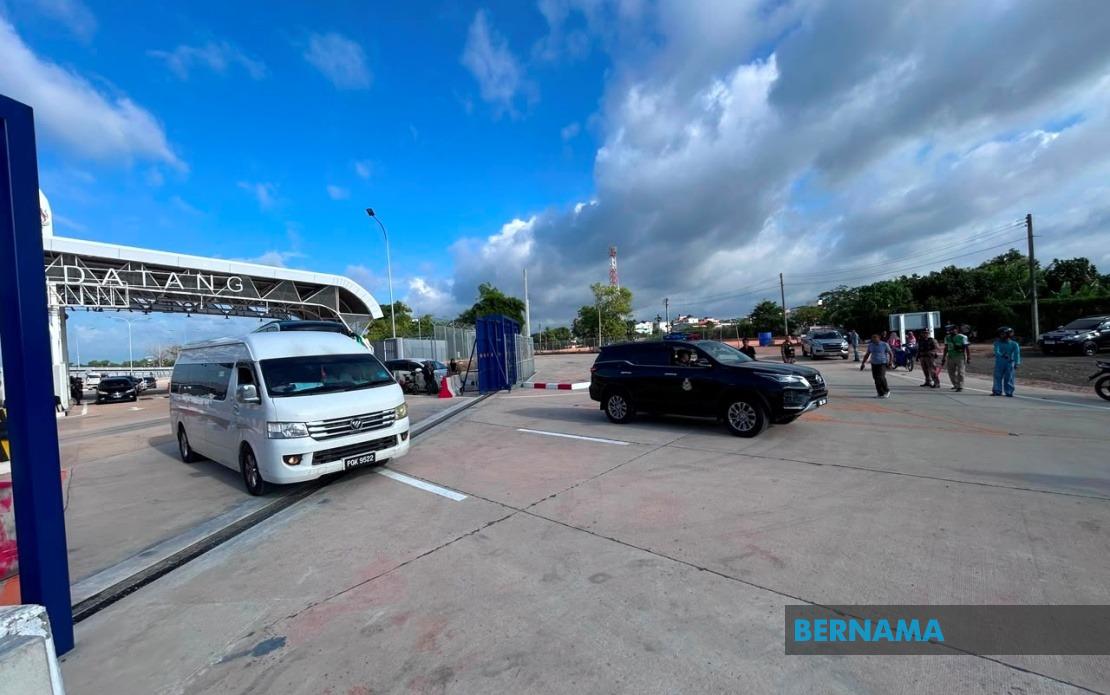
Malaysia and Thailand have taken a significant step in strengthening their bilateral connectivity with the opening of a new road linking the Bukit Kayu Hitam Immigration, Customs, Quarantine and Security (ICQS) Complex in Kedah directly to the Sadao Customs, Immigration and Quarantine (CIQ) Complex in Thailand. The route commenced operations at 6 am on July 11, marking the culmination of infrastructure efforts designed to transform one of Southeast Asia's busiest land borders into a more efficient crossing point.
Prime Minister Datuk Seri Anwar Ibrahim and Thai Prime Minister Anutin Charnvirakul jointly inaugurated the corridor yesterday, underscoring the strategic importance both governments attach to facilitating seamless people and goods movement across their shared border. The infrastructure development reflects a broader regional commitment to enhancing trade corridors and tourism flows that have historically been constrained by bottleneck conditions at the traditional entry points.
The new thoroughfare arrives at a critical juncture for Malaysia's northern corridor, where weekend and holiday traffic regularly creates queues extending for kilometres. Motorists and commercial operators have long complained about the congestion resulting from the concentration of traffic through a single primary checkpoint. The separate dedicated route promises to distribute traffic flow more evenly, particularly for vehicles destined for different processing lanes within the respective customs facilities.
Early feedback from users has been overwhelmingly positive. Penang resident Mohd Faizal Ahmad, a frequent traveller to Thailand, observed that the new route offers substantially better organisation compared to previous arrangements. He specifically highlighted relief during school holiday periods, when the traditional crossing became notoriously congested, indicating that the new infrastructure addresses a long-standing pain point for Malaysian families and holiday travellers.
The design improvements extend to practical operational considerations that directly impact transit times and safety. Heavy vehicle operators have particularly welcomed the systematic separation of commercial lorries from passenger vehicles within the Sadao CIQ approach. Wan Muhammad Shahid Wan Mohd Desa, a 28-year-old lorry driver, emphasized that the widened facility prevents the chaotic mixing of different vehicle classes that previously created bottlenecks. Previously, heavy vehicles travelling from Bukit Kayu Hitam to Danok had no dedicated lanes, resulting in severe congestion for all users attempting to enter or exit Thailand.
Thai nationals frequently crossing into Malaysia have also experienced tangible benefits from the upgraded infrastructure. Mat Li Daman, a 59-year-old regular traveller, praised the expanded Sadao CIQ facilities, which now provide substantially more space for processing and improved accommodation for documentation procedures. The new building represents a dramatic upgrade from the cramped conditions that characterised the previous checkpoint, with enhanced systems for vehicle entry declarations and clearer traffic management protocols.
Beyond immediate convenience considerations, the new crossing holds strategic significance for regional economic integration. The improved infrastructure is explicitly intended to facilitate trade and tourism flows that have historically suffered from transport bottlenecks. Malaysian exporters seeking market access across the border and Thai tourists and traders heading south will benefit from reduced transit times and lower logistics costs. This efficiency gains compound across multiple crossings, meaning businesses operating along the Malaysia-Thailand economic corridor should see measurable improvements in operational costs.
The project exemplifies how targeted infrastructure investment can address regional development needs. The Bukit Kayu Hitam ICQS Complex on the Malaysian side represents a substantial modernisation of border administration, featuring integrated systems for immigration, customs, quarantine and security functions. Its counterpart in Sadao similarly consolidates multiple government functions into a more efficient facility. This architectural approach to border management reflects international best practices increasingly adopted across Southeast Asia.
For Malaysian policymakers, the successful opening validates the strategic focus on northern corridor development as a counterbalance to congestion affecting southern border crossings. The Johor-Singapore border regularly experiences similar congestion issues, making innovations at Bukit Kayu Hitam potentially instructive for future improvements elsewhere. The partnership framework demonstrated between Malaysia and Thailand suggests that bilateral cooperation on infrastructure can overcome longstanding coordination challenges that typically plague shared borders.
The broader implications extend to Malaysia's role within regional supply chains. As manufacturing operations increasingly distribute production across Southeast Asia, transportation efficiency becomes a competitive factor. A faster Malaysia-Thailand crossing reduces friction costs for companies operating factories on both sides of the border. Electronics manufacturers, automotive suppliers, and agricultural exporters all benefit from streamlined customs procedures and reduced idle time for vehicles and goods in transit.
Looking forward, the new crossing will require ongoing management coordination between Malaysian and Thai authorities to maintain efficiency as traffic volumes inevitably increase. Peak holiday periods will test whether the expanded capacity truly accommodates demand or merely postpones recurrence of bottlenecks. Both governments will need to maintain investment in complementary systems, including digital documentation platforms and staff training, to sustain the operational benefits the physical infrastructure provides.
The opening also reflects evolving transportation patterns in Southeast Asia, where increased cross-border labour mobility, tourism, and trade have made border infrastructure a critical development priority. Malaysia's positioning as a gateway between Thailand and Singapore means improvements at its northern border ultimately benefit the entire Malaysia-Singapore economic relationship. The successful collaboration on this project between Malaysian and Thai governments offers a model for addressing similar infrastructure challenges elsewhere in the region, particularly as ASEAN integration deepens and cross-border movements continue accelerating.

