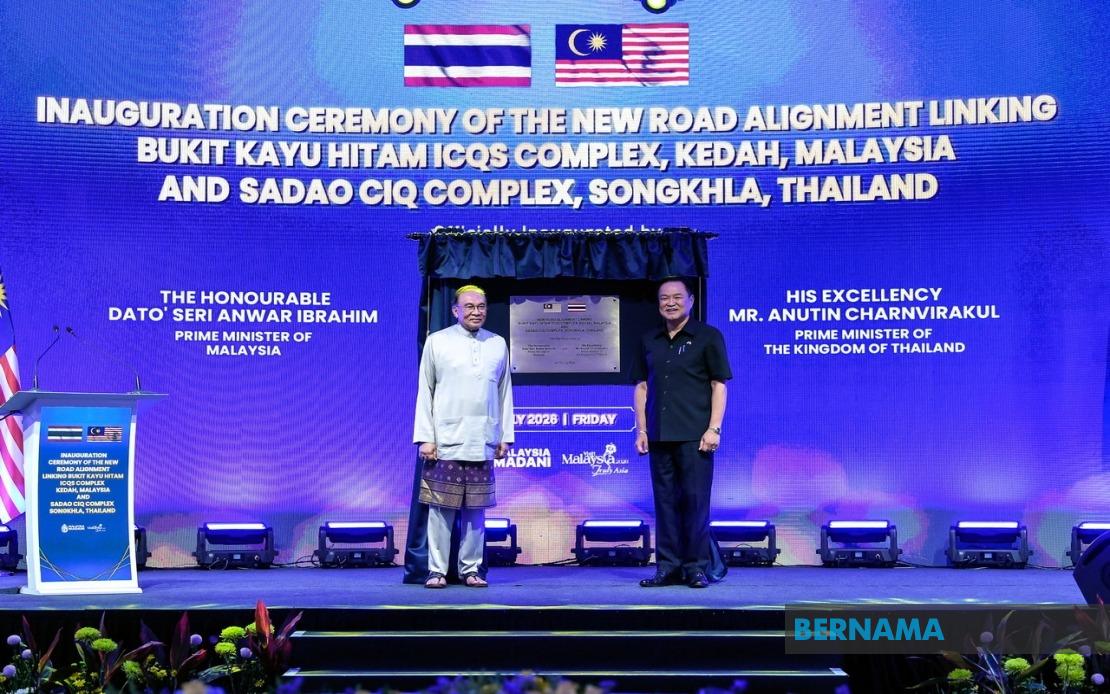
Prime Minister Datuk Seri Anwar Ibrahim has unveiled an ambitious infrastructure project that promises to reshape economic activity along the Malaysia-Thailand border. The launch of a new road alignment connecting the Bukit Kayu Hitam Immigration, Customs, Quarantine and Security Complex in Kedah with the Sadao Customs, Immigration and Quarantine Complex in Thailand signals a major shift towards deeper cross-border integration between the two nations. Jointly inaugurated with Thailand's Prime Minister Anutin Charnvirakul at the border crossing on July 10, the project represents both countries' commitment to leveraging their geographical proximity for mutual prosperity.
Anwar characterised the initiative as a watershed moment in Malaysia-Thailand relations, extending far beyond conventional diplomatic exchanges. Rather than merely facilitating border crossing procedures, the two leaders envision the infrastructure as a cornerstone for establishing a special economic border zone spanning northern Malaysia and southern Thailand. This concept moves beyond traditional trade agreements by creating a designated area where commerce, investment, and economic activity can flourish with tailored policies and incentives. Such zones have proven instrumental in other border regions globally, where they have generated employment, attracted foreign investment, and lifted communities out of poverty.
The northern Malaysian states of Perlis, Kedah, Kelantan, Perak, and Penang stand to benefit substantially from this arrangement. These regions, which have historically relied on agricultural production, manufacturing, and smaller-scale trading, could access new markets and investment opportunities through enhanced cross-border connectivity. The new road alignment itself eliminates previous bottlenecks that traders and logistics operators faced, reducing transit times and operational costs. For businesses in these states, particularly small and medium enterprises engaged in cross-border commerce, the infrastructure improvement translates directly into competitive advantages and expanded commercial horizons.
Anwar acknowledged that constructing a genuine special economic zone requires patience and sustained commitment rather than rapid implementation. The complexity lies in harmonising regulations, tax structures, labour standards, and business practices between two sovereign nations with different institutional frameworks. Yet both leaders demonstrated resolve in tackling outstanding issues that have accumulated over years or even decades of negotiations. The Prime Minister highlighted that during recent discussions, Malaysia and Thailand achieved rapid resolution on multiple fronts including customs procedures, immigration protocols, fisheries management, and trade facilitation—matters that typically consume years of diplomatic engagement.
This acceleration in bilateral problem-solving reflects shifting political will at the highest levels. Anwar's comments suggest that both governments recognise the mutual benefits of resolving disputes expeditiously rather than allowing them to fester. For the trading and business communities on both sides, such resolutions directly improve operational efficiency. Reduced bureaucratic friction at the border means goods cross more swiftly, documentation processes streamline, and business confidence grows. These practical improvements have ripple effects throughout supply chains connecting Malaysia and Thailand with broader Southeast Asian markets.
The two countries have set an ambitious bilateral trade target of USD30 billion by 2027, representing substantial growth from current levels. Enhanced border infrastructure and streamlined customs procedures provide concrete mechanisms for achieving this goal. The new road alignment eliminates physical constraints to trade expansion, while simultaneous improvements in administrative procedures remove procedural obstacles. Together, these developments create momentum that can propel bilateral commerce significantly upward over the next few years. Malaysian exporters of automotive components, agricultural products, and manufactured goods gain improved access to Thai markets, whilst Thai investors exploring opportunities in Malaysia face fewer logistical barriers.
Anwar's emphasis on understanding communities beyond major urban centres underscores an often-overlooked dimension of cross-border development. Border regions frequently experience economic marginalisation, with national governments prioritising metropolitan areas for infrastructure investment and policy attention. By personally visiting Bukit Kayu Hitam and welcoming Thailand's Prime Minister to this frontier location, Anwar signals that northern Malaysian communities merit serious consideration in national development strategies. Similarly, Anutin's attendance demonstrates Thai commitment to developing southern Thai provinces, which historically have received less investment than Bangkok and central regions.
The special economic border zone concept carries significant implications for regional integration throughout Southeast Asia. Malaysia and Thailand's initiative could serve as a template for other ASEAN members sharing land borders, particularly Myanmar-Thailand, Laos-Thailand, and Cambodia-Vietnam boundary regions. If successful, the model demonstrates that carefully structured cross-border economic cooperation generates prosperity for both nations whilst strengthening bilateral relations. The initiative also aligns with ASEAN's broader Regional Comprehensive Economic Partnership framework, which aims to deepen integration across member states through reduced tariffs and harmonised standards.
Specific resolutions on fisheries cooperation deserve particular attention given historical tensions between the countries over maritime boundaries and fishing rights. Both Malaysian and Thai fishing communities have experienced conflicts over jurisdiction and resource access. Establishing clear protocols for fisheries management protects both nations' marine resources while protecting livelihoods of coastal communities. Similarly, progress on customs and immigration matters benefits travellers and reduces delays that previously discouraged legitimate cross-border movement of people and goods.
The infrastructure investment itself reflects changing geopolitical calculations in Southeast Asia. As regional economies grow increasingly interdependent and global trade patterns shift, countries recognise that isolated economic development yields inferior outcomes compared to coordinated regional approaches. Malaysia and Thailand both face competition from other Southeast Asian nations for foreign direct investment and supply chain positioning. By demonstrating commitment to frictionless cross-border operations, both countries position themselves as attractive alternatives for multinational enterprises considering manufacturing or logistics hubs in the region.
For Malaysian consumers, improved border efficiency eventually translates to lower prices for Thai imports, particularly agricultural products and light manufactures. Thai investors exploring Malaysian opportunities in manufacturing, property development, and services face reduced transaction costs and faster project implementation timelines. These consumer and investor benefits compound over time, generating economic momentum that extends well beyond the immediate border region into broader Malaysian and Thai economies.
The launch ceremony itself embodied symbolic significance beyond the physical infrastructure. Anwar and his wife personally welcoming Anutin and his delegation emphasised the personal rapport between the two nations' leaderships. Such personal connections facilitate smoother negotiations on complex issues and create political space for bold initiatives that might face resistance in more contentious bilateral relationships. The willingness of both prime ministers to spend time at a border crossing rather than confining discussions to capital city venues demonstrates genuine commitment to understanding regional development challenges.
Looking forward, the success of this project depends on sustained implementation and follow-through on agreed resolutions. Initial infrastructure investment must be complemented by ongoing institutional cooperation, regular bilateral consultations, and flexibility in addressing unexpected challenges. Both governments must ensure that administrative procedures actually simplify rather than merely changing form, and that promised investment incentives materialise. For Malaysian readers, particularly those in northern states, this initiative represents concrete evidence that their regions remain central to national economic strategy and that their communities' welfare commands serious governmental attention.

