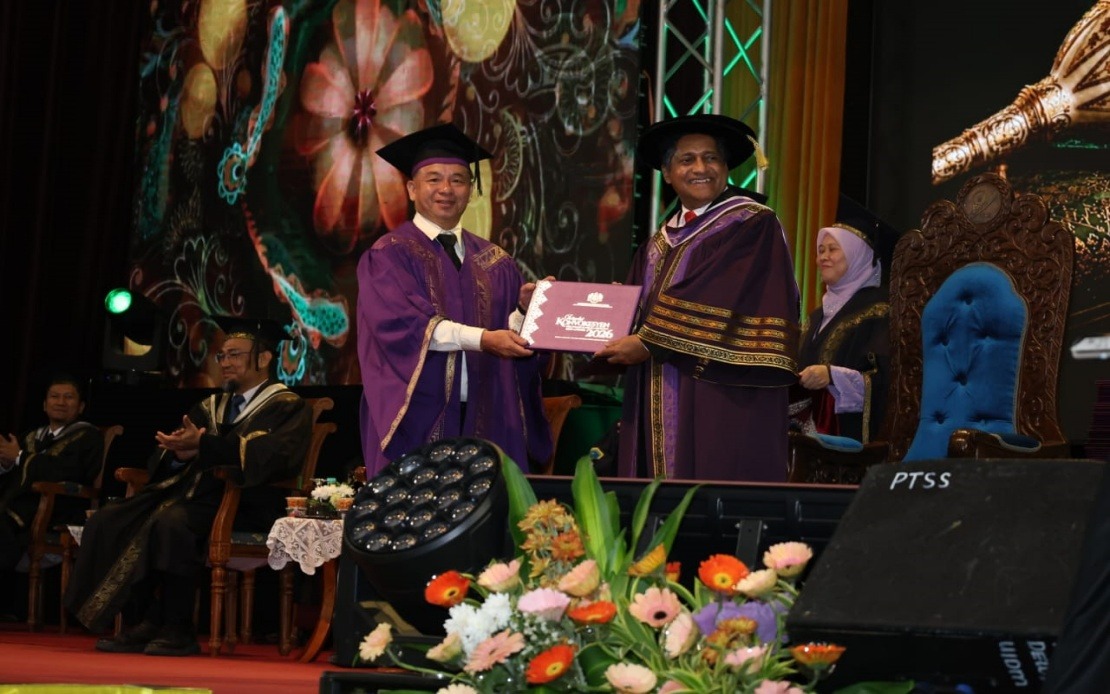
At 57 years old, Heng Meng Lai has shattered the assumption that formal education belongs exclusively to the young. During the Seberang Perai Polytechnic (PSP) Convocation Ceremony 2026, he became the institution's oldest graduate, earning his Diploma in Electrical and Electronic Engineering after deferring his educational aspirations for nearly five decades. His accomplishment represents more than a personal milestone—it signals a broader cultural shift in Malaysia towards recognising lifelong learning as a viable and valuable pathway for adult learners seeking career advancement and self-improvement.
Heng's journey to the graduation stage was shaped by early hardship and resilience. The third of seven siblings, he lost his father at age nine, leaving his mother to sustain the family through factory work. These formative struggles instilled in him a determination to transform his circumstances through education, even as competing demands—employment obligations and family responsibilities—repeatedly postponed his formal studies. For decades, this dream remained on the horizon, seemingly out of reach. Yet rather than abandoning it entirely, Heng carried the aspiration through decades of work experience, ultimately deciding that age would not be an excuse for inaction.
When he finally enrolled at PSP, Heng drew upon his industrial background to select his field of study. His extended tenure working in electronics manufacturing had cultivated a genuine passion for the technical aspects of electrical and electronic systems. This practical grounding meant he arrived at the polytechnic with real-world context that many younger students lacked, allowing him to connect classroom theory to tangible workplace applications. His choice of specialisation reflected a deliberate strategy to formalise and expand upon knowledge he had already acquired through years of shop-floor experience.
The transition to student life at 57, surrounded by peers typically decades younger, posed a significant cultural and social adjustment. Rather than experiencing marginalisation or diminished engagement from the institution, Heng found unexpected support from the academic staff. PSP's lecturers adopted a mentoring approach specifically tailored to his circumstances, providing patient guidance that acknowledged his maturity while recognising the learning curve inherent in formal education. This institutional responsiveness—creating an inclusive environment that neither patronised nor overlooked an older learner—reflects best practices in adult education that remain increasingly relevant across Malaysian higher learning institutions.
Heng's experience highlights a critical gap in Malaysia's education narrative. While the country has invested substantially in youth-oriented secondary and tertiary pathways, opportunities for mature workers seeking reskilling or upskilling remain comparatively limited. His success at PSP demonstrates that polytechnic institutions can serve not only school-leavers but also experienced professionals and career-changers. This expanded role becomes increasingly important as Malaysia navigates economic transitions, automation, and sectoral shifts that demand worker adaptability across all age groups. Adult learners like Heng possess motivation, discipline, and contextual understanding that distinguish them from traditional students.
Looking ahead, Heng's trajectory does not conclude with his diploma. He has explicitly stated his intention to pursue a Bachelor's degree, signalling that his educational ambitions extend well beyond merely obtaining a credential. This commitment to continued progression positions him within Malaysia's broader human capital development framework. His demonstrated willingness to invest in advanced qualifications, despite having already spent decades in the workforce, suggests that older workers may represent an underutilised reservoir of talent capable of reaching middle and senior technical or managerial roles if provided appropriate pathways.
PSP Director Mohd Ruzi Hamzah positioned Heng's achievement as emblematic of the institution's commitment to democratising access to quality technical education. The director's emphasis on Heng's occupational journey—from storekeeper to production supervisor to diploma-holding engineer—underscores the tangible career progression that structured vocational training can facilitate. This narrative counters the historically pervasive Malaysian narrative that polytechnic education serves only as a consolation pathway for those unable to secure university admission. Instead, it reframes polytechnics as dynamic institutions capable of nurturing meaningful professional advancement throughout a person's working life.
The broader policy implications of Heng's graduation extend beyond individual inspiration to systemic considerations. Malaysia has articulated ambitious targets for upskilling its workforce and transitioning towards higher-value economic activities. Realising these objectives requires engaging not only school leavers but also experienced workers who wish to formalise or update their qualifications. Creating flexible enrolment structures, offering evening or part-time programming, and establishing recognition of prior learning mechanisms would enable institutions like PSP to scale the kind of individualised support that enabled Heng's success. Such adaptations would yield significant returns in terms of economic competitiveness and worker satisfaction.
Furthermore, Heng's story offers valuable counter-narrative to age-related employment discrimination, a persistent challenge across Malaysia's labour market. Potential employers observing a 57-year-old pursuing advanced credentials might recognise such individuals not as costly or inflexible but rather as motivated, self-directed professionals capable of substantial contribution. The visibility of mature graduates within institutional convocation ceremonies normalises the presence of older learners and may encourage other mid-career workers harbouring educational ambitions to pursue them with confidence. This demographic dimension becomes increasingly salient as Malaysia's workforce ages and labour shortages in technical fields persist.
Heng's personal reflection—that learning recognises no age boundary—carries particular resonance in Southeast Asia's broader development context. Across the region, many economies grapple with skills mismatches and struggles to retain experienced talent. Reimagining education as a lifelong endeavour rather than a front-loaded investment completed by one's mid-twenties could help countries retain and develop workers who might otherwise face redundancy in transitioning economic sectors. Malaysia, as one of the region's more advanced economies, has the institutional capacity to lead in demonstrating how mature workers can be successfully reintegrated into formal learning environments.
As Heng prepares to re-enter the workforce armed with his diploma, and subsequently plots his pursuit of bachelor-level studies, his trajectory will likely encounter further obstacles and triumphs. The significance of his graduation ceremony, however, extends beyond his individual aspirations. It represents institutional validation that education serves purposes beyond age-normalised progression, that polytechnics can function as inclusive spaces for diverse learners, and that Malaysia's commitment to developing skilled human capital must encompass workers across all career stages. His diploma, earned at 57, stands as testament not merely to personal perseverance but to the untapped potential residing within Malaysia's experienced workforce.

