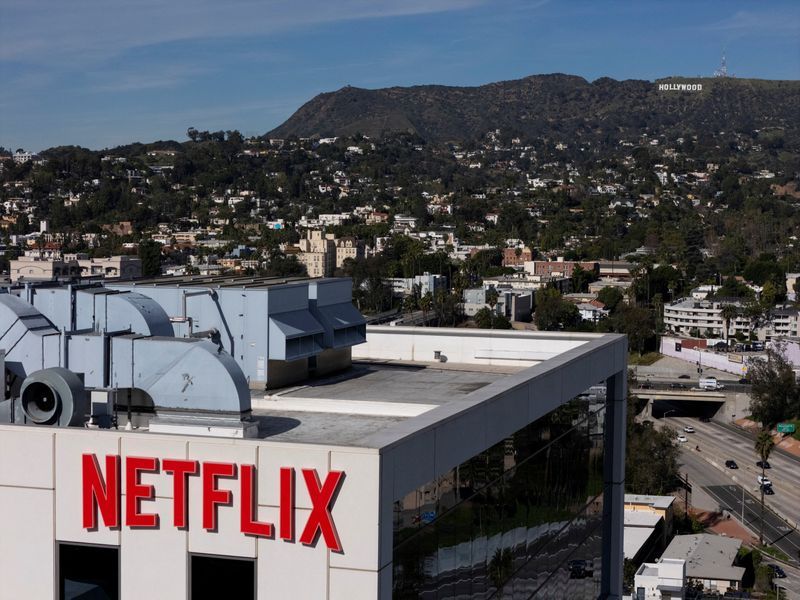
Netflix enters its second-quarter earnings announcement facing mounting investor concerns about the sustainability of its business model, having surrendered over a fifth of its market value this year amid questions about whether the streaming pioneer can reignite the explosive growth that once defined its trajectory. The Los Gatos-based company must convince Wall Street that it has mapped a credible path forward as traditional headwinds intensify and the easy wins from password-sharing crackdowns and subscription price increases begin to fade into the rear-view mirror.
Analysts tracking the company's performance expect revenues to climb 13.6 percent to $12.59 billion in the quarter ending in June, marking Netflix's slowest advance in more than four consecutive quarters. This deceleration underscores the reality that Netflix has matured from a growth-stage disruptor into an established media giant grappling with the constraints of an already-saturated market. Adjusted earnings per share are projected to reach 79 cents, reflecting a business that remains profitable even as its expansion engines cool. For a company built on the promise of relentless growth, these figures signal a fundamental transition that the investment community has begun to price into valuations.
The advertising tier represents Netflix's primary lever for reigniting momentum as it confronts the ceiling on subscription growth. The ad-supported business is forecast to generate $705.8 million in quarterly revenue, yet this figure has disappointed relative to earlier expectations circulating among market analysts. Emarketer's Ross Benes highlighted the disconnect between optimistic forecasts and actual performance, noting that advertising expansion has proceeded at a considerably more measured pace than most Wall Street observers initially anticipated. This shortfall matters deeply because Netflix and management had positioned ads as the growth engine that would offset decelerating subscriber additions once the benefits of cost increases and account-sharing restrictions were exhausted.
The structural challenge Netflix confronts extends beyond near-term advertising revenue. A growing body of evidence suggests that viewer loyalty across the platform is fragmenting in ways that threaten long-term economics. Bloomberg News reported recently that audiences for acclaimed original series have exhibited a troubling pattern: shows that captivate millions in their inaugural season experience dramatic audience attrition when new chapters arrive. The Night Agent and Beef—both celebrated programs that drove subscriber engagement—hemorrhaged roughly half or more of their viewership between seasons, a pattern that inverts the traditional television economics Netflix promised to disrupt. This retention crisis implies that the company may need to allocate substantially more capital toward content production simply to maintain engagement levels, compressing margins and consuming resources that might otherwise fund growth investments.
Netflix's response to these pressures reveals the company's strategic pivot toward experiential and live entertainment offerings that could deepen subscriber value propositions. The company has been exploring bids for FIFA World Cup broadcasting rights covering 2030 and 2034 competitions in the United States, a move that would align the platform alongside traditional sports broadcasters in acquiring premium live content. Simultaneously, Netflix has engaged in acquisition discussions around Letterboxd, the online film community platform, suggesting a willingness to bundle social discovery features alongside its core streaming service. These initiatives reflect a recognition that content alone may no longer suffice to differentiate Netflix from rivals including YouTube, mobile viewing platforms, and incumbent broadcasters who now operate sophisticated streaming operations of their own.
The competitive environment surrounding Netflix has transformed fundamentally since the company achieved dominance through streaming-exclusive models and original programming investments. Traditional media conglomerates including Comcast's NBCUniversal have launched competitive platforms with access to vast libraries of established intellectual property, creating consumer choice that fragmented the streaming market in ways Netflix's leadership perhaps underestimated. YouTube's short-form video ecology and mobile platforms have captured incremental viewing hours that previously flowed toward longer-form episodic content. This landscape suggests that Netflix's challenge transcends advertising monetization or subscriber acquisition—the company must convince a distracted, overwhelmed audience that its particular selection of content and features justifies ongoing financial commitment amid proliferating alternatives.
Industry observers including Paolo Pescatore from PP Foresight have articulated the philosophical challenge Netflix confronts as it matures. The company has transitioned from disrupting established media into becoming the establishment itself, a position that requires fundamentally different strategic thinking. Growth from a position of dominance requires cultivation of increasingly marginal customer segments, whereas Netflix achieved its ascent by capturing the mainstream. Sustaining momentum from such a substantial base demands either expanding into adjacent markets, deepening monetization within existing audiences, or both—a considerably more difficult proposition than the company's earlier expansion phases.
Market speculation has swirled regarding potential acquisitions following NBCUniversal's separation from Comcast, yet observers expect Netflix to pursue a measured approach focused on smaller, strategic transactions rather than another transformative deal. This discipline reflects both the company's financial constraints given its valuation discount and a growing recognition that scale in streaming has provided diminishing returns. Netflix's leadership must balance growth aspirations against the sobering reality that the incremental subscriber becomes progressively more expensive to acquire and more prone to churn, a dynamic that complicates any return to historical growth rates without fundamental business model innovation.

