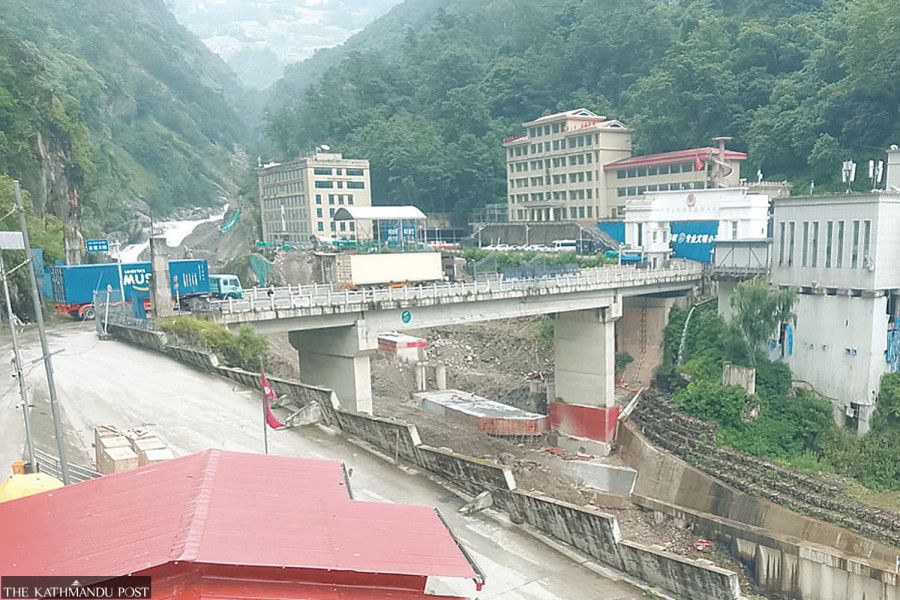
Nepal's overland commerce with China grinds to a halt almost every year as monsoon rains unleash landslides and floods across the Himalayan borderlands, a cycle that has persisted for nearly a decade with no end in sight. The disruptions come at a particularly costly moment, coinciding with Nepal's peak festival season when demand for imported goods surges, forcing traders and consumers to absorb mounting price increases. The northern routes, which should serve as vital arteries linking Nepal to its northern neighbour, instead become impassable quagmires for weeks or months at a stretch, leaving cargo stranded and delivery schedules in disarray.
Two principal overland corridors connect Nepal to China: the Araniko Highway terminating at Tatopani, and the Syabrubesi-Rasuwagadhi route. Both traverse extraordinarily difficult terrain—steep mountainsides studded with unstable slopes and fast-flowing rivers that swell unpredictably during the monsoon. Narendra Pariyar, chief district officer of Rasuwa, describes the phenomenon with understated candour: landslides occur "frequently" and the road "goes on and off during monsoon" as if controlled by an unseen switch. The geographic predicament is undeniable, yet experts increasingly argue that nature alone cannot shoulder the blame for the recurrent paralysis.
Kalpana Adhikari, general secretary of the Nepal Geotechnical Society, points to systemic failings in how Nepal has designed and maintained these routes. Engineers, she argues, typically focus narrowly on road construction while disregarding the geological realities surrounding their projects. Slope investigations and protective measures—fundamental to stability in such terrain—are routinely subordinated to cost considerations and expedience. However, Adhikari acknowledges a recent policy shift: the current government's decision to ring-fence separate budgets specifically for slope studies and protection represents a meaningful departure from past negligence.
The financial barriers to remediation remain substantial. Trade officials and business leaders estimate that stabilising the most landslide-prone sections would require approximately Rs200 million. Yet even projects formally contracted have languished incomplete. A Rs480 million rehabilitation contract was cancelled after China signalled its willingness to undertake the repairs independently, but neither nation has since followed through, leaving the vulnerable section frozen in its deteriorated state and serving as a monument to bureaucratic inertia across two governments.
Tatopani, which has operated as a border crossing since 1967 at the terminus of the Araniko Highway, now sits completely shuttered due to successive landslides along the Tatopani-Bahrabise section. This is not a recent or temporary closure. Over the past eight to ten years, this road has been repeatedly assailed by landslides of varying intensity almost annually, severing the border for protracted periods. The Bhotekoshi River, which runs immediately below the highway along a steep slope, creates conditions that Krishna Prasad Sharma, assistant chief district officer in Sindhupalchok, describes as inherently precarious. The route's vulnerability was exacerbated by the catastrophic 2015 earthquake, which devastated the area and from which the crossing has never genuinely recuperated. Most tellingly, China has resisted reopening Tatopani to outbound cargo exports since the earthquake, a political decision that has effectively amputated Nepal's ability to use this traditional conduit for shipments to the north.
The economic consequences are staggering. Tatopani typically processed thirty to forty trucks daily in functioning periods and was projected to generate Rs25 billion in annual revenue. These aspirations have evaporated. With the crossing closed at the beginning of the fiscal year, traders have been compelled to reroute consignments through Kerung on the Chinese side, a workaround that has more than tripled transport costs from approximately Rs90,000 to about Rs300,000 per shipment to Kathmandu. Beyond the price shock, the detour introduces severe delays—as Rajendra Sangraula, president of the Nepal Freight Forwarders Association, observes with dark humour, "summer goods can end up arriving in winter." These delays compound losses through mounting detention charges on containers stranded along extended routes.
Rasuwagadhi, the second major crossing, confronts parallel predicaments rooted in different immediate triggers. The Syabrubesi-Rasuwagadhi road, engineered and opened by the Nepali Army in 2018, was designated for upgrading under a 2019 Nepal-China implementation agreement supported by Chinese grant funding. That work remains substantially incomplete. The sixteen-kilometre stretch continues to succumb to monsoon flooding and washouts. Last July, a flash flood on the Lhende River obliterated the Miteri Bridge and ravaged the customs yard, necessitating replacement with a temporary Bailey bridge possessing only roughly half the original structure's capacity. Consequently, daily cargo throughput has collapsed from sixty to seventy loaded containers to merely thirty to forty. Adding insult to infrastructure injury, the Integrated Check Post at Rasuwagadhi stands only approximately sixty per cent complete, with customs operations persisting from makeshift provisional facilities rather than the proper infrastructure that would expedite clearance and reduce congestion.
Kewal Prasad Bhandari, former secretary of the National Planning Commission and erstwhile chief of Tatopani Customs, identifies inadequate facilities as a substantial constraint independently of weather and geology. Rasuwagadhi, he stresses, "still lacks smooth customs infrastructure," a shortcoming that compounds the challenges created by incomplete physical infrastructure and compromised bridge capacity. A third crossing, Korala, commenced international operations only in the previous fiscal year and currently handles negligible cargo, offering neither a substitute for the disabled northern routes nor meaningful relief to the trade system.
The financial impact radiates beyond border districts into Nepal's broader economy. Rerouting through Kerung alone inflates goods costs by an estimated twenty to twenty-five per cent by the time merchandise reaches consumers. Freight operators anticipate overall logistical expenses climbing to approximately thirty per cent of transaction value this year, up from twenty-two per cent previously. This escalation materialises precisely when Nepali households prepare for Teej, Dashain, and Tihar—peak shopping periods when imported goods consumption surges dramatically.
The disruptions simultaneously lay bare deeper structural imbalances in Nepal-China commerce. Tatopani and Rasuwagadhi collectively facilitated more than Rs93 billion in imports during the previous fiscal year. Exports to China, by contrast, remained negligible at below Rs2 billion. Posh Raj Pandey, chair emeritus of the South Asia Watch on Trade, Economics and Environment, argues that the disparity reflects not merely infrastructure deficiency but also fundamental diplomatic and strategic priorities. Nepal's national trade architecture has historically oriented exports toward the Indian market rather than China, and complementary support systems—functioning laboratory testing and quarantine facilities meeting Chinese phytosanitary requirements—remain underdeveloped. Pandey contends that addressing the crisis demands diplomatic engagement as much as physical reconstruction, requiring high-level negotiation to establish sustainable, cost-efficient corridors. Nepal's trade diplomacy, he notes, has chronically prioritised the Indian relationship, leaving the northern route systematically under-invested and strategically marginalised despite its significance as an alternative commercial artery.
The persistent monsoon disruptions thus represent not merely an environmental challenge or engineering problem, but rather a compound failure of planning, diplomacy, and institutional commitment spanning both countries. Until Nepal and China jointly prioritise completion of infrastructure projects, establish reliable maintenance protocols, and harmonise customs procedures, the annual paralysis will persist—exacting mounting economic costs on traders, consumers, and regional commerce throughout the broader South Asian ecosystem.

