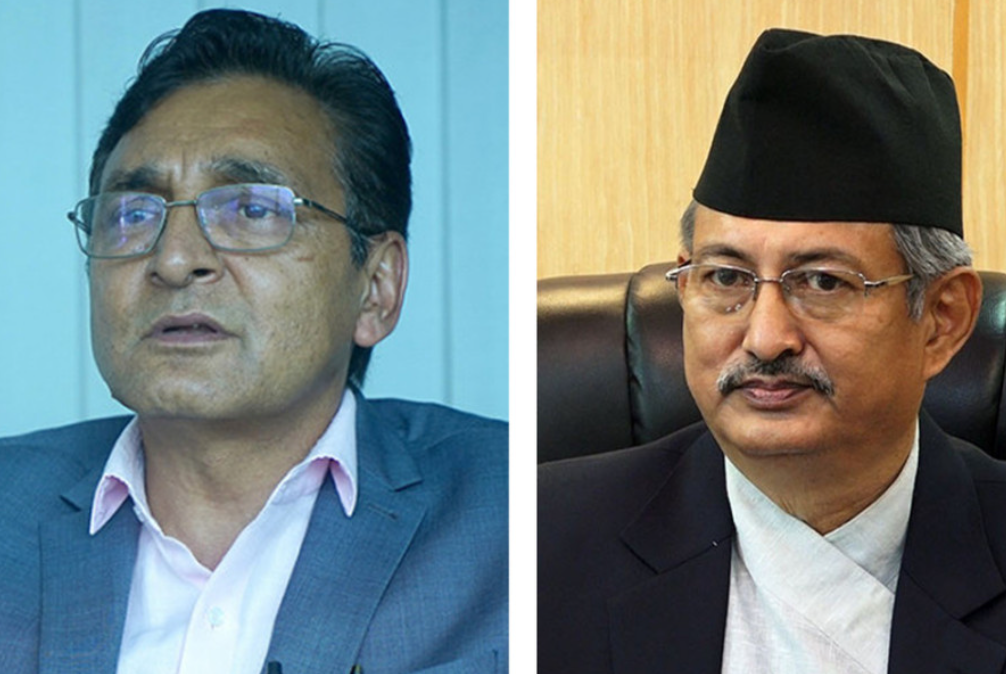
A Kathmandu district court has handed down prison sentences to two high-ranking former Nepali government officials who were found guilty of masterminding a fraud scheme involving the resettlement of Nepali citizens under false refugee credentials. Former Deputy Prime Minister and Energy Minister Top Bahadur Rayamajhi received a four-year sentence for offences against the state, fraud, and involvement in organised crime, while his co-conspirator and former Home Minister Bal Krishna Khand was sentenced to two years as an accomplice to the deception. The convictions mark a significant outcome in a case that has drawn attention to vulnerabilities in international refugee vetting systems and the extent of corruption that allegedly permeated Nepal's government before its recent political upheaval.
The verdict, delivered late on Tuesday and officially documented on Wednesday, represents the culmination of an investigation that exposed systematic exploitation of refugee resettlement programmes. Rayamajhi remains in custody following the ruling, while Khand, who had been granted bail during proceedings, was not present when the sentence was announced. Both officials have consistently maintained their innocence throughout the legal process, insisting they had no direct involvement in the fraudulent documentation scheme. Legal representatives for both men have already signalled their intention to challenge the convictions in higher courts, suggesting a drawn-out appellate process may yet unfold.
Beyond the two ministers, the court also convicted fourteen additional individuals implicated in the conspiracy, including a former senior bureaucrat from the home ministry and a previous leader of Bhutanese refugee communities in Nepal. These co-conspirators received sentences ranging up to four years, indicating that the fraudulent network extended well beyond ministerial circles into administrative machinery and refugee organisations themselves. The breadth of the conviction list underscores how the scam exploited institutional weaknesses and leveraged trust within refugee populations to facilitate forgery and deception on a considerable scale.
The specifics of how many Nepali nationals were ultimately processed and resettled to the United States under fraudulent Bhutanese refugee identities remain unclear. The opacity surrounding this critical detail raises troubling questions about the effectiveness of documentation verification procedures within the international resettlement framework, particularly concerning the vetting processes managed by American immigration authorities. This gap in public information may itself become a focal point for investigations by US authorities seeking to identify and potentially rescind status granted through fraudulent means.
The scam came to light in 2023, by which time both Rayamajhi and Khand had already departed their ministerial positions. This timing raises questions about whether the investigation benefited from political insulation following their departure from office, or conversely, whether their removal facilitated whistleblowing and evidence collection that might have been suppressed during their tenure. The case adds another layer to Nepal's longstanding corruption narrative, demonstrating that even schemes involving vulnerable refugee populations became vehicles for personal enrichment among powerful officials.
The broader context involves nearly 120,000 people of Nepali ethnicity who fled Bhutan beginning in the early 1990s, driven by political marginalisation in the Buddhist-majority Himalayan nation of fewer than 800,000 residents. These individuals, who constitute a significant proportion of Bhutan's population, sought refuge primarily in eastern Nepal, where many languished in camps for decades awaiting resolution to their displacement. Rather than facilitating bilateral repatriation agreements, Nepal and Bhutan eventually permitted international resettlement as an alternative solution, opening pathways through third-country programmes administered by Western nations.
Approximately 113,000 of these Bhutanese refugees have been successfully resettled across multiple Western democracies, with the United States accepting roughly 100,000 individuals through its resettlement programme. Canada and Australia have also participated in absorbing significant cohorts. The sheer volume of persons processed through these channels created both opportunity and incentive for exploitation, as the scale of bureaucratic processing inevitably creates gaps where fraudulent documentation might slip through. The conspiracy uncovered in Nepal appears to have exploited exactly such vulnerabilities, manufacturing false identities and credentials to enable unqualified individuals to access resettlement slots intended for genuinely displaced persons.
Several thousand Bhutanese refugees remain in camps throughout eastern Nepal, many expressing determination to eventually return to their homeland despite the passage of three decades. These prolonged encampments represent a humanitarian holding pattern, with residents neither fully integrated into Nepali society nor able to access Bhutanese citizenship. The refugee fraud scheme is particularly troubling within this context, as it diverted scarce resettlement opportunities from those most desperately seeking escape from camp conditions, enriching officials while extending suffering for legitimate claimants.
Nepal's political landscape has shifted dramatically in recent months, creating conditions for more aggressive anticorruption enforcement. In September of the previous year, youth-led demonstrations protesting rampant government corruption escalated into violence resulting in 76 deaths and ultimately forcing the resignation of the ruling administration. The subsequent electoral cycle brought to power a new government led by Balendra Shah, a 36-year-old former rapper whose party emerged with significant Gen Z support and a mandate to systematically address corruption embedded within state institutions. Shah's administration has explicitly prioritised investigating and prosecuting malfeasance committed under his predecessors, making high-profile convictions like Rayamajhi and Khand politically valuable demonstrations of resolve against entrenched corruption.
The refugee resettlement fraud case thus operates simultaneously on multiple levels: as a specific criminal matter with identifiable perpetrators and victims, as symptomatic of deeper institutional decay within Nepal's government apparatus, and as a potential diplomatic matter affecting US-Nepal relations and international confidence in refugee verification procedures. The convictions provide partial closure for one chapter of this multifaceted scandal, yet significant questions remain unresolved regarding the full extent of fraudulent resettlement, the security implications of false identities entering Western countries, and systemic reforms necessary to prevent recurrence of similar schemes in future refugee processing operations.

