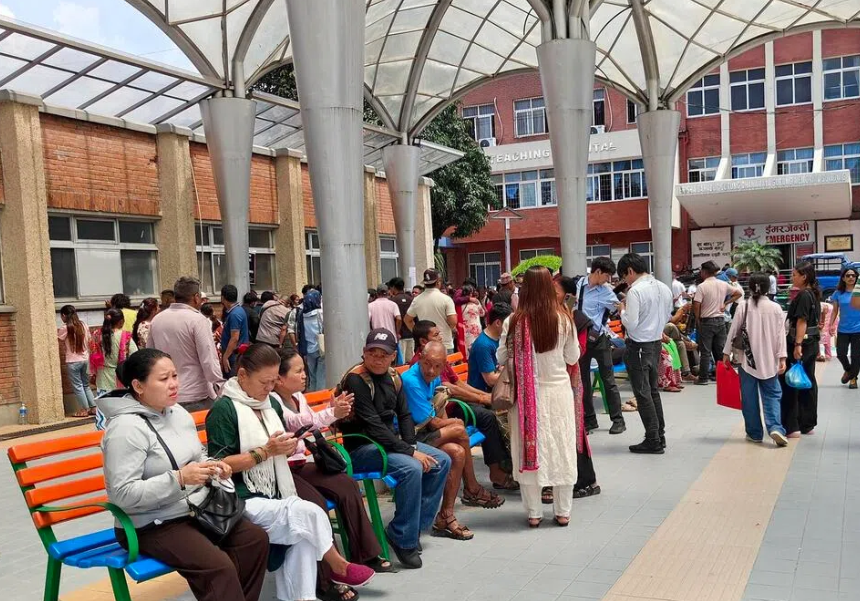
The aftermath of Nepal's catastrophic flash flood on August 26 has transformed Kathmandu's Tribhuvan University Teaching Hospital into a grim centre of identification and mourning. For the past seventy-two hours, the hospital's gates have been lined with photographs of severely damaged bodies, creating a haunting tableau that has drawn hundreds of desperate family members to the capital. The death toll across northern Nepal has now surpassed 500, whilst the number of reported missing persons continues to climb, with more than 1,500 individuals unaccounted for as rescue teams navigate through the devastated Bhotekoshi river system and its downstream tributaries.
The scale of the humanitarian catastrophe has imposed an almost unbearable emotional burden on those searching for their loved ones. Dolma Tamang, a 36-year-old woman, has spent three days shuttling between Kathmandu's hospitals seeking any trace of her sister and brother-in-law, whose truck was traversing Rasuwa district when the floodwaters struck on the morning of August 26. The couple, engaged in cross-border goods transport from China, have been completely unreachable since that morning. When Tamang spoke with The Straits Times, her voice reflected the exhaustion of hope deferred. "It has been very difficult; my tears have run dry," she said, capturing the profound desolation experienced by thousands of relatives now cycling through hospitals with photographs printed on paper and displayed on their mobile phones.
The identification process itself has become its own ordeal. Bikesh Shrestha, a 35-year-old searching for his cousin Rakesh, found himself unable to view the displayed photographs of the deceased. Standing outside the hospital gates, he turned away from the images, hugging himself to prevent emotional collapse whilst simultaneously clinging to the possibility that his cousin might have survived. The psychological toll on searchers is immense, as they confront the possibility of losing their family members while being confronted by images of disfigured remains. Inside the same hospital, Sushila Shrestha, just 23 years old, searches for her younger brother Bir Bahadur Shrestha, a driver who was traversing Rasuwa district when the disaster struck. The absence of any news has paradoxically become a source of desperate optimism for her. "I am convinced he will return; he has to return," she insisted, illustrating how families grasp at silence as evidence of survival.
The disaster's geographic concentration along the Nepal-China border has created particular vulnerability for those engaged in regular cross-border commerce. The August 26 flash flood devastated multiple districts along established trade routes, with Rasuwa district bearing a disproportionate burden. The Gyirong border crossing, connecting Nepal to Tibet, was severely damaged by mudslides and floodwaters, creating a geographic bottleneck where hundreds of people and vehicles were caught in the deluge. Many of the foreign nationals now missing were engaged in the sacred Kailash-Mansarovar pilgrimage, a spiritually significant journey that routes through this border region. Approximately 288 Indian nationals remain unaccounted for, many of whom were either initiating the pilgrimage or returning from Mount Kailash and Lake Manasarovar when the flooding occurred.
The international dimension of this disaster has prompted an unusual convergence of family members from across the region. The Nepal Tourism Board reported on August 28 that whilst 121 foreign tourists had been rescued—including 85 Indians and 16 Chinese nationals—many others remained missing. A group of men from Tamil Nadu arrived in Kathmandu on an early morning flight from New Delhi on August 28 to locate members of a travel group that had become separated whilst returning from Tibet. One man from Coimbatore made the journey to assist his friend in tracing his wife and son, offering reassurance upon landing: "Whatever it is, we will face it together; you have to be strong." Singapore has also been affected, with nine Singaporean nationals reported missing in the initial aftermath.
Nepal's rescue and recovery operation has been substantial, though hampered by both logistical challenges and environmental uncertainties. More than 4,400 police personnel have been deployed specifically for search and rescue operations, whilst the Nepali Army and Armed Police Force have been mobilised across affected areas. However, on the morning of August 28, rescue efforts were temporarily suspended due to concerns that a barrier lake breach could unleash another catastrophic flash flood. By evening, operations resumed after officials determined there was no immediate danger, though the situation remained unclear and precarious. The government has established mechanisms to update the public on rescue operations, with names of those successfully rescued being posted on an official website.
The infrastructure destruction has compounded the humanitarian challenge significantly. Dozens of bridges ranging from small footbridges to major structures have been destroyed or severely damaged across the affected regions. Chitwan district, located further downstream and adjoining India's border, has experienced particularly devastating impacts, with its world-famous national park and elephant sanctuary area suffering extensive damage. Roads through the district have become impassable due to debris and silt accumulation. By August 28 afternoon, the district had recovered 186 bodies, yet its hospitals possessed morgue capacity for only 30 to 50 deceased individuals. The Kathmandu Post reported that hospitals throughout several districts were already running critically short of space for storing bodies, raising serious concerns about the infrastructure's ability to manage the scale of mortality.
Nepal's leadership has taken a deliberate approach to international assistance, informed by lessons learned from the devastating 2015 earthquake. Prime Minister Balen Shah has declined offers from China, India, and other nations to deploy their own search and rescue teams, reasoning that previous experiences with multiple international rescue coordination had created inefficiencies and complications. Instead, the government has requested financial assistance through a unified mechanism that officials planned to announce shortly. This strategic decision represents a shift towards prioritising financial support for reconstruction and rehabilitation over direct operational assistance. India, meanwhile, has already sent 47 tonnes of humanitarian aid including temporary shelters, blankets, hygiene kits, solar lamps, medicines, and food packets via military transport aircraft. New Delhi has additionally offered prefabricated truss bridges to facilitate reconstruction of critical infrastructure damaged in the deluge.
The missing persons situation continues to evolve as recovery operations progress and communication networks are gradually restored. Families maintain hope tempered by the harsh reality reflected in the photographs displayed at hospital gates throughout Kathmandu. The disaster has particularly affected those engaged in cross-border commerce and pilgrimage activities, populations whose livelihoods and spiritual practices necessarily expose them to the region's geographical hazards. As search teams continue combing through downstream areas, the distinction between hope and acceptance becomes increasingly blurred for those awaiting news.

