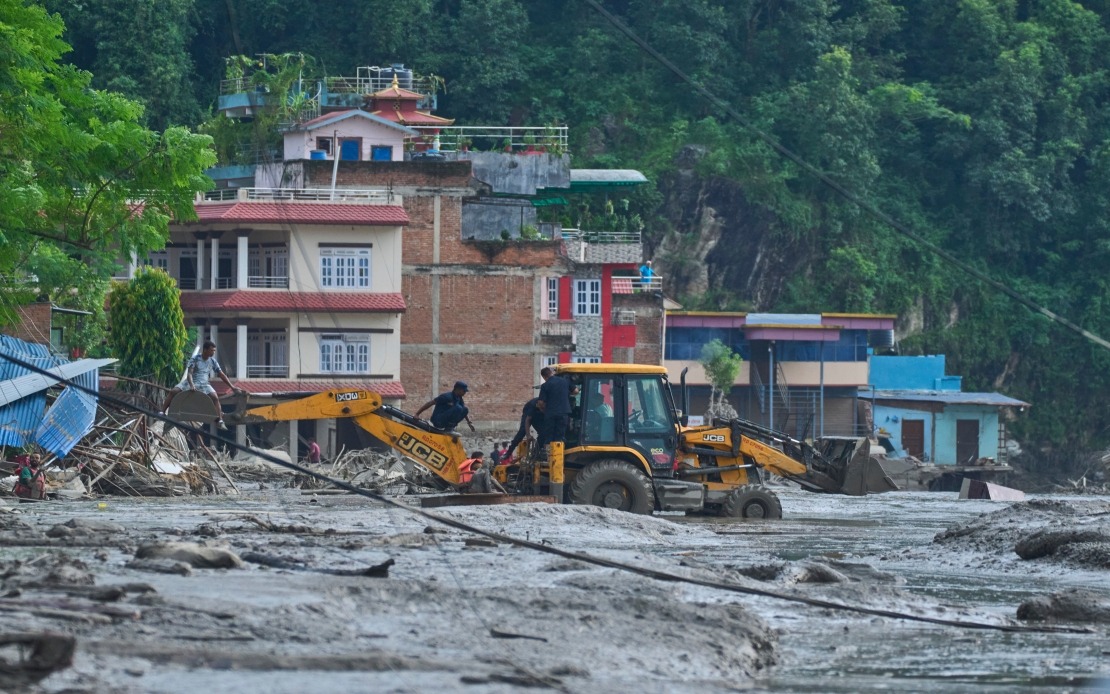
A catastrophic disaster unfolded along the Nepal-China border on Wednesday as flash floods and landslides claimed at least 160 lives and left more than 680 people unaccounted for, according to officials from both nations. The calamity has emerged as one of the region's most significant natural disasters in recent years, triggering urgent search and rescue operations on both sides of the frontier and drawing international humanitarian attention across South and Southeast Asia.
Nepalese authorities reported recovering 157 bodies so far, whilst successfully extracting 54 survivors from the devastated areas. Across the border, Chinese state-run media confirmed three fatalities and 265 missing persons in the southern Tibet region. The grim statistics underscore the scale of destruction, with officials working to establish precise casualty figures as recovery efforts continue in remote, mountainous terrain where communication remains disrupted and access difficult.
The Nepalese Prime Minister's Office released a breakdown of the missing that illustrated the diversity of those caught in the disaster. Security personnel bore a particularly heavy toll: 44 army personnel, 28 police officers, and 13 armed police operatives disappeared during the emergency. Additionally, 60 civilian workers employed on hydropower projects vanished, whilst initial reports indicated 484 missing tourists and travellers, comprising 391 foreign nationals and 93 Nepali citizens. The involvement of so many workers on energy infrastructure projects highlights how economic development ventures in challenging terrain carry substantial risk during extreme weather events.
The infrastructure damage proved equally staggering. At least 19 bridges were swept away entirely by floodwaters, whilst 40 kilometres of road—critical arteries through the mountainous region—were destroyed or rendered impassable. Thirteen hydropower projects sustained substantial damage, setting back Nepal's renewable energy ambitions and triggering financial consequences for domestic and cross-border development initiatives. Speaking to parliament, Nepalese Foreign Minister Sishir Khanal described the disaster as erasing hydropower projects, government offices, and road facilities across the Rasuwa, Dhading, and Chitwan districts in sweeping terms that conveyed the comprehensive nature of the devastation.
The epicentre of destruction lay near Gyirong Port, a major binational border crossing in China's Xizang Autonomous Region. A massive mudslide struck the area with such force that it severed road connections to the port from the Chinese side whilst simultaneously cutting communications and power supplies, isolating affected communities and impeding rescue coordination. The incident highlighted the geographic vulnerability of border infrastructure in seismically active, high-altitude zones where steep terrain and seasonal weather patterns create persistent natural hazard risks.
The tourist dimension added urgency to rescue efforts. The Rasuwagadhi area serves as a primary gateway for trekkers accessing the Langtang region, one of Nepal's most celebrated trekking destinations that attracts thousands of international visitors annually. Many other travellers utilise the same crossing as a transit route to sacred religious sites including Mount Kailash and Lake Mansarovar in China. The timing of the disaster during trekking season meant that unusually high concentrations of foreign nationals were in the region, accounting for the large proportion of international missing persons.
The nationalities of those unaccounted for reflected the route's international importance. Missing persons included nationals from Malaysia, Australia, the United Kingdom, South Africa, India, and the Netherlands, with many others awaiting identification. South Korea's Foreign Ministry separately reported eight nationals unaccounted for and ten others stranded by the floods, prompting diplomatic engagement at the highest levels. This transnational dimension transformed the incident into a regional crisis requiring coordinated international response.
Both governments mobilised comprehensive rescue operations with available resources. Nepal deployed personnel from the Nepal Police, Armed Police Force, and Nepal Army, utilising helicopters, drones, and rafting equipment to search flood-affected zones and extract survivors from isolated pockets. Chinese authorities similarly launched all-out rescue efforts after President Xi Jinping issued direct orders for intensive search operations and humanitarian response. Xi specifically instructed evacuation of at-risk residents and provision of medical care to minimise additional casualties, signalling the priority attached to the emergency at China's highest political levels.
Regional states rapidly mobilised support infrastructure. In Kathmandu, government hospitals and security agency medical facilities were cleared and readied to receive casualties, reflecting anticipation of high injury numbers. India moved quickly on the diplomatic front, with Prime Minister Narendra Modi telephoning his Nepalese counterpart Balendra Shah to express condolences and pledge assistance. India subsequently dispatched 10 tonnes of humanitarian supplies, disaster relief materials, and medicines to support Nepal's emergency response, whilst Bihar state authorities in eastern India initiated heightened embankment monitoring and embankment patrolling given the flood's proximity to Indian territory.
The disaster carries significant implications for regional infrastructure development and cross-border cooperation. Hydropower projects represent crucial elements of Nepal's renewable energy strategy and economic development, yet the disaster exposed vulnerabilities in project design and worker safety protocols in extreme weather scenarios. The incident may prompt reassessment of disaster preparedness measures and climate resilience in infrastructure projects across the Himalayan region. For Malaysia and other Southeast Asian nations with citizens affected, the event underscores the risks inherent in adventure tourism activities in remote, high-altitude zones during monsoon seasons.
Longer-term consequences extend beyond immediate humanitarian concerns. The destruction of 13 hydropower projects threatens Nepal's energy security and development timelines. Road damage isolates communities and disrupts supply chains for both countries. Border crossing disruptions affect bilateral trade and tourism revenue. For Nepal's economy, which depends substantially on tourism and hydropower exports, the disaster represents a significant setback requiring sustained international support and reconstruction investment.
The unfolding recovery operations will test regional disaster management capabilities and international cooperation frameworks. The involvement of multiple nationalities and cross-border complications underscores how natural disasters transcend political boundaries and demand coordinated multilateral responses. As search efforts continue and casualty figures stabilise, attention will increasingly focus on rebuilding efforts and implementing lessons learned to protect against future disasters in one of the world's most geologically active and climatically variable regions.

