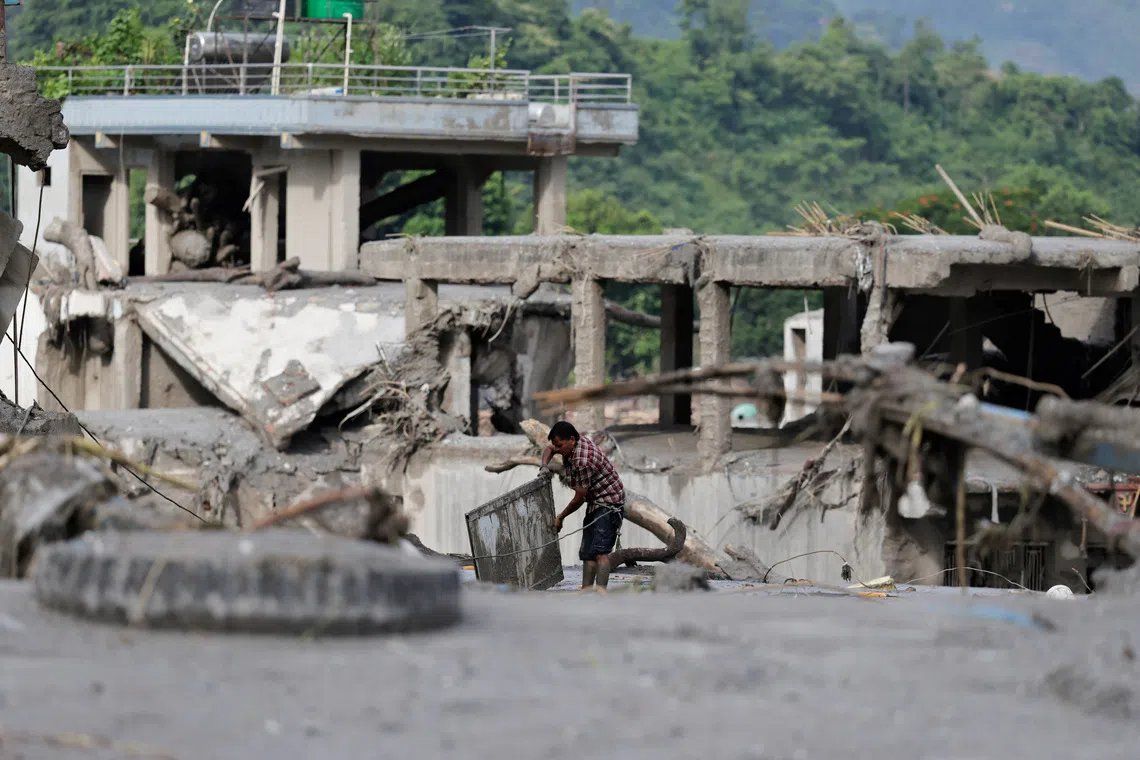
The disaster unfolding across the Nepal-China border has entered a perilous new phase, with authorities from both nations sounding alarms on Thursday over the prospect of secondary flooding triggered by two unstable lakes that have formed in the wake of a catastrophic glacier collapse. The original deluge that struck the Himalayan region on Wednesday claimed at least 362 lives, left over 1,000 people missing, and created conditions that have spawned fresh hazards potentially as dangerous as the initial catastrophe. Search and rescue teams continue operating across debris-laden valleys and slopes, but they now face the added burden of accelerating their work against an intensifying clock as water levels in both lakes creep dangerously toward critical thresholds.
The entire calamity originated from a massive glacier failure in the high mountains, which unleashed enormous quantities of rock, ice, and mud into the river systems that flow through some of Asia's most challenging terrain. This initial collapse generated the deadly Wednesday flood that ravaged border communities, but the debris also created an unintended consequence: the accumulation of material has obstructed natural waterways, causing water to pool behind these impromptu barriers and form what amounts to natural dams lacking any engineered safety systems. Nepal's disaster management authority recognized the danger almost immediately and on Thursday formally cautioned the public about the rising waters trapped behind the debris blockage at the original flood site, explicitly ordering residents, rescue personnel, and all those in lower-elevation areas to move away from riverbanks and seek higher, safer ground.
The situation on the Chinese side of the border appears even more urgent, with state authorities warning that approximately 3 million cubic meters of water—a volume equivalent to roughly 1,200 Olympic-sized swimming pools—will flow into an already-dammed lake over the coming three days. This inflow poses an extreme risk that the dam could fail or be overtopped, potentially releasing a secondary surge of floodwaters that could cascade downslope with tremendous force. Chinese water resources officials have projected that the most dangerous period will arrive around September 1, when the combined flow is expected to peak. The prospect of such a breach has alarmed both governments and the international community, as the consequences could extend the disaster zone across international boundaries and impact populations that have only just begun to process the initial tragedy.
Weather forecasts have added another layer of concern to an already fraught situation. Rainfall expected across the region over the coming week will continue to swell both lakes, further increasing the pressure on the natural barriers holding them back. Zhu Jinfeng, a researcher with China's water resources ministry hydrology department, stated to the national broadcaster CCTV that "the volume of water is continuing to increase, and so is the risk," underscoring how each passing day compounds the threat rather than allowing it to stabilize. This meteorological timing is particularly unfortunate, as the region would benefit from a period of drier conditions to allow water levels to recede or at least stabilize. Instead, the forecast suggests that nature will continue to work against recovery efforts and safety.
The warnings have already begun to influence operations on the ground. Rescue workers in Nepal, who had been concentrating their efforts in the disaster zone to locate missing persons and retrieve bodies, have begun relocating to higher elevations and safer locations away from the threatened river corridors. Pawan Koirala, leading a rescue team of 13 personnel, described the difficult decision to withdraw from areas where people still needed assistance but where the secondary flood risk had become untenable. "We are here for rescue and don't want to be near the danger zone," Koirala explained, capturing the tension between the humanitarian imperative to continue searching for survivors and the practical necessity of preserving the lives of the very rescuers attempting to save others.
For regional observers, particularly in Southeast Asia, the unfolding situation underscores the vulnerability of cross-border river systems and the consequences of large-scale climate and glacial changes in the Himalayan region. The reliance of downstream populations on rivers for water, agriculture, and transportation makes them acutely exposed to sudden geological events that generate floods with minimal warning. Malaysia and other nations in the region with their own mountain-fed river systems should consider whether their own early-warning systems and inter-agency coordination protocols are adequate to handle similarly unexpected secondary hazards following major disasters.
The economic and humanitarian toll will extend well beyond the immediate death toll once the full picture emerges. The disruption to transportation routes, agricultural lands, and infrastructure across the border region will likely persist for months or years, affecting trade between Nepal and China as well as the broader regional economy. Nepal's tourism sector, heavily dependent on Himalayan trekking and mountaineering, faces potential setbacks as access to regions becomes restricted and traveler confidence wavers. Insurance companies and development agencies will confront significant claims and rebuilding challenges, while governments grapple with the costs of expanded rescue operations and the displacement of thousands of people.
The coordination between Nepal and China in issuing joint warnings and sharing information about the glacier collapse and secondary flood risks demonstrates some positive aspects of bilateral cooperation during crisis. However, the speed and scale of the disaster also reveals gaps in predictive capacity and infrastructure resilience that affect the entire Himalayan region. Building more robust monitoring systems, upgrading downstream flood defense infrastructure, and developing clearer evacuation protocols could help mitigate the impact of future such events. For now, the focus remains on the immediate threat posed by the expanding lakes and the race to move people and equipment to safety before the critical window closes around September 1.

