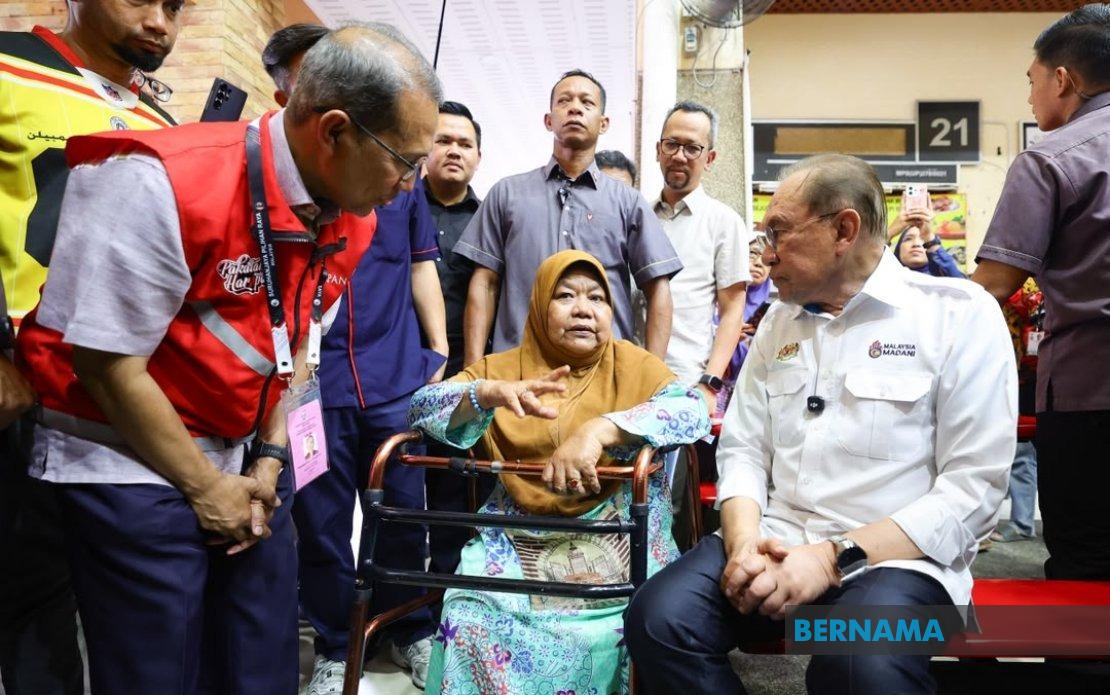
Prime Minister Datuk Seri Anwar Ibrahim has held up the implementation of reciprocal river development projects across Negeri Sembilan as a tangible demonstration of the Pakatan Harapan administration's willingness to return state resources directly to communities. Speaking during a public engagement in Ampangan on Monday, Anwar argued that such initiatives exemplify how development agendas can be aligned with the public interest through transparent and accountable governance structures, marking a departure from previous administrative practices that residents had experienced under earlier state governments.
The initiative is particularly evident in the Ampangan area, where combined river widening and deepening operations serve a dual purpose. Beyond the immediate practical benefit of reducing flooding vulnerability in this riverside locality, the project framework specifically ensures that ancillary resources generated during construction are recycled back into community welfare rather than disappearing into state coffers or private pockets. This model reflects a deliberate policy choice to make development self-sustaining and community-centric rather than extractive.
Central to this approach is the strategic redeployment of sand excavated during river dredging operations. Rather than treating extracted materials as waste or valuable commodities to be sold off, the Negeri Sembilan government has instituted a system where revenue from sand utilisation finances ongoing maintenance and infrastructure enhancement within the same river corridors. This circular economy principle transforms what might otherwise be a one-time intervention into a mechanism for continuous improvement of local water management infrastructure, reducing the long-term fiscal burden on state budgets.
Anwar's remarks came during a community forum event held in Ampangan, where he engaged directly with residents to discuss governance priorities and development philosophy. The occasion provided an opportunity to contextualize the river projects within a broader framework of integrity-based governance, a concept the Prime Minister has consistently positioned as foundational to Malaysia's political and developmental trajectory. For many Negeri Sembilan voters preparing for the upcoming state election, such concrete examples of how governance principles translate into neighbourhood-level benefits carry significant weight in determining electoral preferences.
The Prime Minister reinforced his broader argument by drawing parallels to his earlier experience negotiating the Port Dickson hotel development, a project that required balancing commercial interests with social responsibility toward the local fishing community. In that instance, the negotiated terms included provisions for educational support and housing improvements for affected residents, illustrating how development projects can be structured to incorporate welfare considerations from inception rather than addressing them as afterthoughts. This comparative framing suggests that integrity-based governance is not merely rhetorical but manifests in tangible protections for vulnerable populations during development implementation.
Emphasizing that every state project must prioritize community welfare, Anwar called upon Negeri Sembilan residents to exercise their voting power strategically in the state election. His appeal transcended simple partisan cheerleading by arguing that voters should focus on selecting trustworthy individuals regardless of ethnic or religious background, reflecting the multiethnic composition of Negeri Sembilan's population. This framing attempts to shift electoral discourse away from narrow communal calculations toward broader questions of personal integrity and demonstrated competence in governance.
For the August 1 state election, Pakatan Harapan is mounting a comprehensive campaign across all 36 state constituencies. The coalition has distributed candidatures according to its established arrangement: Parti Keadilan Rakyat holds 16 seats, the Democratic Action Party contests 11, and Amanah fields nine candidates. This division reflects both the relative organisational strength of coalition members within the state and strategic calculations about which party best appeals to particular electoral constituencies. Early voting is scheduled for July 28, allowing working professionals and those with mobility constraints to participate before polling day.
The timing of Anwar's Negeri Sembilan visit reflects the intensifying campaign schedule as the election approaches. As Pakatan Harapan chairman, the Prime Minister's presence at grassroots engagement events serves multiple purposes: it amplifies media attention on coalition campaign messaging, provides visible endorsement to local candidates, and allows the party leadership to emphasize themes of clean governance directly to voters. The Ampangan event specifically featured Muhammad Nazri Kassim, the PH candidate for the Ampangan state seat, positioning the local representative within the broader narrative of integrity-driven governance that Anwar emphasised.
Negeri Sembilan has emerged as a significant political battleground in Malaysian electoral politics. As a relatively compact state with a population of approximately one million, it represents a microcosm where specific governance successes or failures can be evaluated by voters with relative clarity. The emphasis on visible infrastructure projects and transparent resource management suggests that Pakatan Harapan campaign strategy in the state is grounded in demonstrable achievements rather than abstract promises, a strategy designed to appeal to pragmatist voters concerned with tangible improvements to daily life and local infrastructure conditions.
The reciprocal river project model also carries implications for how Malaysian state governments might approach infrastructure financing and maintenance in the broader context of fiscal constraints. Many state administrations across the country face chronic shortfalls in maintenance budgets for essential services, leading to deteriorating infrastructure and mounting public frustration. By demonstrating how development projects can generate internal revenue streams for ongoing upkeep, Negeri Sembilan offers a potential blueprint for other states seeking to break the cycle of deferred maintenance that characterises many Malaysian municipalities. This aspect of the initiative extends beyond campaign messaging to suggest potential systemic reforms in how development resources are managed.
Anwar's governance message resonates within Negeri Sembilan partly because the state has experienced significant administrative transitions in recent years. The restoration of Pakatan Harapan control in the state represented a significant political shift, and consolidating that position in the upcoming election is essential for the coalition's broader national political standing. A successful performance in Negeri Sembilan state election would provide Anwar with fresh momentum heading into potential federal electoral contests, making this regional contest strategically significant within national political calculations. The emphasis on corruption-free governance and direct resource returns to communities addresses voter concerns that transcend state boundaries, touching on fundamental questions about how Malaysian government operates at all levels.

