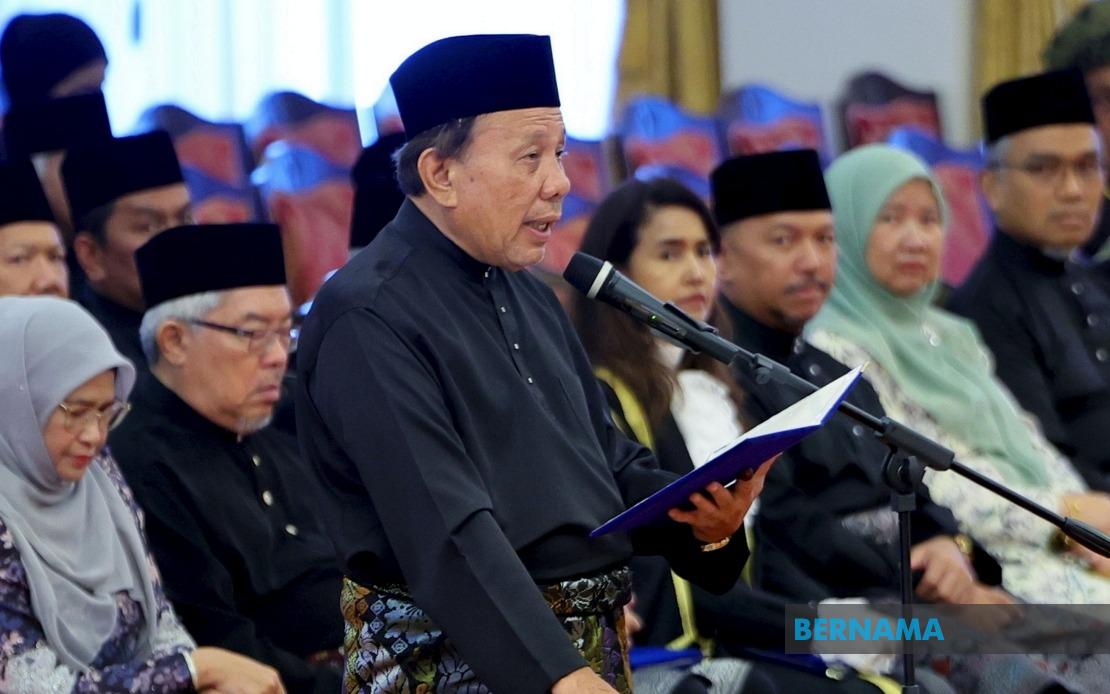
Datuk Ismail Lasim took the oath of office as Negeri Sembilan's new Menteri Besar at an investiture ceremony in Kuala Pilah, marking the formal transition of leadership following the state election results. Speaking before Yang Dipertuan Besar Tuanku Muhriz Tuanku Munawir at Istana Besar Seri Menanti, Ismail articulated his vision for steering the state through a fresh administrative chapter grounded in accountability and responsiveness to citizens' needs.
The incoming chief minister framed his appointment as both an honour and a solemn responsibility, emphasizing that the electoral mandate carries profound obligations beyond ceremonial acceptance. Ismail stressed that governing with public trust requires demonstrable commitment to fairness, openness, and tangible delivery of services, positioning these principles as foundational to his tenure rather than aspirational rhetoric. This framing signals an attempt to reset public expectations after the electoral transition, signalling that performance metrics and institutional responsiveness will be central to his administration's legitimacy.
Ismail's commitment to upholding constitutional monarchy and parliamentary democracy underscores the institutional framework within which his government must operate, particularly within Malaysia's system of delegated sovereignty. His pledge to respect the Yang Dipertuan Besar's guidance reflects the ceremonial and substantive role played by royal institutions in state administration, a feature that distinguishes Negeri Sembilan's governance structure. For regional observers, this deference illustrates how Malaysia's constitutional arrangements embed checks on executive authority through established hierarchical relationships and traditional institutional channels.
A distinctive element of Ismail's inaugural address centres on Adat Perpatih, the customary system unique to Negeri Sembilan that emphasizes consensus, justice, and communal wisdom. The new leader's commitment to preserving and transmitting this heritage to future generations reflects recognition that state identity and governance legitimacy in Negeri Sembilan are inseparable from its matrilineal traditions and customary law framework. This positions development policy within a culturally-rooted governance paradigm rather than treating traditional systems as heritage curios divorced from contemporary administration.
On economic development, Ismail articulated a multi-faceted approach encompassing investment attraction, employment creation, skills development, and living standards improvement across both urban and rural constituencies. His emphasis on quality investment rather than mere capital inflow suggests awareness of concerns regarding low-value economic activity and exploitative labour practices that have afflicted some Malaysian states. The explicit mention of rural development indicates recognition that electoral support spans geographic divides and that uneven prosperity distribution undermines political stability and social cohesion.
Ismail's redefinition of progress beyond infrastructure and GDP growth to encompass social harmony, institutional strength, and public confidence in governance reflects evolving discourse around development metrics in Malaysia. This perspective acknowledges that physical development divorced from institutional quality and citizen trust can generate resentment and political instability, a lesson evident in various Malaysian constituencies where rapid growth has not translated into political goodwill. The framing suggests Ismail recognizes that sustainable governance requires simultaneous attention to material welfare and intangible factors including fairness perception and institutional credibility.
The new Menteri Besar's emphasis on civil service professionalism and dedication indicates intention to leverage bureaucratic capacity as an implementation instrument for policy objectives. By highlighting trust, integrity, efficiency, and transparency as administrative principles, Ismail signals that his government's effectiveness depends substantially on institutional performance rather than personalities alone. This recognition carries particular significance in Malaysian governance where informal networks and factional dynamics within civil services can either facilitate or obstruct policy execution.
Ismail's explicit welcome of constructive criticism and commitment to consensus-building represent departures from more insular governance approaches, potentially indicating willingness to engage civil society, opposition viewpoints, and external expertise. This openness, whether implemented substantively or performatively, establishes public expectations against which his government can be measured. For stakeholders including NGOs, businesses, and community organizations, such pledges create opportunities to advocate for specific policy positions and to hold the administration accountable to stated principles.
The new leader's gracious acknowledgment of outgoing Menteri Besar Aminuddin Harun and commitment to continuity in development initiatives suggest transition without rupture, seeking to preserve institutional momentum while establishing fresh direction. This balancing act reflects the political reality that wholesale rejection of predecessor policies risks alienating constituencies and disrupting existing programs, while excessive continuity invites criticism of lacking independent vision. Ismail's framing positions himself as custodian of state progress rather than revolutionary reformer, a positioning that may satisfy centrist constituencies while frustrating those seeking transformative change.
For Malaysian and Southeast Asian observers, Negeri Sembilan's leadership transition illustrates broader patterns in Malaysian politics wherein state elections produce leadership change, followed by inaugural commitments to governance improvement. The real test lies in whether Ismail's administration translates pledges into institutional reforms that demonstrably alter governance quality, citizen access to services, or development outcomes. Given Malaysia's history of governance promises unfulfilled at state and federal levels, political stakeholders will monitor early administrative actions, budget allocation patterns, and responsiveness to grievances as indicators of whether this transition represents genuine institutional renewal or rhetorical repositioning.
Ismail's invocation of royal guidance, constitutional propriety, and traditional wisdom alongside contemporary governance principles reflects the multiple legitimacy sources available within Malaysia's constitutional framework. Whether his administration can harmonize these distinct legitimacy registers—constitutional democracy, traditional authority, meritocratic administration, and inclusive development—while delivering tangible improvements in citizen welfare remains the substantive agenda underlying his inaugural commitments.

