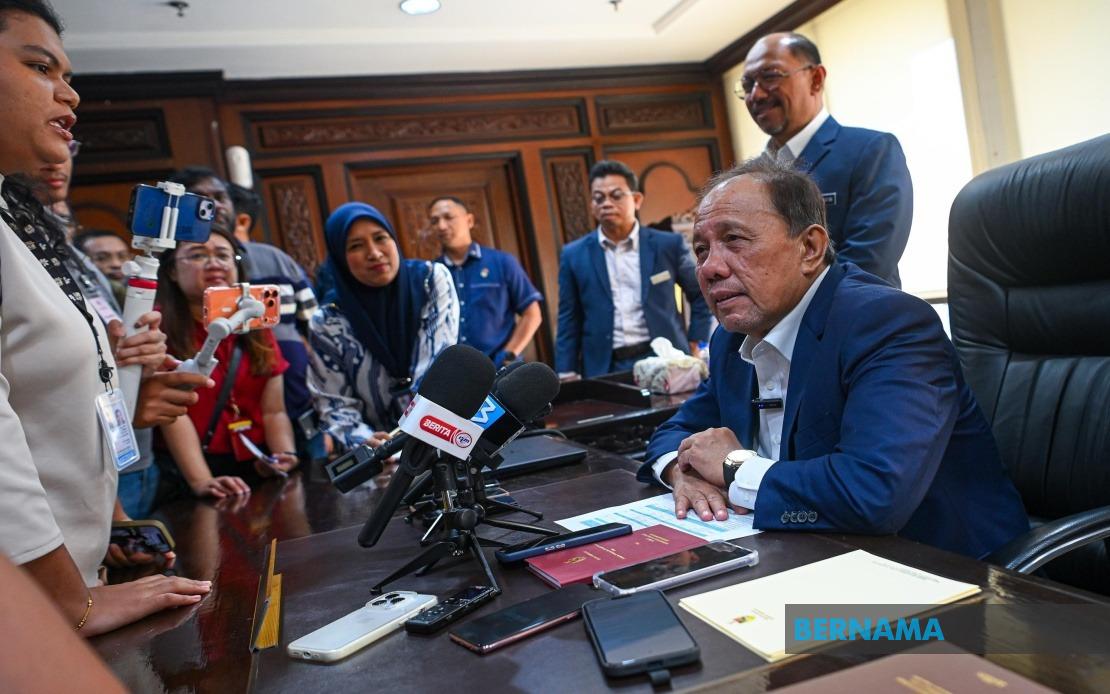
Negeri Sembilan is preparing to expand its executive framework by introducing Deputy Executive Council positions for critical government portfolios, according to newly sworn-in Menteri Besar Datuk Ismail Lasim. Speaking to journalists at Wisma Negeri in Seremban on his first working day, Lasim outlined the administration's intention to broaden leadership capacity across the state government through this structural innovation, even as the formal composition of the cabinet remained under finalisation.
The proposal to establish Deputy Exco roles represents a significant departure from conventional state administration structures in Malaysia. Rather than operating under the traditional fixed number of executive council positions, the Negeri Sembilan government seeks to distribute responsibilities more widely among elected representatives. This approach would allow assemblymen from the ruling coalition to take on substantive portfolios without exhausting the limited senior Exco appointments available. Lasim acknowledged that the conventional cabinet structure did not provide sufficient positions for all capable representatives seeking executive responsibilities, making the deputy tier a pragmatic solution.
The beneficiaries of these new posts will come from the state government's three component parties: the Barisan Nasional coalition members, the Pan-Malaysian Islamic Party (PAS), and Parti Wawasan Negara (Wawasan). This multi-party arrangement reflects the political arithmetic that delivered victory in the recent state election, where BN secured 18 seats and Perikatan Nasional—which includes PAS—won seven seats, jointly commanding a supermajority of 25 seats in the 40-member state assembly. The inclusion of representatives from all coalition parties in executive roles sends a signal of inclusive governance, though it also underscores the complexity of managing a broad-based coalition administration.
Lasim's ascension to the Menteri Besar position came after his swearing-in ceremony before the Yang Dipertuan Besar of Negeri Sembilan, Tuanku Muhriz Tuanku Munawir, at Istana Besar Seri Menanti on Sunday. The 67-year-old Juasseh state assemblyman formally commenced his duties at the Menteri Besar's Office on the morning in question, received by State Secretary Datuk Mohd Zafir Ibrahim and departmental leadership. His arrival marked the beginning of a new administrative chapter for the state, following the conclusion of the recent electoral contest.
The electoral outcome that secured the current government's position reflected voter preference for stability and continuity. Barisan Nasional's capture of 18 seats represented a strong showing for the traditional ruling coalition in the state, while Perikatan Nasional's seven seats solidified its position as the second-largest bloc. Together, these forces achieved a two-thirds supermajority, granting them unusual legislative flexibility and the capacity to pursue constitutional amendments or significant policy shifts if required. Pakatan Harapan's 11 seats placed the opposition in a minority position, effectively sidelining the coalition from governance but potentially positioning it as a vocal parliamentary counterweight.
The timeline for announcing the full cabinet lineup reflected ongoing deliberations about ministerial allocation and deputy appointments. Lasim indicated that the Exco composition would be unveiled either on Friday or, at the latest, the following Monday, suggesting that negotiations over portfolio distribution were still ongoing. The decision to delay announcement while consulting coalition partners demonstrated the need to balance competing demands within the governing coalition and ensure that all parties felt adequately represented in the executive structure.
The introduction of Deputy Exco positions carries implications for how state governments across Malaysia might restructure their administrations. If successful in Negeri Sembilan, the model could be replicated elsewhere, offering a template for managing coalition governments where the number of qualified representatives exceeds available cabinet seats. This innovation also reflects evolving governance practices in Southeast Asia, where expanding executive structures to accommodate coalition partners has become increasingly common in multi-party political environments.
For Malaysian observers, the move signals Lasim's willingness to adopt institutional creativity in addressing administrative constraints. Rather than adhering rigidly to inherited structures, the new Menteri Besar appears prepared to reshape the executive framework to maximise the utilisation of available talent within the ruling coalition. This pragmatism may set expectations for how subsequent governments handle similar challenges, particularly in states where coalition politics require careful calibration of power-sharing arrangements.
The specific portfolios earmarked for deputy-level appointments have not yet been disclosed, though Lasim suggested that they would be chosen based on perceived importance to state administration. Key areas such as economic development, education, healthcare, and infrastructure typically attract sustained attention in state governments, and the deputy posts could potentially be allocated to such domains. The selection process would likely balance technical competence with political considerations, ensuring that appointments serve both administrative efficiency and coalition harmony.
The broader context of Negeri Sembilan governance reflects national trends toward coalition-based administrations across Malaysian states. The current arrangement mirrors similar configurations in other states where BN and PN cooperate to govern, necessitating arrangements to distribute executive responsibilities fairly. This political landscape represents a departure from the pre-2018 era when single-bloc dominance was more common, and it has fundamentally altered how state governments must manage their internal dynamics and maintain cohesion among diverse political partners.
Lasim's early emphasis on structural reforms suggests that the incoming administration intends to signal proactive governance from its outset. By immediately addressing the question of executive capacity through the deputy positions proposal, the Menteri Besar is communicating to both coalition partners and the broader electorate that his government will pursue organised and inclusive administration. The success of this initial institutional innovation may well shape public and political perceptions of his leadership, establishing whether his administration will be remembered as one that fostered collaborative governance or struggled to manage coalition tensions.

