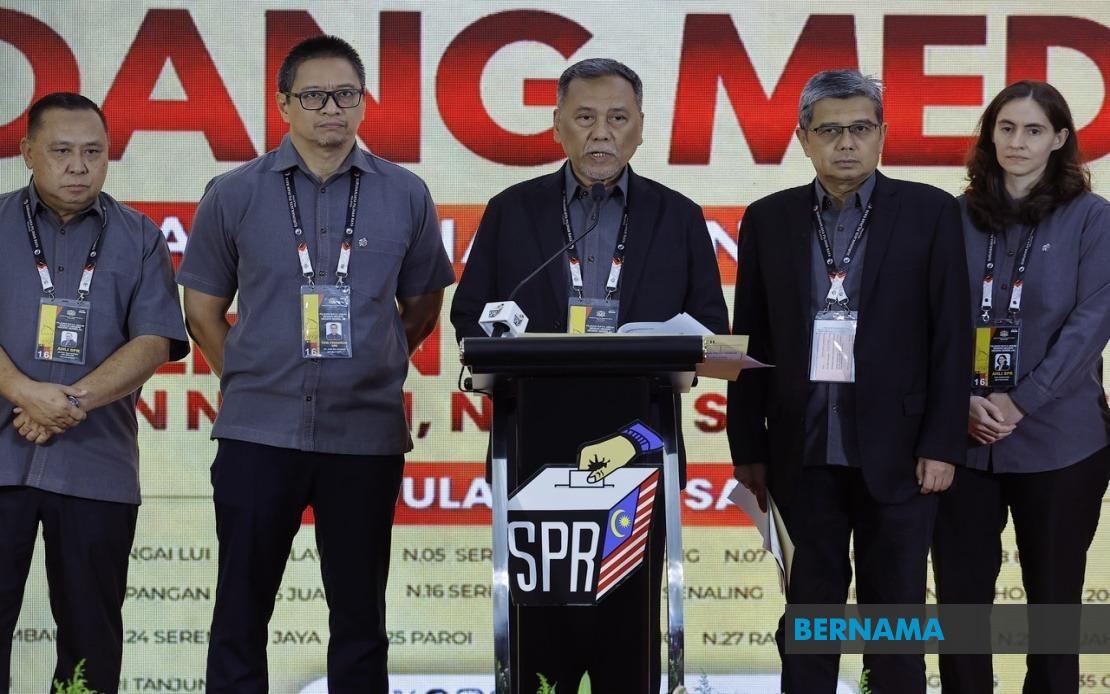
The Negeri Sembilan state election is shaping up as a closely contested affair, with the Election Commission announcing that 103 candidates have been certified eligible to compete across the state's 36 assembly seats. The clearance process concluded on July 18 after nominations closed at ten in the morning, with officials verifying submissions across eight nomination centres throughout the state. The diversity of the candidate field underscores the competitive nature of this election cycle, which will take place on August 1 following early voting on July 28.
Pakatan Harapan has emerged as the dominant force in the race, fielding a full slate of 36 candidates to contest every seat in the state assembly. This comprehensive deployment reflects the coalition's confidence in its platform and organisational strength across Negeri Sembilan. Barisan Nasional, the traditional ruling coalition, has fielded 25 candidates, while Bersatu, which has carved out an increasingly significant role in Malaysian politics, is contesting with 24 nominees. Perikatan Nasional, the opposition alliance anchored by PAS and Bersatu, has put forward 11 candidates, suggesting a strategic focus on specific constituencies rather than a blanket campaign approach.
Smaller parties and independent candidates are adding complexity to the electoral dynamics. Barisan Jemaah Islamiah Se-Malaysia, the Malaysian Orang Asli Party, and the Socialist Party of Malaysia each fielded a single candidate, while four independent contenders are running without party affiliation. This splintering of the vote across multiple platforms reflects Malaysia's evolving political fragmentation and offers voters in several constituencies genuine multi-option contests beyond the traditional two-coalition framework.
The most striking feature of this election is the prevalence of three-cornered fights, with 21 of the 36 seats set for such contests. These multi-way races introduce unpredictability into electoral outcomes, as votes can be split across multiple candidates even in constituencies where one party might historically have enjoyed comfortable majorities. Additionally, two seats—Nilai and Sri Tanjung—will witness five-cornered battles, while Jeram Padang and Rahang are set for four-way contests. The concentration of multiple candidates in certain areas suggests either fierce internal competition within coalitions or strategic targeting by smaller parties attempting to maximise their chances in receptive constituencies.
The candidate pool itself reflects Malaysia's ongoing underrepresentation of women in electoral politics. Of the 103 nominees, 94 are male and only nine female, a ratio that mirrors broader gender disparities in political candidacy across the country. The age range of candidates spans from a 23-year-old representing Bersatu in Sri Tanjung to a 70-year-old Pakatan Harapan candidate in Gemencheh, encompassing multiple generations of political activists and representatives. This generational breadth suggests both the continuity of established political figures and the emergence of younger voices seeking to reshape the state's political direction.
Negeri Sembilan's electorate comprises approximately 889,490 registered voters, a substantial constituency capable of delivering a decisive mandate to whichever coalition secures majority support. The voter base includes 867,151 ordinary citizens, alongside 16,884 military personnel and their spouses and 5,455 police officers, reflecting the demographic composition of the state. These security force voters have historically shown distinct voting patterns and represent a meaningful bloc that candidates typically target through specific messaging regarding defence, security, and public service benefits.
The dissolution of the state assembly on June 5 set this election in motion, following what Malaysian observers generally perceive as political calculations aimed at securing fresh mandates during perceived advantageous circumstances. The timing of the election reflects strategic consideration of the political climate and state-level dynamics independent of federal parliamentary cycles. Negeri Sembilan, while not the largest state by population or economic output, holds symbolic and strategic importance in Malaysian federalism as a historically Malay-led state with its own unique constitutional arrangements and power structures.
For Malaysian observers and regional analysts, this election serves as a significant indicator of voter sentiment and coalition strength in a peninsular state that occupies a geographical and political position between the developed Klang Valley region and the rural southern states. The outcome will provide valuable insight into whether Pakatan Harapan can consolidate its federal electoral advantages at state level, whether Barisan Nasional maintains residual support in constituencies it has traditionally dominated, and whether newer political forces like Bersatu and Perikatan Nasional can translate national attention into meaningful state-level representation. The prevalence of three-cornered contests ensures that victory margins may be narrower and more difficult to predict than in previous elections where two-cornered fights dominated.
The electoral environment heading into polling day will likely feature intense competition over bread-and-butter issues affecting Negeri Sembilan residents—economic development, infrastructure investment, education, healthcare, and religious administration. These state-level concerns, combined with national political debates filtering down into local campaigns, will shape voter behaviour across the 36 constituencies. The three-month period from dissolution to election allows sufficient campaign time for candidates to establish their platforms, though the compressed timeline compared to federal elections may limit the depth of engagement with voters in less politically-contested constituencies.

