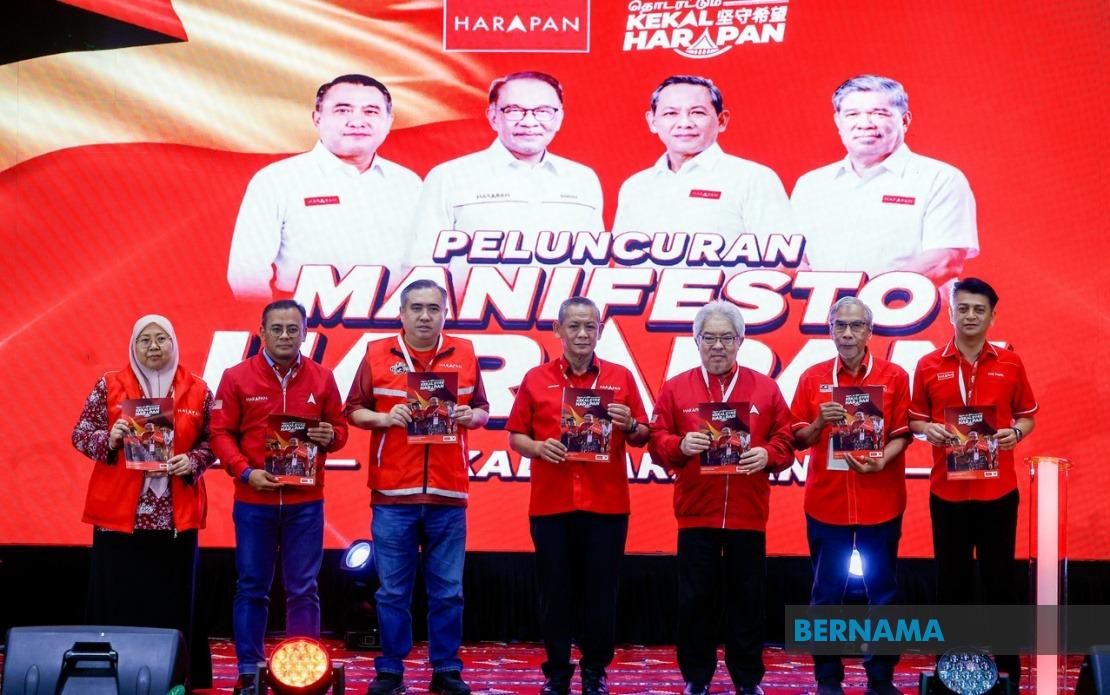
Pakatan Harapan aims to distinguish its approach in the forthcoming Negeri Sembilan state election by emphasizing concrete, achievable commitments rather than aspirational campaign messaging. Coalition chairman Datuk Seri Aminuddin Harun, who also serves as Menteri Besar, positioned the manifesto as evidence of the coalition's maturity in governance, marking a deliberate shift from making grand promises to refining and expanding programmes already proven on the ground. Speaking at the manifesto launch in Seremban on July 20, Aminuddin articulated a strategic philosophy centred on institutional continuity and incremental improvement rather than radical reimagining.
The manifesto, unveiled under the theme 'Negeri Sembilan Kekal Harapan' (Negeri Sembilan Stays With Harapan), crystallizes eight years of PH stewardship into ten substantive policy commitments. Aminuddin's framing suggests a recognition that voters increasingly distinguish between rhetoric and results, particularly in competitive Malaysian state contests where track records carry substantial electoral weight. By anchoring the coalition's campaign narrative to established initiatives, PH appears to be hedging against the risk of appearing disconnected from ground realities or making commitments that cannot be realistically fulfilled within a five-year term.
This messaging strategy carries significant implications for how PH competes in Negeri Sembilan, a state where coalition governance has persisted long enough to generate both accomplishments and potential fatigue. The emphasis on "improving and strengthening" existing schemes rather than launching wholesale new programmes reflects pragmatic electoral calculus. Voters in economically developed states like Negeri Sembilan often prioritise reliability and competent administration over visionary promises, particularly when the incumbent has demonstrated basic competence. By positioning itself as the custodian of proven achievements, PH can claim the mantle of stability while subtly suggesting that alternatives represent risk and uncertainty.
Aminuddin's explicit distinction between past aspirations and future consolidation hints at a broader confidence in accumulated institutional credibility. The statement that "in the past, we focused on what we wanted to implement" acknowledges earlier campaigns as preliminary positioning, while "this time, we are improving and strengthening those initiatives" signals maturation. This rhetorical move attempts to reframe previous elections not as failures to deliver but as necessary foundational phases preceding the present stage of optimization. For Malaysian voters accustomed to seeing campaign promises evaporate after polling day, such an acknowledgment of the gap between aspiration and reality may resonate as refreshing candour.
The five-year timeframe invoked repeatedly in Aminuddin's remarks underscores PH's attempt to establish realistic expectations. Rather than promising transformation by the next election, the coalition frames its agenda as ensuring established initiatives reach full maturity and deliver measurable impact. This measured approach contrasts sharply with opposition rhetoric that typically emphasizes dramatic change and sweeping reform. In Negeri Sembilan's relatively developed context, where infrastructure and basic services already function reasonably, voters may find incremental improvement more credible than promises of revolutionary change.
The manifesto's ten key commitments remain largely unspecified in available reporting, creating ambiguity about whether these represent genuinely new undertakings or repackaged existing programmes. The opacity invites scrutiny regarding what "deliverable" actually entails operationally. Nevertheless, the framing device of emphasizing implementation capacity over policy novelty represents a calculated gambit in modern Malaysian electoral competition. Increasingly, voters assess political parties partly on their ability to execute programmes, not merely conceive them. By placing execution capacity at the centre of its campaign narrative, PH acknowledges this shift in voter expectations.
Aminuddin's candidacy in the Linggi state seat adds personal dimension to the manifesto launch, signalling that the leadership team stands to be directly accountable for manifesto implementation. Such symbolic commitment, while common across Malaysian politics, reinforces the distinction between leadership that stakes its credibility on achievement versus leadership that maintains distance from policy outcomes. This particularity matters in state-level contests where voters often have more direct access to elected representatives and greater capacity to hold them accountable for unfulfilled promises.
The manifesto launch also reflects broader positioning dynamics within Malaysian coalition politics. As PH seeks to establish itself as a competent, growth-oriented alternative to BN legacy governance while maintaining distance from more radical reform agendas, emphasizing deliverable programmes rather than ideological grand designs serves strategic purposes. It allows the coalition to appeal simultaneously to voters seeking change and those preferring continuity, to attract both aspirational voters wanting progress and conservative voters valuing stability.
For other Malaysian states observing the Negeri Sembilan contest, PH's manifesto strategy offers a template for incumbent coalitions seeking re-election without the baggage of sweeping unfulfilled pledges. However, the gambit carries risks. Opposition parties can characterize limited ambition as lack of vision, contending that Negeri Sembilan stagnates under an exhausted administration offering merely incremental tweaks rather than bold improvement. Whether voters embrace PH's emphasis on realistic delivery or view it as political timidity will substantially influence not merely the Negeri Sembilan election outcome but PH's broader electoral viability across Malaysia's remaining competitive states.

