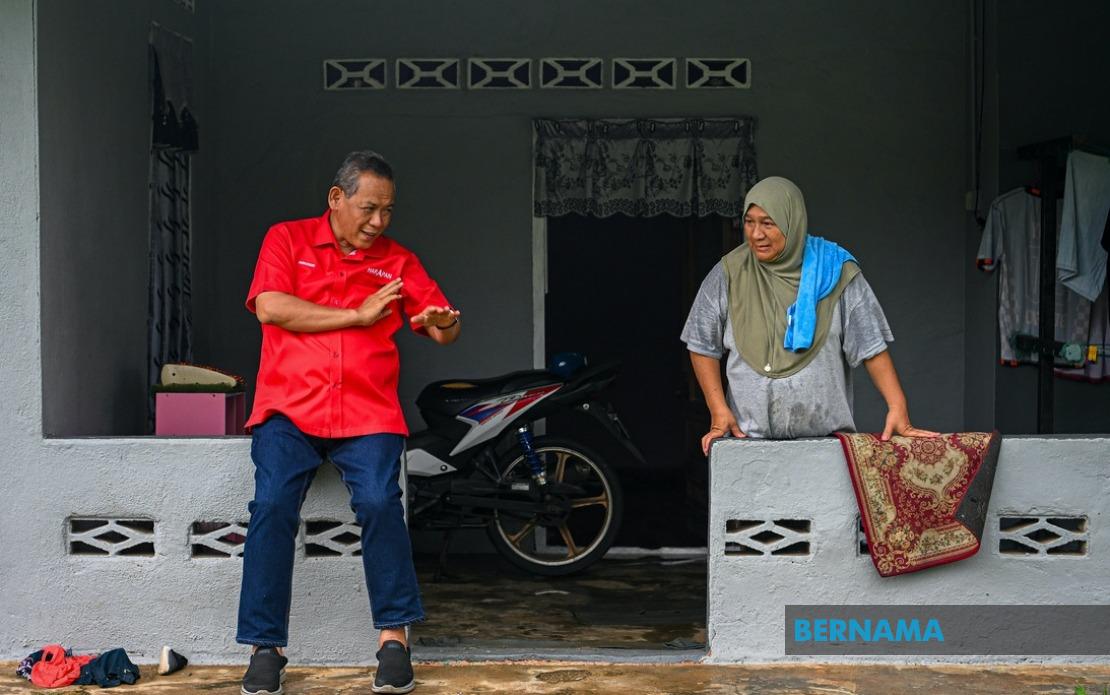
Pakatan Harapan enters the Negeri Sembilan state election with a campaign anchored firmly on the administrative credentials and governance record of incumbent Menteri Besar Datuk Seri Aminuddin Harun, positioning stability and corruption-free leadership as the coalition's primary appeal to voters across the state. The strategy reflects PH's confidence that Aminuddin's tenure—spanning nearly two terms—has established sufficient voter trust to overcome any electoral headwinds, particularly as the coalition seeks to retain the seat of power in a state where electoral outcomes have historically been competitive and occasionally unpredictable.
Datuk Seri Amirudin Shari, who serves as PH's election director while also holding the position of Selangor Menteri Besar, articulated the coalition's core messaging during campaigning, emphasizing that voters have responded positively to the emphasis on clean and accountable governance. According to Amirudin, the PKR vice-president's assessment of grassroots sentiment during the initial phases of the campaign period revealed that Aminuddin's decade-long leadership continues to resonate with voters, particularly concerning their desire for predictable policy and continued prosperity. The feedback mechanisms within PH's organizational structure, drawing on inputs from party workers operating at the community level, indicated that there remained substantial voter confidence in the current administration's ability to deliver on economic and developmental fronts.
In an assessment that underscores PH's confidence in its position, Amirudin noted the absence of major governance scandals or administrative controversies that might have weakened the incumbent coalition's standing. This emphasis on clean administration stands in contrast to historical narratives in Malaysian electoral politics, where corruption allegations and governance failures have frequently figured prominently in opposition campaigns and voter decision-making. By highlighting the absence of such complications, PH effectively shifts the electoral conversation toward questions of administrative competence and proven track record rather than allowing opponents to dictate the agenda through allegations of malfeasance or fiscal mismanagement.
The Gombak Member of Parliament characterized the early campaign feedback as encouraging, though he acknowledged that traditional metrics of electoral momentum—such as the size and enthusiasm of campaign rallies—might not fully capture the depth of voter support. Instead, Amirudin placed greater emphasis on the intelligence gathered through PH's grassroots organizational network, which he suggested provides a more granular and reliable understanding of voter sentiment than headline-grabbing public events. This distinction reflects a sophisticated appreciation of how electoral support operates at the community level, where sustained engagement by party machinery often proves more consequential than episodic mass mobilization.
Amirudin also highlighted Aminuddin's dual credibility as both menteri besar and Member of Parliament for Port Dickson, suggesting that this combination of state and federal representation enhances his political standing and demonstrates his ability to serve constituents across multiple levels of governance. The proposition that a leader simultaneously commanding respect at state and federal levels carries particular weight in Malaysian electoral contexts, where voters frequently evaluate candidates partly on their apparent influence within broader national political structures. This multi-dimensional positioning potentially strengthens PH's argument that retaining Aminuddin safeguards voter interests across different administrative domains.
The coalition's campaign infrastructure has been carefully organized to maximize organizational efficiency and reach, with Amirudin attributing considerable weight to PH's grassroots machinery as a strategic asset. The effectiveness of party workers in translating sentiment into actual voter mobilization remains a decisive factor in Malaysian state elections, where turnout and the efficiency of getting committed supporters to polling stations can determine outcomes. By emphasizing the strength of its organizational apparatus alongside Aminuddin's personal credibility, PH presents a two-pronged argument: that voters trust the leadership and that the coalition possesses the structural capacity to convert that trust into electoral victory.
Prime Minister and PH chairman Datuk Seri Anwar Ibrahim's role in the campaign represents a secondary but important dimension of PH's electoral strategy. Amirudin indicated that Anwar's demonstrated popularity and the perceived success of his federal administration would extend electoral benefits to state-level candidates, drawing an analogy to recent experience in Johor where national leadership dynamics appeared to bolster support for coalition candidates in subnational contests. This suggests PH strategists believe that voter evaluations of federal governance performance are substantially filtering downward into state-level electoral calculus, making the Prime Minister's political standing a material asset in state campaigns.
The coalition's manifesto, scheduled for unveiling during the campaign, was characterized as bridging ongoing programmatic initiatives with new proposals designed to address voter concerns and aspirations. This balancing approach—maintaining credibility through continuation of established priorities while demonstrating responsiveness through novel commitments—reflects a standard strategy among incumbent coalitions seeking reelection. For Negeri Sembilan voters, the manifesto would presumably address local economic diversification, rural development, and social service delivery, issues that consistently rank highly in state-level electoral contests throughout Malaysia.
The electoral arithmetic in Negeri Sembilan demonstrates PH's precarious but workable position heading into the August 1 polling day. In the 2023 state election, PH secured 17 of 36 seats, representing a commanding majority that nevertheless depends on relatively tight margins in several constituencies. Barisan Nasional captured 14 seats while Perikatan Nasional won five, meaning that any significant shift in voter preference—particularly in swing constituencies—could alter the outcome substantially. The distribution suggests that PH must hold its base while potentially absorbing some undecided voters, a task that appeals to proven governance become especially critical.
The voter population eligible to participate comprises 889,490 registered electors distributed across ordinary voters, military personnel and their spouses with early voting privileges, and police personnel accessing early voting provisions. Early voting is scheduled for July 28, with general polling occurring on August 1, following the dissolution of the Negeri Sembilan State Legislative Assembly on June 5. The electoral calendar compresses the campaign period into roughly three weeks, intensifying the importance of early messaging and organizational efficiency in reaching voters before the polling window closes.
For Malaysian observers and regional analysts tracking patterns of electoral competition in Southeast Asia, the Negeri Sembilan contest offers insights into how incumbent coalitions in competitive democracies balance claims of administrative accomplishment against opposition accusations and broader voter concerns about economic opportunity. The emphasis on corruption-free governance and proven track record reflects a rational calculation that in the post-2018 Malaysian political environment, voter preferences have shifted measurably toward valuing clean administration and predictable leadership over alternative appeals. Whether this calculation proves correct will illuminate how deeply governance quality has penetrated voter decision-making in Malaysian subnational elections and whether parties can credibly claim electoral benefits from clean administration in contexts where structural and institutional factors also significantly shape outcomes.

