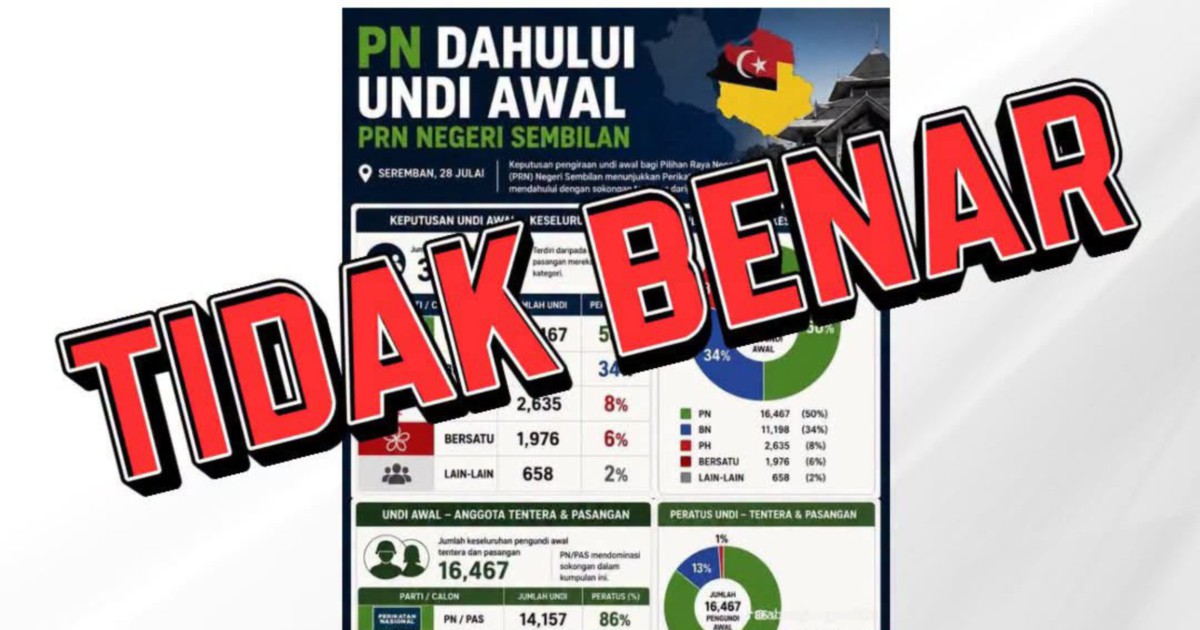
The Election Commission clarified on Friday that the tabulation of early votes cast during the 16th Negeri Sembilan state election will commence at 5pm on Saturday, establishing a definitive timeline for the initial phase of the counting process in the state capital Seremban.
This schedule represents the official window for processing votes submitted by voters who exercised the early voting facility—a mechanism increasingly utilised in Malaysian elections to accommodate those unable to cast their ballots on the standard polling day. The timing is crucial for both election observers and political parties monitoring the electoral proceedings, as early vote tallies often provide the first indicators of voting patterns and momentum shifts.
Simultaneously, the EC issued a firm statement addressing misleading information proliferating across social media platforms. The commission specifically refuted claims that have gained significant traction online, which suggested that a particular political coalition—identified as PN in the viral content—had already established a commanding lead in the Negeri Sembilan contest. Such premature declarations and false projections undermine public confidence in electoral integrity and can influence voter behaviour, making the EC's swift denial an important institutional safeguard.
The emergence of these unverified claims reflects a broader challenge facing Malaysian electoral processes in the digital age. Misinformation regarding election outcomes spreads rapidly through WhatsApp groups, Facebook pages, and Twitter accounts, often before official results are available. Such disinformation can discourage turnout, create unfounded expectations, or delegitimise actual results when they ultimately diverge from the false predictions.
Negeri Sembilan, situated in the central region of Peninsular Malaysia, holds particular political significance as a traditionally competitive state where coalition fortunes have shifted markedly across recent electoral cycles. The state's 36 seats have become a focal point for both Barisan Nasional and the opposition, with demographic shifts and local grievances shaping electoral dynamics in different constituencies.
The EC's announcement underscores the commission's responsibility to maintain transparency throughout the electoral process while actively countering false narratives. By specifying the exact time for early vote counting and publicly dismissing premature lead claims, the commission attempts to establish a factual foundation upon which legitimate election commentary can occur. This approach contrasts with allowing misinformation to circulate unchallenged until official results become available.
For Malaysian voters and observers accustomed to monitoring state elections, understanding the counting schedule proves instrumental in distinguishing between actual developments and speculative claims. The 5pm Saturday commencement time means that preliminary indicators from early voters will emerge in the early evening, several hours before general polling concludes and the main tabulation phase begins. This temporal separation allows for systematic processing and reduces the likelihood of procedural confusion that could arise from simultaneous operations.
The viral PN lead claims appear to have originated from partisan sources attempting to create momentum or demoralise supporters of competing coalitions. Such tactics have become increasingly sophisticated, sometimes incorporating fabricated screenshot evidence or doctored graphics that superficially resemble official EC announcements. The speed with which false information travels through messaging applications—where many Malaysian voters receive their news—means that countering such claims requires immediate and authoritative responses.
From a broader electoral health perspective, the EC's intervention signals that the commission recognises the stakes involved in protecting informational integrity during the voting period. Confidence in electoral systems depends not merely on the physical security of ballots and polling procedures, but also on the reliability of information surrounding the process. When voters encounter contradictory claims about results or voting momentum, institutional trust deteriorates regardless of actual electoral conduct.
The Negeri Sembilan election represents a meaningful test case for electoral dynamics in contemporary Malaysia, occurring amid evolving patterns in voter alignment, support for competing coalitions, and the effectiveness of campaigns conducted through both traditional and digital channels. The early vote counting scheduled for Saturday evening will provide the first substantial data point regarding how these forces have crystallised among a subset of the electorate.
Moving forward, the EC's proactive stance in addressing false claims sets expectations for continued institutional vigilance throughout the counting process and the post-election period. As Malaysia's electoral commission, its role extends beyond mere administration to encompass credibility protection in an information ecosystem where rumour and fact increasingly compete for attention and influence voter perceptions of legitimacy.

