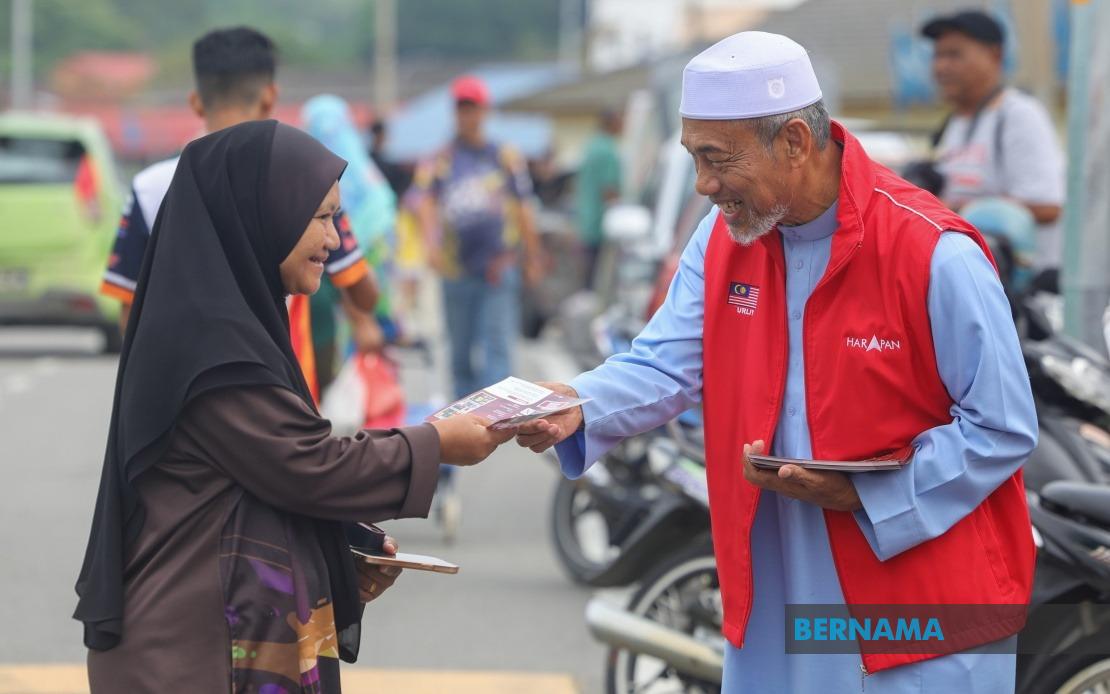
The campaign for Negeri Sembilan's 16th state election entered its critical second phase on Friday as candidates across all major political coalitions launched intensive grassroots operations designed to maximise voter contact in the remaining 12 days before polling. The shift towards ground-level engagement reflects a strategic recognition that persuasion in state elections often hinges on personal interactions and direct responsiveness to community concerns rather than broader media campaigns.
Menteri Besar Datuk Seri Aminuddin Harun, the Pakatan Harapan candidate defending the Linggi seat, exemplified this approach by beginning his day with dawn prayers at Masjid Jamek Pasir Panjang before moving directly into a series of walkabouts spanning six separate neighbourhoods and communities within his constituency. The deliberate timing of his campaign activities—starting with religious observance before pivoting to community engagement—reflects an established pattern in Malaysian state elections where candidates seek to signal both piety and accessibility to voters. As Negeri Sembilan Pakatan Harapan chairman and a senior PKR figure holding the Port Dickson federal seat, Aminuddin carries significant organisational resources and party machinery to sustain such an ambitious daily schedule.
The breadth of Aminuddin's constituency engagement illustrates how contemporary state election campaigns operate across multiple demographic and geographic layers. His itinerary included residential areas such as Pasir Panjang town and established neighbourhoods like Taman Setia and Taman Kekatong, but also extended to traditional residential clusters including Kampung Telok Pelandok and specific ethnic community sessions. This segmented approach suggests that campaign strategists recognise voter preferences and concerns vary significantly across different settlement types and cultural communities within a single state seat. The inclusion of a dedicated Indian community session underscores awareness that minority communities, while numerically smaller in many constituencies, often constitute crucial swing voters in tight electoral contests.
Elsewhere, DAP secretary-general Anthony Loke, who holds the Chennah state seat currently, adapted his campaign schedule to combine market visits with evening community events. Market walkabouts represent a proven tactic in Malaysian electoral strategy, allowing candidates to encounter voters during their daily commercial activities when defences are lower and engagement more casual. Loke's deployment of evening dinner programmes reflects the need to accommodate working voters and extend campaigning into periods when people are more available and socially relaxed.
Other Pakatan Harapan candidates demonstrated similarly aggressive scheduling. Kamarul Ariffin Wafa, contesting the Seri Menanti seat for PH, structured his campaign around eight separate programmes including market engagement and specific neighbourhood focus. Yaacob Mahmood, the PH candidate for Serting, adopted a deliberate informality by arranging breakfast sessions and business district visits in Felda Raja Alias 3 and Bandar Seri Jempol. Yaacob explicitly framed this grassroots strategy as creating space for unscripted community dialogue on local issues, suggesting that campaigns increasingly recognise voter appetite for genuine discussion rather than choreographed political theatre.
The Barisan Nasional coalition matched these efforts with its own field operations. Datuk Seri Mohamad Hasan, the incumbent Rantau assemblyman and BN deputy chairman, maintained visibility through polling district centre activities in Taman Kelab Tuanku, Mambau. His status as both a senior national BN figure and a sitting state representative provides him with incumbent advantages including established constituent relationships and institutional infrastructure. Meanwhile, Negeri Sembilan UMNO liaison chairman Datuk Seri Jalaluddin Alias combined youth mobilisation activities—evidenced through sepak takraw tournament attendance—with outreach to Orang Asli communities, indicating BN recognition of the electoral importance of younger voters and indigenous communities.
The escalation in campaign intensity reflects the compressed timeline and electoral stakes. The Negeri Sembilan State Legislative Assembly was dissolved on June 5, with the Election Commission scheduling August 1 for the general poll and July 28 for early voting. This timeline provides candidates with approximately two weeks for intensive campaigning, necessitating daily multi-programme schedules to achieve adequate voter contact across geographically dispersed constituencies. The early voting provision accommodates military personnel and police officers, totalling 22,339 individuals from these services, recognising their scheduled availability constraints.
The election encompasses 889,490 registered voters, comprising 867,151 ordinary voters alongside the aforementioned military and police cohorts. This voter universe represents a meaningful electoral exercise, with state election outcomes carrying implications for both local governance and the broader Malaysian political landscape given Negeri Sembilan's position within the larger Klang Valley metropolitan region. State elections serve as important barometers of public sentiment between federal elections, and Negeri Sembilan's result will be scrutinised for signals regarding voter satisfaction with both Pakatan Harapan's governance performance and Barisan Nasional's opposition positioning.
The intensive campaign schedules reveal how Malaysian political parties have refined ground operations through repetitive electoral cycles. Rather than concentrating on mass rallies or media-dependent messaging, contemporary state election campaigns emphasise constituent relationship-building through repeated direct contact. Candidates recognise that voters, particularly in state elections with more local character than federal contests, prioritise demonstrated accessibility and attentiveness to immediate community concerns. This grassroots emphasis also reflects practical political calculation: state constituencies are sufficiently compact that systematic coverage remains theoretically achievable with disciplined daily scheduling.
The participation of senior national figures like Aminuddin, Loke, and Mohamad Hasan in state-level campaigning underscores the interdependence between state and federal politics in Malaysia's political system. These individuals maintain both state electoral interests and significant federal party positions, meaning state election outcomes affect their standing within national party hierarchies. Their personal presence on the campaign trail signals organisational seriousness and attempts to mobilise party machinery at peak efficiency.
As voting approaches on August 1, the intensity of daily multi-programme campaigning will likely increase further, with candidates potentially expanding their schedules and visiting additional constituencies. The effectiveness of these grassroots operations will ultimately determine whether Pakatan Harapan can maintain its current state administration or whether Barisan Nasional can regain control of a state it governed continuously until 2018. The campaign's ground-level character suggests that the outcome will depend substantially on which coalition better executes these direct voter engagement strategies and responds more effectively to community-level concerns articulated during these grassroots interactions.

