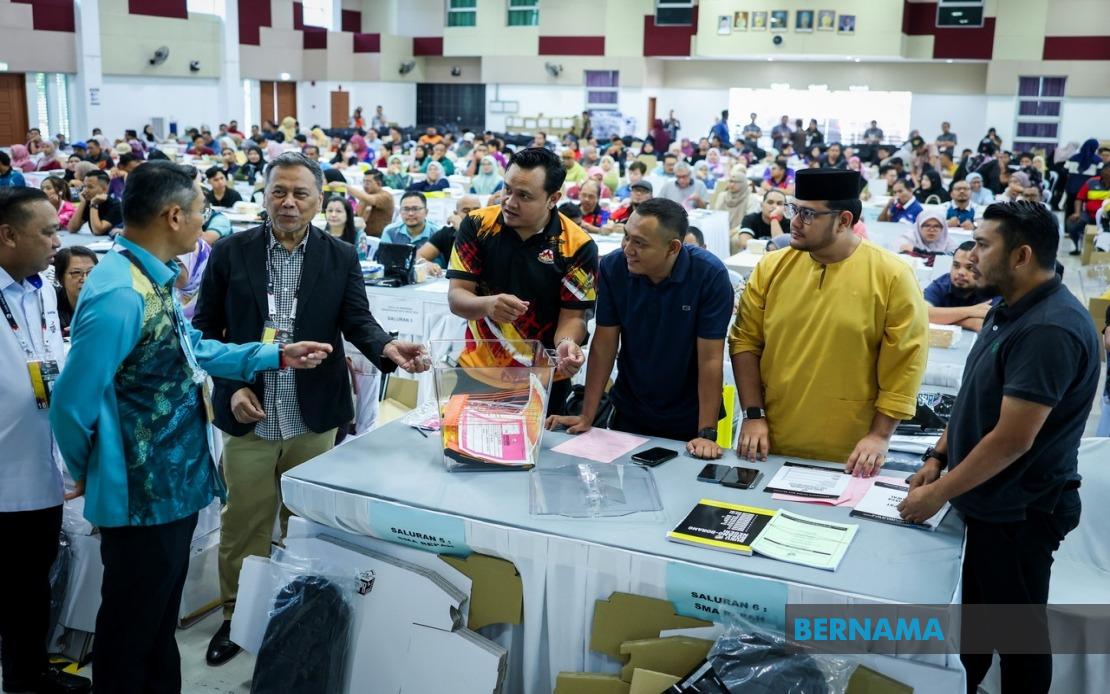
The Elections Commission has mobilised an extensive infrastructure to facilitate voting across Negeri Sembilan tomorrow as nearly 860,000 registered voters prepare to cast their ballots in the state's 16th legislative election. Election Commission chairman Datuk Seri Ramlan Harun announced that 859,760 voters, including 7,391 postal voters, will participate in determining representation across 36 State Legislative Assembly constituencies. The scale of the exercise underscores the logistical complexity of managing electoral processes across Malaysia's smaller states, where voter concentration varies significantly between urban and rural districts.
Authorities have established 401 polling centres equipped with 1,668 voting channels to accommodate the anticipated turnout across the state. The voting window extends from 8 am to 6 pm, providing a ten-hour period for the electorate to exercise their franchise. To ensure operational efficiency and maintain electoral integrity throughout this extended period, the Elections Commission has deployed 15,344 election officers across all polling venues. This deployment ratio reflects the commission's emphasis on maintaining order and transparency, particularly given the competitive nature of several contests and the importance of voter confidence in the electoral process.
Regarding the counting process, the Elections Commission is targeting preliminary results announcement by 10 pm on election night, with expectations that a comprehensive final tally will be available before midnight. This accelerated timeline represents improved logistical planning compared to previous state elections and demonstrates the commission's commitment to delivering swift electoral outcomes. The rapid result transmission is particularly significant for Malaysian observers, as state election outcomes often serve as political barometers for federal-level dynamics and coalition performance across different regions.
Tampin, one of the district's key urban centres, will host voting for three assembly seats: Gemas, Gemencheh, and Repah. The district accounts for 77,725 registered voters, representing roughly nine percent of the state's total electoral population. This concentration highlights Tampin's electoral significance within the broader Negeri Sembilan context and reflects the district's role as a regional commercial and administrative hub.
The Gemas seat presents the most competitive battlefield in Tampin, featuring a three-way contest that will test voter preferences across traditional party lines. Incumbent Ridzuan Ahmad, contesting under WAWASAN, faces challengers Siti Aishah Seman @ Othman representing the opposition Pakatan Harapan coalition and Azman Abdullah fielding for Parti Pribumi Bersatu Malaysia. This triangular contest reflects the fragmented political landscape in several Negeri Sembilan constituencies, where incumbent parties cannot assume automatic voter retention and newer political movements vie for relevance.
Gemencheh presents a more straightforward two-candidate race between sitting assemblyman Suhaimizan Bizar of Barisan Nasional and opposition candidate Abd Latib A. Tambi from Pakatan Harapan. Such direct contests tend to polarise voter choice and often demonstrate whether incumbent advantage translates into electoral success or whether dissatisfaction with incumbent performance drives voter realignment. The outcome in Gemencheh will be particularly revealing regarding Barisan Nasional's standing in the state.
The Repah seat likewise features a one-on-one contest between MCA's Koh Kim Swee and incumbent assemblyman S. Veerapan from Pakatan Harapan. This seat's dynamics reflect the broader question of whether opposition parties can consolidate recent electoral gains or whether swing voters will revert to traditional coalition preferences. Repah's competitive nature suggests neither side can claim this seat as safely held.
The composition of these contests across Tampin demonstrates a pattern replicated throughout Negeri Sembilan: a mixture of straight fights and multi-cornered competitions that will fragment votes and potentially produce surprise outcomes. Voters in constituencies with more than two candidates face more complex decision-making processes, and results in such seats often reflect complex coalition dynamics and local constituency factors rather than state-wide or national political tides.
Election officials conducting surveys at counting centres reported that all preparatory measures were progressing satisfactorily, suggesting the machinery was positioned to execute voting and tabulation without significant hitches. The logistical readiness reflected in these reports is essential, as electoral delays or procedural irregularities can undermine public confidence regardless of ultimate results.
For Malaysian political observers, the Negeri Sembilan election carries implications extending beyond the state. As a relatively compact state with diverse urban-rural characteristics, Negeri Sembilan often reflects broader national political trends while remaining manageable for detailed analysis. Results will provide crucial indicators regarding coalition performance in non-peninsular Malay-majority settings and the viability of various political combinations heading toward future federal elections. The state's outcome will particularly illuminate whether recent shifts in voter sentiment persist or represent temporary fluctuations.
The election's timing and scale represent a significant civic exercise, with over 850,000 voters participating in determining their state's political direction for the next five years. The comprehensive deployment of election personnel and voting infrastructure demonstrates the Elections Commission's operational capabilities, though the speed with which results are expected also raises questions about whether quality and accuracy can be maintained under accelerated timelines. Regardless, tomorrow's election will produce a decisive verdict on Negeri Sembilan voters' preferences and potentially reshape the state's political complexion.

