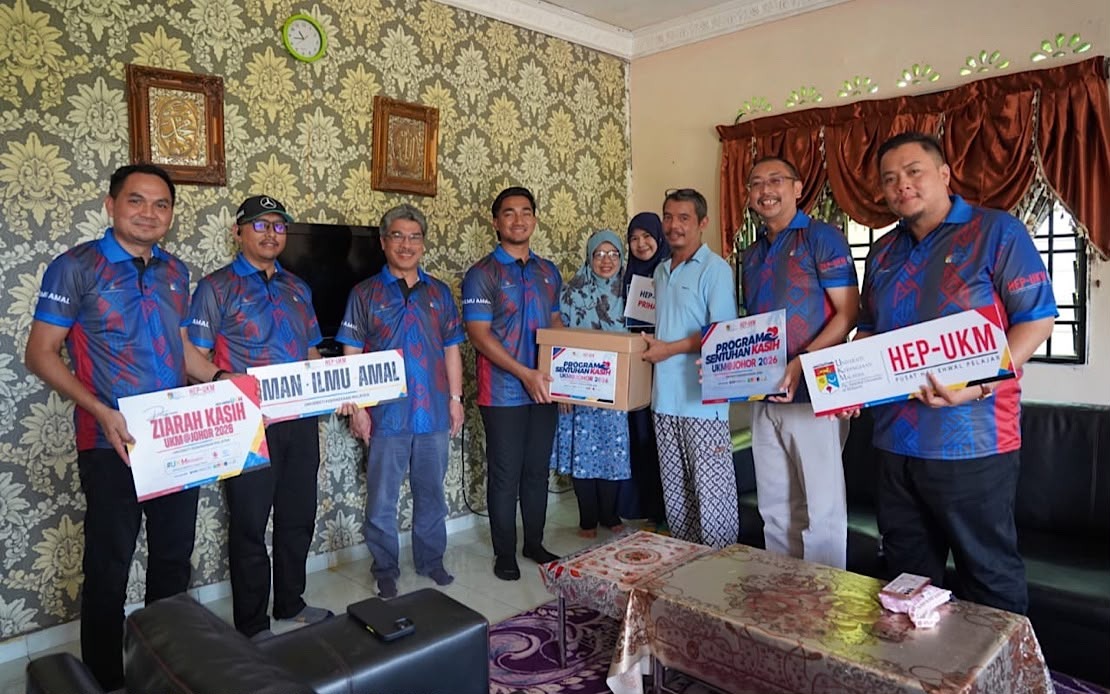
Universiti Kebangsaan Malaysia (UKM) successfully mobilised an extensive community engagement operation across Johor last weekend, drawing participation from nearly 1,000 local residents and 78 university representatives. The Sentuhan Kasih UKM@Johor programme, executed through the university's Student Affairs Centre (HEP-UKM), reflects a strategic push by Malaysia's premier research institution to deepen institutional connections with the surrounding society beyond traditional academic boundaries. The initiative unfolded simultaneously across four distinct communities—Kota Masai and Pasir Gudang on the industrial outskirts, plus Kampung Baru Sri Aman and Taman Jaringan in the Skudai residential zone—demonstrating careful geographic targeting to reach diverse demographic groups. Higher Education Minister Datuk Seri Dr Zambry Abd Kadir's attendance underscored the initiative's significance within Malaysia's broader higher education agenda.
The programme's framework, anchored by the theme "Dari Kampus ke Komuniti, Menyebar Kasih dan Bakti" (From Campus to Community, Spreading Love and Service), transcends conventional university-community relations by embedding service alongside knowledge exchange. The activities programme mixed practical community labour through gotong-royong schemes with targeted health interventions, including mental health screening sessions that address often-neglected wellness concerns in working-class neighbourhoods. Sports competitions and recreational activities created informal channels for social bonding, while the "ziarah kasih" (compassionate visits) component allowed students to directly witness the circumstances and challenges facing families in the catchment areas. This multifaceted approach acknowledges that community trust builds through tangible contributions rather than symbolic gestures.
Associate Professor Dr Darfizzi Derawi, HEP-UKM director and programme chairman, articulated a philosophy increasingly embraced by Malaysian universities seeking relevance beyond academic rankings. His contention that universities cannot function as insular institutions detached from societal needs challenges the traditional ivory tower model that has long characterised higher education in Malaysia. The emphasis on experiential learning—whereby students develop adaptive capacity, communication proficiency and soft skills through direct community interaction—addresses persistent graduate employability concerns raised by Malaysian employers. This pedagogical shift recognises that classroom instruction alone cannot cultivate the interpersonal competencies demanded by contemporary workplaces, particularly in sectors requiring cross-cultural navigation and stakeholder management. Dr Darfizzi's statement that UKM intends periodic expansion to other states signals institutional commitment to scaling this model nationwide, potentially establishing a template for peer universities contemplating similar grassroots engagement strategies.
The Johor deployment encountered noteworthy participation constraints that paradoxically strengthened the programme's significance. Herman Ismadi Ismail, identified as the Kota Delima Zone Community Leader, acknowledged that approximately 80 percent of residents in the target areas work within the industrial sector, a demographic typically constrained by demanding shift schedules and limited weekend availability. Despite these structural barriers, community response remained substantially positive, with residents demonstrating strong attendance and cooperative engagement. This resilience suggests deep-seated local appetite for institutional partnership and university accessibility—sentiments that contrasts sharply with broader public perceptions of Malaysian universities as exclusive, urban-oriented entities. The programme simultaneously functioned as a knowledge-sharing platform, allowing residents exposure to UKM's academic opportunities, scholarship pathways and institutional initiatives that might otherwise remain invisible to working-class communities. Such demystification of university processes directly addresses barriers to social mobility that have long plagued Malaysia's education system.
Beyond the headline participant numbers, the programme incorporated a targeted student welfare dimension that reveals UKM's holistic student support philosophy. The university conducted outreach visits to seven families of enrolled students in the Tiram and Puteri Wangsa areas, effectively deploying the initiative as a dual-purpose instrument for both community engagement and student pastoral care. This integration acknowledges that student welfare extends beyond campus infrastructure; it encompasses family circumstances and socioeconomic contexts that significantly influence academic performance and completion rates. For students from working-class backgrounds or those managing family pressures typical of industrial communities, direct institutional recognition of household realities through pastoral visits communicates tangible commitment to supporting their educational trajectories. Such initiatives, though modest in absolute numbers, generate profound psychological reassurance among vulnerable student cohorts often experiencing isolation and financial stress.
Universiti Kebangsaan Malaysia Vice-Chancellor Prof Datuk Dr Sufian Jusoh positioned the Sentuhan Kasih programme within the institution's broader mandate to develop "holistic human capital" rather than narrowly focused academic graduates. His framing emphasises values of compassion, communal solidarity and civic responsibility as essential attributes alongside technical competency. This philosophy aligns with Malaysia's stated aspirations under Vision 2050 and the National Reunion Framework to develop citizens capable of contributing to social cohesion amidst growing economic inequality. The vice-chancellor's assertion that student support transcends financial mechanisms—encompassing psychological wellness, family stability and community integration—reflects evolving understanding of student success factors. Contemporary Malaysian universities increasingly recognise that bursaries and scholarship allocations, while necessary, prove insufficient if students lack stable home environments, mental health support and practical experience with community challenges. Investment in programmes like Sentuhan Kasih therefore functions as preventive intervention against student attrition and as foundational infrastructure for producing socially conscious graduates.
The industrial workforce composition of the target communities carries particular significance for Malaysia's economic competitiveness and skill development agenda. Workers in Pasir Gudang and Kota Masai areas—predominantly engaged in petrochemical, port operations, manufacturing and logistics sectors—represent the backbone of Johor's economy but historically experience limited exposure to higher education advancement pathways. By positioning UKM staff and students within these communities through service activities, the programme implicitly advertises educational opportunities to demographics that might otherwise regard universities as socially distant institutions. This visibility becomes especially crucial as Malaysia navigates transition toward higher-value manufacturing and knowledge-intensive industries; expanded educational aspiration among industrial workers and their children could incrementally shift demographic patterns in tertiary enrolment. The programme thus functions simultaneously as community service and strategic workforce development positioning.
The expansion trajectory proposed by Dr Darfizzi suggests institutional recognition that community engagement, when strategically implemented, generates mutual benefits justifying resource allocation. UKM's intention to periodically roll out the Sentuhan Kasih model across other states indicates confidence that the framework transfers effectively across diverse geographic and demographic contexts. Such scaling requires developing robust logistical capacity, training adequate student cohorts in community engagement methodologies, and cultivating relationships with local authorities and community leaders nationwide. The periodic approach, rather than continuous permanent presence, likely reflects resource constraints while maintaining momentum and preventing stakeholder fatigue. Malaysian universities historically concentrated community engagement activities in their immediate surrounding regions; UKM's statewide ambition potentially establishes precedent for competitor institutions, particularly local universities in Kuala Lumpur, Selangor, Penang and Sabah/Sarawak territories, to develop comparable programmes.
The programme's success metrics extend beyond quantifiable participation figures to encompass shifts in community perception toward higher education institutions and in student understanding of their social obligations. Over time, repeated community exposure to university staff and students engaged in service activities gradually reshapes narratives that position universities as privileged enclaves indifferent to surrounding populations. For students, direct exposure to working-class community realities fosters empathy, contextualises theoretical knowledge learned in classrooms, and cultivates understanding of inequality structures that shape life trajectories in industrialised neighbourhoods. Such exposure becomes increasingly crucial as Malaysia grapples with persistent urban-rural development imbalances and regional inequality. Universities positioned strategically as civic institutions capable of supporting community development rather than merely extractive knowledge producers strengthen societal cohesion and democratic legitimacy of higher education institutions, particularly important during periods when public universities face budgetary pressures and perceived relevance questions.

