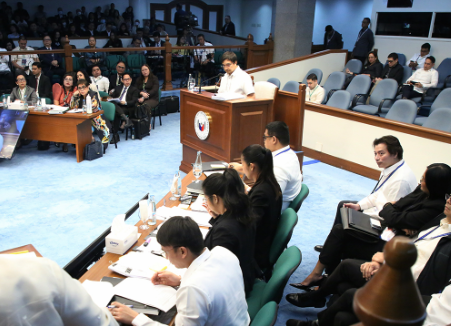
The fifth day of Vice President Sara Duterte's impeachment trial centred on testimony from National Bureau of Investigation regional director Jeremy Lotoc, who asserted that the Vice President possessed both the intent and operational capability to execute her publicly stated threats of assassination against President Ferdinand Marcos, First Lady Liza Araneta-Marcos, and former Speaker Martin Romualdez. Senate President Sherwin Gatchalian pressed Lotoc on whether Duterte had the means to carry out such threats, eliciting a blunt affirmation. The NBI's position formed a critical pillar of the prosecution's case, which maintains that Duterte's remarks constitute grave threats and a fundamental betrayal of public trust inconsistent with holding the Philippines' second-highest constitutional office.
Lotoc, who formerly headed the NBI's Cybercrime Division and oversaw the investigation into Duterte's statements, testified that the bureau had determined the elements constituting the crime of grave threats had been satisfied. He explained that investigators had found her utterances to be "serious, real and active," supported by what the NBI characterised as her demonstrated capacity and willingness to follow through. This assessment prompted the bureau to recommend that the Department of Justice file formal charges. The testimony carried particular weight because it anchored the prosecution's argument that Duterte's threats extended beyond mere rhetoric or political hyperbole to constitute actionable criminal conduct meriting removal from office.
When questioned about the basis for concluding that Duterte possessed such capability, Lotoc pointed to her position as Vice President as the foundational element. However, when Gatchalian challenged whether the office alone conferred such capacity, Lotoc broadened his reasoning to encompass her political lineage and influence. He noted that her father had previously served as president of the Philippines, and that this family background and associated networks provided her with material advantages that amplified her practical ability to arrange violence. This argument reflected a larger analytical framework employed by the NBI: assessing not merely formal constitutional position but the informal networks and accumulated political capital that accompany high office in the Philippine system.
A particularly contentious element of Lotoc's testimony involved the NBI's conclusion that Duterte had enlisted someone to execute retaliatory killings should she herself face assassination. The basis for this finding rested exclusively on Duterte's own public statements, most notably her November 23, 2024 online press conference and a subsequent November 26 interview in which she explicitly stated she had spoken with an unidentified person about exacting revenge if she were killed. Lotoc maintained that the bureau interpreted these remarks as genuine admissions rather than hypothetical speculation or defensive posturing. He stated plainly: "We believe the Vice President was not kidding when she made those remarks. So our stand, she has spoken to somebody."
The question of whether an actual assassin existed or whether Duterte had merely made rhetorical claims exposed the limits of the NBI's investigative reach. Lotoc acknowledged that the Cybercrime Division possessed no independent corroborating evidence identifying any alleged hit man or confirming such a person's existence. When pressed by senators on whether the entire case rested solely upon Duterte's statements, Lotoc conceded: "Yes. Statements and admission, Sir." This admission highlighted a critical vulnerability in the prosecution's chain of evidence, as the case hinged fundamentally on accepting Duterte's words as sincere admissions of a contract killing rather than alternative interpretations such as rhetorical excess, political performance, or defensive exaggeration in response to perceived threats.
The failure of Duterte to submit to questioning by the NBI became a significant point of contention. Lotoc testified that investigators had sought to conduct a personal interview with the Vice President to explore her assertions directly and to probe for additional evidence, but she did not appear before the bureau. He expressed frustration that this absence prevented investigators from testing the truthfulness of her claims or uncovering circumstantial evidence that might validate or refute the allegation of contracted assassination. In response, Duterte's written denials—asserting that she had not in fact hired anyone—were dismissed by Lotoc as legally insufficient to negate the offence, given that she never disputed making the statements themselves. Her non-cooperation thus became framed by prosecutors as an obstruction preventing investigators from completing their work, while her symbolic refusal to engage with the NBI could be interpreted as an assertion of executive privilege or a rejection of the tribunal's legitimacy.
During redirect examination by private prosecutor Amado Virgil Ligutan, the distinction between Duterte's actual and alleged conduct crystallised. The prosecution underscored that Duterte had never actually denied making the assassination threats themselves; rather, she had confined her denials to the allegation that she contracted someone to carry them out. This parsing mattered significantly, as it meant the foundational assertion—that she had publicly threatened the President's life—remained uncontested factual terrain. When Lotoc reviewed Duterte's November 26 interview, he characterised it as a reinforcement rather than a retraction of her earlier remarks, arguing that this repetition demonstrated the seriousness of her initial utterances. The prosecution framed this pattern as evidence of calculated intent rather than momentary anger or ill-considered speech.
Defence objections to technical deficiencies in NBI documentation were summarily rejected by Lotoc, who maintained that typographical and clerical errors in the bureau's records did not undermine its substantive findings. This dismissal reflected a broader prosecutorial strategy: to treat the charge as resting upon the undisputed fact of Duterte's public statements and their apparent meaning, rather than becoming ensnared in documentary minutiae or evidential technicalities. The prosecution team, represented in subsequent argument by adviser Robert Ace Barbers, characterised the defence's cross-examination as having focused on "typographical and clerical errors" whilst failing to challenge the core substance of Lotoc's testimony regarding Duterte's capacity and intent.
Another dimension of the testimony addressed Duterte's claim that she faced assassination threats herself, purportedly tied to an operation designated "Operation Romanov." Lotoc testified that NBI investigation traced this term to Davao City Mayor Sebastian "Baste" Duterte, the Vice President's brother, who had invoked it during a January 2024 rally, directing it at President Marcos and his family rather than at the Vice President herself. The bureau concluded it could not validate any separate "Romanov operation" targeting Duterte. Additionally, information about the alleged operation provided by vlogger Princess Maui, who had introduced the concept during Duterte's November 23 briefing, was deemed unreliable after Maui declined to appear before the NBI to substantiate her claims. This investigation exposed the difficulty of distinguishing between orchestrated narratives constructed for political effect and genuine security intelligence.
The absence of any substantiated threat against Duterte herself represented a critical asymmetry in the impeachment narrative. Whilst prosecutors built their case around Duterte's explicit threats against the President and his family—supported by video evidence and her own admissions—the Vice President's counter-assertion that she faced assassination threats rested on unvalidated information and the cooperation of sources unwilling to submit to official scrutiny. Lotoc stated that the NBI's inquiry had stalled partly because neither Duterte nor her representatives had supplied actionable intelligence or engaged constructively with investigators. This impasse suggested that the Vice President had chosen confrontation and non-cooperation over transparency, a stance that prosecutors argued revealed consciousness of guilt or at minimum contempt for legitimate institutional processes.
The broader implications of Lotoc's testimony extended beyond the immediate factual disputes to questions of presidential succession and constitutional fitness. Prosecutors argue that Duterte's conduct—threatening the sitting president, his spouse, and a senior legislator—demonstrates unfitness to serve as constitutional successor to the presidency, a role the Vice President automatically assumes if the president dies, resigns, or is removed. The threat to constitutional stability posed by a Vice President who has publicly articulated violent intentions against the sitting president represents a category of constitutional crisis distinct from ordinary corruption or dereliction of duty. Duterte's response—denying the hiring but not the statements, refusing to cooperate with investigators, and counter-claiming unfounded threats against herself—suggested a strategy of political confrontation rather than legal defence, framing the proceedings as persecution rather than legitimate accountability.
Lotoc's testimony must be considered within the Southeast Asian and Malaysian context of how impeachment proceedings reflect broader struggles over institutional legitimacy and democratic norms. Philippines impeachment trials, unlike their counterparts in Malaysia where parliamentary procedure governs ministerial accountability, vest significant power in the Senate to judge the fitness of the Vice President for office. The absence of independent corroboration for some prosecution claims—particularly regarding the alleged assassin—raised questions about the sufficiency of evidence required to remove a sitting constitutional officer. For Malaysian observers, the proceedings illustrated how constitutional mechanisms designed for extreme circumstances can become vehicles for political conflict when deep institutional divisions emerge.

