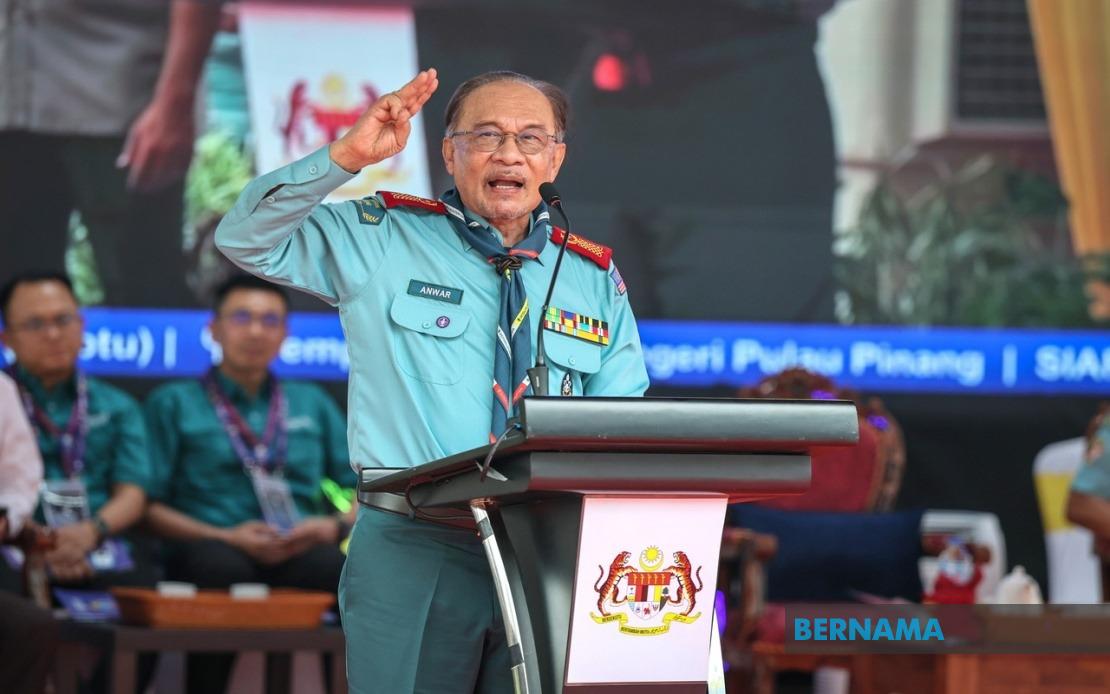
Prime Minister Datuk Seri Anwar Ibrahim has underscored a critical dimension often overlooked in development discourse: the imperative of cultivating a morally grounded and intellectually engaged youth population as essential to Malaysia's future trajectory. Speaking at the 15th Malaysian Scouts Jamboree in Penang on August 29, Anwar articulated a vision of national progress that transcends the conventional metrics of economic expansion and technological advancement, insisting instead that genuine societal development rests upon foundations of ethical education and civic responsibility instilled in young people during their formative years.
The Prime Minister's remarks arrived during an era when Malaysia, like many Southeast Asian nations, confronts mounting pressures from rapid digital transformation and artificial intelligence integration into virtually every sector of economy and society. His emphasis on balancing technological adoption with preservation of cultural identity and moral anchors speaks to a growing anxiety among policymakers across the region regarding generational disconnection from traditional values. Anwar articulated this tension explicitly, questioning the utility of material progress if accompanied by erosion of familial bonds, social cohesion, and spiritual grounding among the young.
Central to his argument was a reconceptualization of educational purpose. Rather than framing schooling purely as a mechanism for knowledge acquisition and economic competitiveness, Anwar positioned formal education as fundamentally oriented toward cultivating virtuous individuals capable of discharging obligations to family, community, and nation. This perspective aligns with ongoing debates within Malaysian education policy circles about whether current institutional frameworks adequately address character formation alongside skills development. The Prime Minister's insistence that young people must internalize a "culture" of discipline and service suggests recognition that values transmission cannot be incidental to curriculum design but must be deliberately engineered into pedagogical approaches.
The venue for these remarks—the Malaysian Scouts Jamboree—carried symbolic weight, given scouting's historical mission to develop youth through experiential learning, leadership training, and community engagement. The jamboree itself represented a substantial convening of young people, bringing together more than 5,450 local and international scouts from 11 countries including South Korea, Indonesia, Singapore, and Sri Lanka. This international dimension lent additional significance to Anwar's emphasis on unity amid diversity, a concern particularly acute in Malaysia's multi-ethnic context but increasingly relevant across Southeast Asia as regional youth populations become more mobile and interconnected.
Anwar specifically cautioned against the younger generation neglecting their "cultural roots and values" whilst navigating technological advancement. This articulation reflects deepening anxieties about cultural homogenization and identity erosion accompanying globalization, particularly in societies with strong communal and familial traditions. The challenge he outlined—adapting to technological change without surrendering inherited values—represents perhaps the defining developmental tension facing contemporary Southeast Asian societies. Malaysia's experience as a rapidly modernizing, multicultural nation positions it as a crucible for exploring how traditional identity and cosmopolitan engagement might be reconciled rather than positioned as mutually exclusive.
The timing of these remarks, framed explicitly with reference to approaching 2026 National Day celebrations, injected a patriotic dimension into what might otherwise have remained abstract philosophical terrain. Anwar's invocation of patriotism and preparation for "future tests and challenges" subtly acknowledged that national cohesion and resilience depend substantially upon generational transmission of collective identity and shared purpose. In Malaysia's context, where national unity across ethnic and religious lines has periodically faced strain, cultivation of patriotic consciousness among youth serves instrumental political functions alongside its intrinsic civic value.
The Prime Minister's intervention occurs within a broader regional pattern where political leaders increasingly pivot toward youth-focused rhetoric and policy initiatives. Singapore, Vietnam, and Thailand have each prioritized youth engagement and development as cornerstone strategies for navigating uncertain geopolitical and economic terrain. Malaysia's emphasis on character development and moral discipline distinguishes its approach somewhat from purely technocratic or economistic strategies, reflecting both Islamic influences on governance philosophy and traditional Malay communal values emphasizing collective welfare and filial piety.
Anwar's remarks also implicitly critique a purely consumption-oriented vision of development that has characterized Malaysian discourse during certain historical periods. By questioning what material progress signifies absent moral and relational grounding, he challenges the adequacy of GDP-centric frameworks for assessing national wellbeing. This intellectual repositioning carries implications extending beyond youth policy into broader deliberations about Malaysia's development model and the relationship between economic growth and social cohesion—questions equally pressing for other Southeast Asian economies experiencing rapid transformation.
The return of the Malaysian Scouts Jamboree to Penang after a 60-year interval since 1966 itself marked a milestone deserving consideration. The 1966 gathering occurred during a distinct era of Malaysian nation-building, when scouting served more explicitly as a vehicle for instilling nationalist consciousness and unity amid post-independence consolidation. The contemporary jamboree's repatriation to Penang suggests renewed institutional confidence in scouting's relevance to contemporary youth development, even as the nature of challenges facing young people has transformed dramatically across six decades.
Moving forward, Anwar's articulation of development philosophy will likely shape policy conversations regarding curriculum reform, extracurricular programming, and institutional approaches to youth formation. His emphasis on discipline, service, and moral anchoring may encounter varying degrees of receptivity depending on regional and generational perspectives. Yet his fundamental claim—that sustainable national progress requires investment in character development alongside cognitive and technical education—appears increasingly difficult to dismiss as societies across Southeast Asia grapple with questions about social fragmentation, mental health crises among young people, and political polarization threatening social fabric. The Prime Minister's Penang remarks thus contribute to emerging regional discourse positioning moral and character education as central rather than peripheral to national development strategies.

