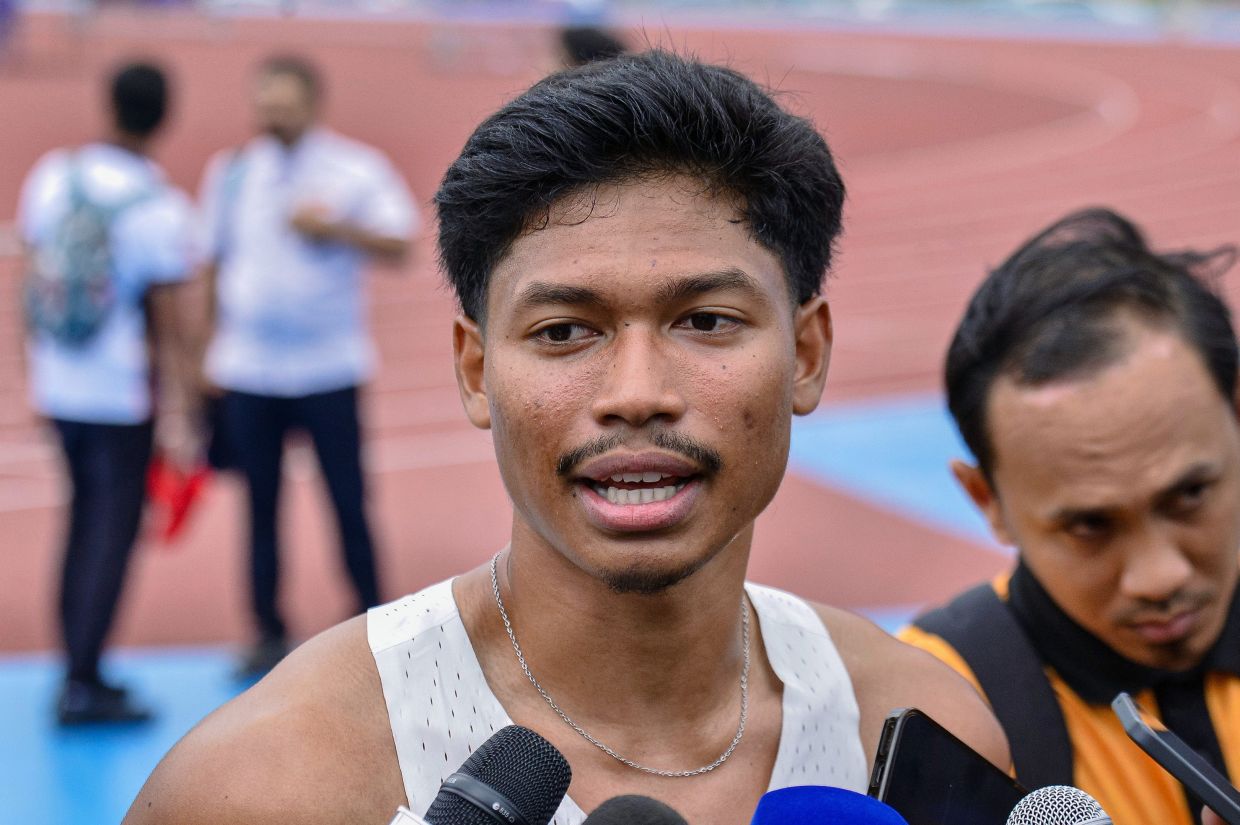
National sprinter Mohd Azeem Fahmi has pivoted from his studies in the United States back to Malaysia, announcing plans to pursue postgraduate qualification at Universiti Malaya after completing his undergraduate programme at Auburn University in Alabama. The 21-year-old athlete recently made a courtesy visit to Malaysia's oldest and most prestigious university, where he was received by vice-chancellor Prof Datuk Seri Dr Noor Azuan Abu Osman, signalling formal institutional support for his academic journey at the institution.
The transition marks a significant milestone for Azeem, who spent roughly two years developing his athletic and academic credentials overseas. His spell at Auburn University, beginning in January 2023, allowed him to pursue formal study in exercise physiology and kinesiology whilst training under internationally renowned coach Ken Harnden. That combination of elite coaching and rigorous academic training in sports science formed a foundation upon which he now builds his postgraduate aspirations, positioning him to blend practical competitive experience with deeper theoretical understanding of human performance.
Universiti Malaya's leadership has committed to facilitating Azeem's progression, with the vice-chancellor emphasising institutional determination to create an optimal environment for his master's studies. The meeting included engagement from key faculty stakeholders, notably Associate Prof Dr Zulkarnain Jaafar, dean of the Faculty of Sports and Exercise Sciences, and Afizal Abu Othman, who directs the university's Sports Centre. This multi-level institutional engagement underscores UM's serious investment in supporting elite athletes pursuing concurrent academic excellence, a model increasingly adopted by Malaysian universities seeking to develop well-rounded sporting talent.
The university's track record in nurturing successful athletes provides compelling context for Azeem's decision. Universiti Malaya has produced numerous national champions and international representatives across diverse sporting disciplines, establishing itself as a destination institution for serious student-athletes. Among its distinguished alumni are diving luminaries Datuk Pandelela Rinong, Ooi Tze Liang and Bryan Nickson Lomas, whose Olympic and world championship achievements elevated both their personal profiles and the university's standing in global sporting circles. Former national women's doubles badminton player Vivian Hoo similarly graduated from the institution with a Bachelor of Sports Science degree in 2019, demonstrating the breadth of athletic talent the university attracts and develops.
Azeem's recent competitive performance suggests he arrives at UM with considerable momentum. At the Malaysian Open championships held last week at Universiti Putra Malaysia Serdang, he claimed gold medals in both the men's 100 metres individual sprint and the 4x100 metres relay. In the relay event, he competed alongside Danish Iftikhar Mohd Roslee, Pengiran Aidil Auf Hajam and Mohd Armin Zahryl, collectively demonstrating Malaysia's emerging strength in short-distance track athletics. These medals underscore that despite his time away in the United States, Azeem has maintained competitive sharpness and remains amongst Malaysia's premier sprinting talents.
The decision to pursue a master's degree domestically rather than continue postgraduate studies in the United States reflects a deliberate choice to invest in Malaysia's higher education ecosystem whilst remaining accessible to national sporting structures. This approach aligns with broader trends amongst Southeast Asian athletes, who increasingly recognise value in completing advanced qualifications whilst maintaining proximity to national teams, coaching systems and competitive opportunities. For Azeem specifically, undertaking a master's programme in sports science at a Malaysian institution positions him to deepen theoretical understanding of training methodologies, biomechanics and sports physiology directly relevant to his sprinting career.
The timing of Azeem's return carries additional significance given Malaysia's bid to strengthen its track and field programme in preparation for major regional and international competitions. His generation of sprinters represents investment in developing home-grown talent capable of competing credibly across Southeast Asian Games, Commonwealth Games and Olympic competitions. By pursuing advanced study in exercise physiology and related disciplines, Azeem contributes to building a cadre of athletes who combine practical competitive excellence with sophisticated scientific understanding of athletic development and performance optimisation.
Universiti Malaya's commitment to facilitating elite athlete progression reflects evolving expectations within Malaysian higher education regarding institutional responsibility towards national sporting development. Beyond traditional academic mission, universities increasingly recognise their role in nurturing talent pipeline for both immediate competitive success and longer-term athlete development. The Faculty of Sports and Exercise Sciences represents this commitment institutionally, offering frameworks through which aspiring postgraduate scholars can balance rigorous academic demands against elite athletic competition schedules.
For Azeem personally, the master's degree represents investment in post-athletic career pathways. Whether eventually pursuing roles in sports science, coaching, athletic administration or related fields, advanced qualification in exercise physiology or kinesiology provides foundation for meaningful professional trajectory beyond competitive performance. Many retired athletes struggle with career transition; Azeem's simultaneous development of advanced academic credentials during his prime competitive years positions him advantageously for eventual career evolution.
The pathway Azeem has chosen—combining Auburn University undergraduate experience with Malaysian postgraduate qualification—increasingly typifies successful regional athletes seeking international exposure whilst maintaining local institutional connections. His journey suggests an emerging model wherein Malaysian athletes leverage overseas educational opportunities for development before returning to contribute expertise and experience within domestic sporting and academic systems, creating beneficial circulation of talent and knowledge.

