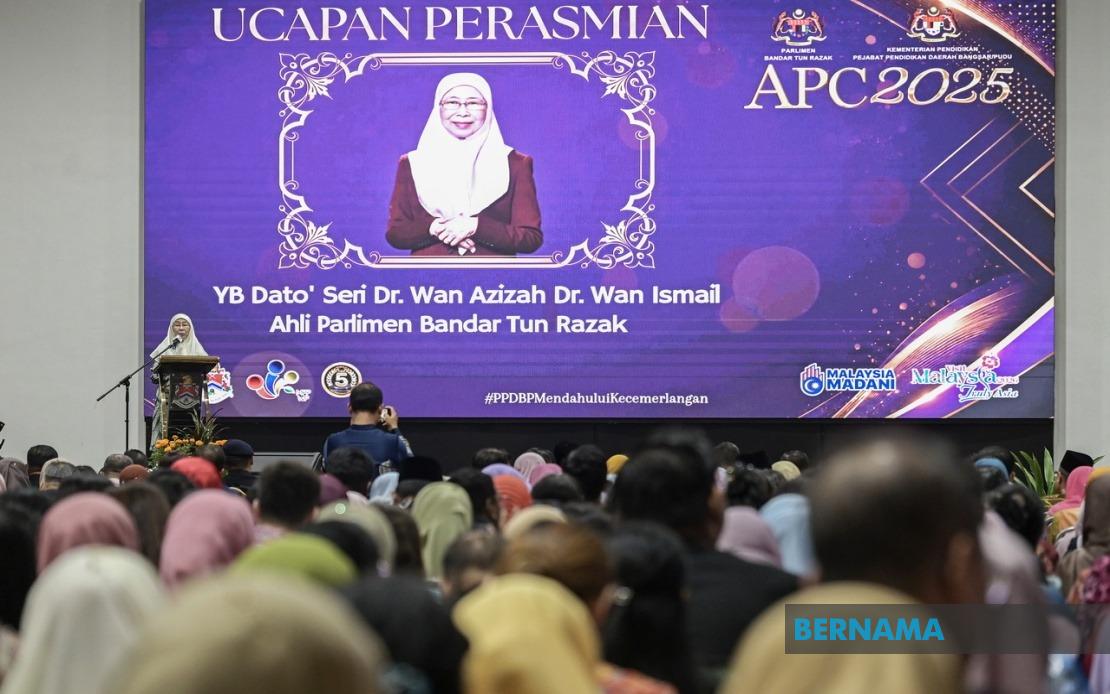
In a address that challenges conventional metrics of national progress, Datuk Seri Dr Wan Azizah Wan Ismail, wife of Malaysia's Prime Minister and Member of Parliament for Bandar Tun Razak, has underscored that sustainable development hinges fundamentally on the cultivation of conscientious, well-informed citizens. Speaking at the 2025 Excellent Service Award ceremony held at the Kuala Lumpur City Hall Training Institute, Dr Wan Azizah positioned moral and intellectual development as the bedrock of national resilience, placing them on equal footing with—or arguably above—economic expansion and infrastructural advancement.
The emphasis on character-formation reflects growing recognition across Southeast Asia that GDP growth and technological adoption, while important, offer incomplete measures of societal wellbeing. Dr Wan Azizah's framing invites Malaysian policymakers and educators to interrogate whether the nation's educational infrastructure adequately balances knowledge transfer with moral and emotional development. The observation carries particular relevance for Malaysia, where rapid urbanisation and increasing economic pressures have compressed the time available for family-based moral instruction in many households.
Central to Dr Wan Azizah's argument is the assertion that teachers occupy the frontline of this values-formation process. Given that urban children in particular spend substantial portions of their formative years within educational institutions, educators inherit responsibility not merely as subject-matter experts but as custodians of character development. This perspective reframes the teaching profession beyond its conventional technical role, positioning educators as agents of social stability and national cohesion. The acknowledgment implicitly raises questions about whether current teacher training, remuneration, and working conditions adequately support this expanded mission.
The recognition of 746 teachers and school administrators from 143 schools across the Bangsar and Pudu districts at a ceremony attended by approximately 1,000 guests served as a backdrop for advancing this broader philosophical position. By publicly honouring educators' contributions to organisational excellence and improved educational outcomes, the event functioned simultaneously as celebration and exhortation—celebrating demonstrated achievement while signalling governmental expectations for continued commitment to holistic student development.
Dr Wan Azizah identified a specific contemporary challenge underpinning the need for robust character education: the advent of artificial intelligence and the exponential growth in information volume. In environments where technology proliferates faster than institutional safeguards can be established, the ability to discern reliable information from misinformation becomes itself a survival skill. Rather than positioning AI as a threat, she framed critical thinking capacity—grounded in ethical understanding—as the appropriate response. This formulation suggests that purely technical AI literacy initiatives must be complemented by education in epistemology and ethics.
The imperative for values-based education extends beyond personal virtue into the realm of social cohesion and democratic resilience. Societies struggling with polarisation, disinformation, and institutional trust deficits often find that technical solutions prove inadequate without underlying agreement on shared values and commitment to factual reality. For Malaysia, with its diverse religious and ethnic composition, the cultivation of compassion and critical thinking across student populations carries implications for intercommunal understanding and social stability.
Dr Wan Azizah's invocation of "noble character, good manners and compassionate hearts" as educational objectives reflects traditional wisdom while speaking to contemporary needs. The language suggests educational purposes that transcend test scores and employment metrics—aims rooted in humanistic and civic traditions. Whether Malaysia's curriculum frameworks and assessment structures adequately measure and incentivise such outcomes remains an open question, particularly in examination-driven systems where quantifiable academic achievement often dominates resource allocation and institutional attention.
The ceremony drew participation from significant figures including Datuk Azman Abidin, the Prime Minister's Political Secretary, and Megat Affandi Ismail, director of the Kuala Lumpur Federal Territory Education Department, lending institutional weight to the occasion. The attendance of senior officials signalled governmental endorsement of educator recognition schemes and, by extension, the broader vision of education outlined by the Prime Minister's wife. Such visible support can influence how educational priorities cascade through district and school-level planning processes.
The scale of the recognition—honours for 746 educators representing 143 institutions—indicates serious effort to acknowledge contribution and encourage excellence across substantial portions of the education system. Yet the numbers also raise systemic questions: if 746 teachers merit recognition in a district of tens of thousands of educators, what is the proportion of recognised excellence, and what mechanisms ensure that non-recipient educators receive meaningful feedback and professional development? Recognition ceremonies, while valuable for morale, must integrate with broader systems of teacher support and advancement to drive systemic improvement.
For Malaysian stakeholders including parents, policymakers, and education administrators, Dr Wan Azizah's remarks constitute a call to examine whether current educational investments adequately prioritise character and critical thinking development. The speech suggests that national development conversations must integrate human formation into economic and technological planning. This carries implications for curriculum design, teacher training programmes, resource allocation, and how educational success itself is measured and valued within Malaysian society.
The underlying argument also resonates across Southeast Asia, where nations grapple with similar challenges of rapid change, urbanisation, and information proliferation. Malaysia's experience in formalising educators' recognition and integrating values-education into institutional frameworks may offer relevant lessons for regional neighbours pursuing comparable objectives. The challenge ahead lies in translating aspirational rhetoric into systematic institutional change that enables teachers to deliver on the comprehensive educational mission outlined, despite competing demands and resource constraints.

