Authorities in Thailand's Narathiwat province have implemented a sweeping curfew after a coordinated spike in violence linked to ongoing southern insurgency. The night-time restrictions, which took effect immediately on Saturday, August 22, 2026, kept residents confined to their homes from 10:15 p.m. until 6 a.m. Sunday under provisions of the Martial Law Act of 1914. The drastic step reflects escalating tensions in one of Southeast Asia's longest-running conflict zones and signals military determination to reassert control over volatile border territories.
The trigger for the curfew was a cascade of attacks across three southern provinces—Narathiwat, Pattani, and Yala—that saw a total of 25 separate violent incidents unfold on a single evening. These attacks unfolded simultaneously across 13 districts and 16 subdistricts, suggesting a degree of coordination among insurgent groups that has prompted security officials to treat the situation as a critical emergency. The breadth and timing of the attacks point to a deliberate escalation of the asymmetric conflict that has simmered in Thailand's deep south for decades, periodically flaring into periods of heightened activity that strain the region's security apparatus.
Major General Yodawut Phuengphak, commander of the Narathiwat Task Force, signed the urgent curfew announcement after consulting with the Fourth Army Region command. The proclamation drew authority from multiple sections of the Martial Law Act of 1914, granting military and police personnel broad powers to conduct searches, restrict movement, and maintain order throughout the province. Officials justified the measure as necessary to safeguard civilian lives and property while allowing security forces sufficient operational space to pursue those responsible and prevent further violence. The extraordinary nature of the declaration underscores how serious military planners assess the current threat level.
Restrictions imposed by the curfew were not absolute. Residents facing genuine emergencies could obtain written permission from military personnel, police officers, subdistrict headmen, village leaders, or local administrative officials to venture outside their homes during the prohibited hours. This provision reflected practical necessity—medical emergencies, childbirth, and other unforeseen circumstances could not reasonably be forestalled by blanket prohibition. However, the requirement to secure advance authorization from authorities effectively concentrated movement control in official hands, enabling security forces to monitor and track anyone abroad during sensitive hours.
The military simultaneously authorized expanded operational powers for uniformed personnel deployed throughout Narathiwat. Soldiers and police were explicitly empowered to conduct searches without normal warrant requirements, prohibit specified activities, and exercise additional enforcement authorities under the martial law framework. These tactical operations were framed as essential to maintaining public order and suppressing insurgent activity, though such broad discretionary powers have historically raised concerns among human rights advocates regarding potential abuse. Civilian government officials were simultaneously directed to comply fully with all military requests related to security operations, effectively subordinating civilian administration to military control during the emergency period.
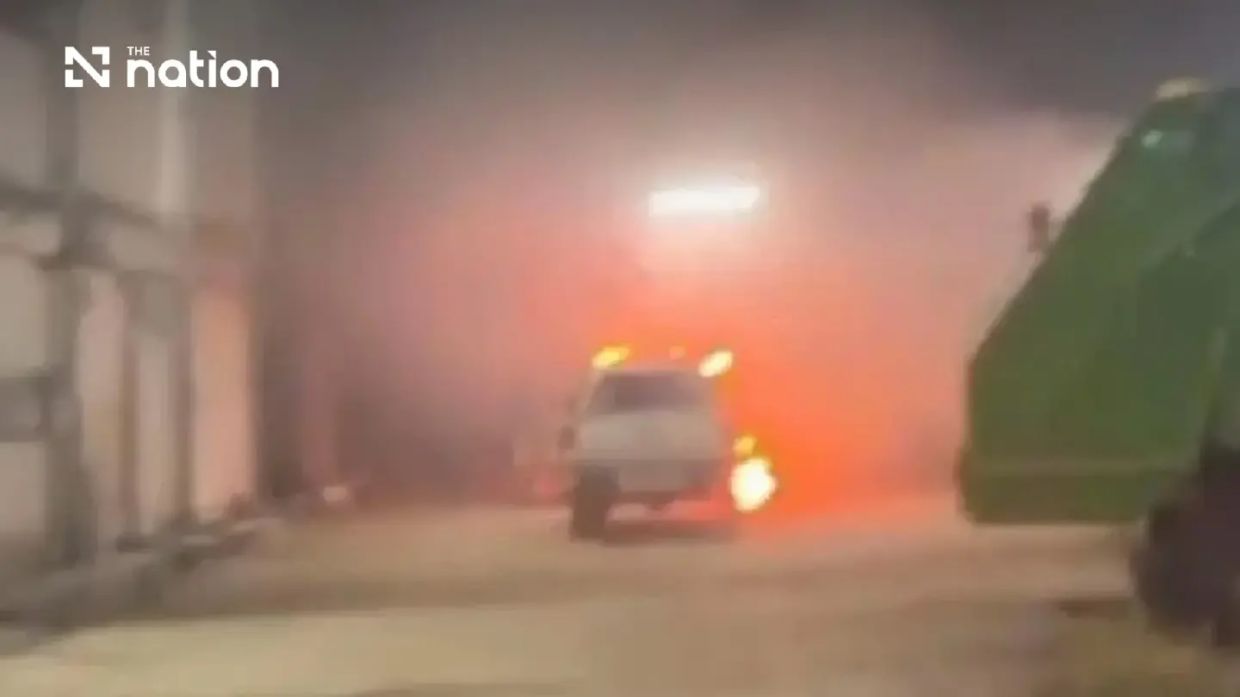
One particularly dramatic incident captured on video during the violence illustrated the brazen nature of Saturday's attacks. In Yaring district of Pattani province, footage showed approximately three to four armed assailants approaching the Bang Pu branch of the 7-Eleven convenience store chain. The attackers moved methodically to clear the premises, with one gunman in a white long-sleeved shirt and dark trousers threatening customers and staff, repeatedly shouting commands to evacuate. His accomplices, dressed in black with their faces partially concealed, carried what appeared to be long guns and maintained a perimeter around the shop as panicked civilians fled the area.
The tactics employed by the assailants demonstrated a pattern increasingly common in southern Thailand's insurgency. After establishing tactical control of the immediate vicinity, the man in white fired his weapon into the air—first a single shot, then several additional rounds—to intimidate remaining individuals and enforce compliance with evacuation orders. Once the shop had been cleared of witnesses, the group methodically set fire to the 7-Eleven branch, inflicting heavy damage before departing on motorcycles that had been positioned nearby. The coordinated nature of the operation, from area denial through arson, reflected tactical sophistication and advance planning that complicates efforts to prevent such attacks.
The concentration of violent incidents across multiple provinces simultaneously underscores a persistent challenge facing Thai security authorities. The three southern border provinces—Narathiwat, Pattani, and Yala—have remained flashpoints of insurgency for years, driven by complex historical, ethnic, and religious factors rooted in the region's distinctive demographics and contested history. Each major outbreak of violence draws heightened military and police responses, yet the underlying drivers of insurgency remain inadequately addressed, creating conditions for recurring cycles of escalation and suppression. For Malaysian observers, the instability across Thailand's southern border carries implications for regional stability and cross-border security cooperation.
The geographic and chronological pattern of Saturday's attacks suggests a degree of operational coordination among insurgent elements that has traditionally been fragmented and decentralized. Whether this reflects improved organizational capability, temporary tactical alignment, or opportunistic simultaneous action remains unclear from available information. Security analysts will scrutinize the incidents for evidence of whether disparate insurgent factions are moving toward greater operational unity or whether the coordinated appearance masks independent but coincidental attacks. The distinction matters significantly for counterinsurgency strategy and long-term threat assessment.
The curfew declaration represents one tool among several available to military authorities confronting insurgent activity. However, such emergency measures carry costs alongside security benefits. Prolonged restrictions on civilian movement impose economic disruptions affecting local commerce, transportation, and essential services. They risk generating grievances among affected populations, particularly if enforcement is perceived as arbitrary or disproportionate. Historical experience in conflict zones worldwide demonstrates that while temporary curfews can provide operational advantages in the immediate crisis period, sustainable security improvements typically require addressing underlying political, economic, and social factors that sustain insurgent recruitment and support.
Security force responses to Saturday's violence now extend beyond Narathiwat's immediate provincial boundaries. Joint operations involving military, police, and civilian personnel across all three southern provinces indicate a coordinated effort to pursue those responsible and prevent immediate follow-on attacks. Intelligence gathering regarding the assailants and their organizational affiliation will likely proceed in parallel with field operations. The priority for security authorities remains preventing escalation while pursuing tactical success against identifiable perpetrators, balancing short-term security gains against longer-term strategic considerations affecting the region's stability and prospects for eventual peaceful resolution of the southern conflict.

